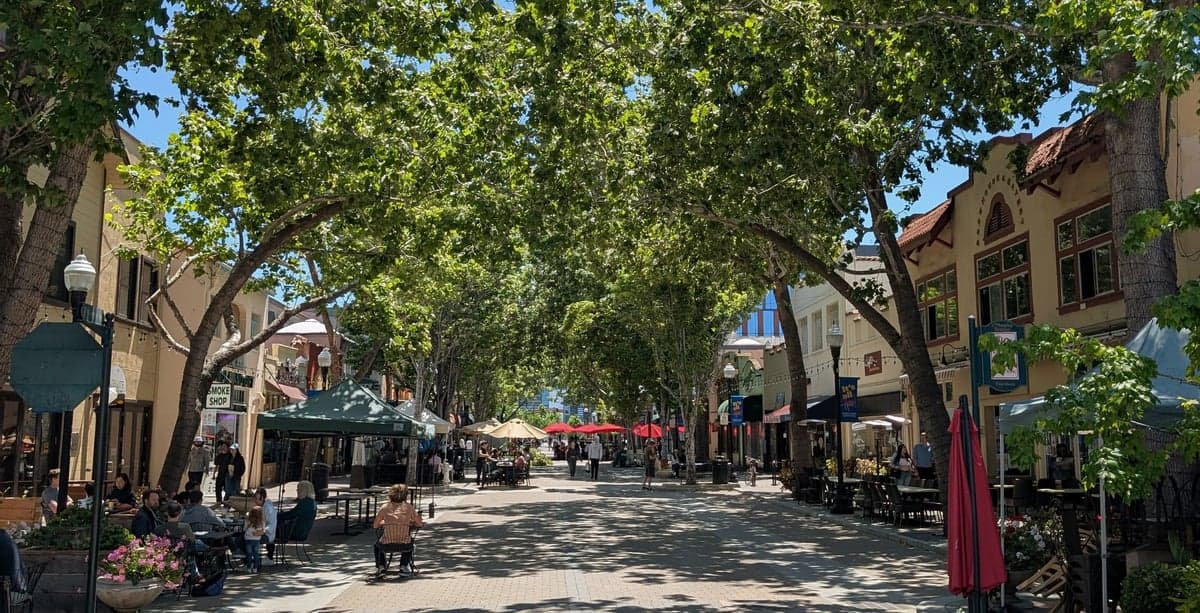
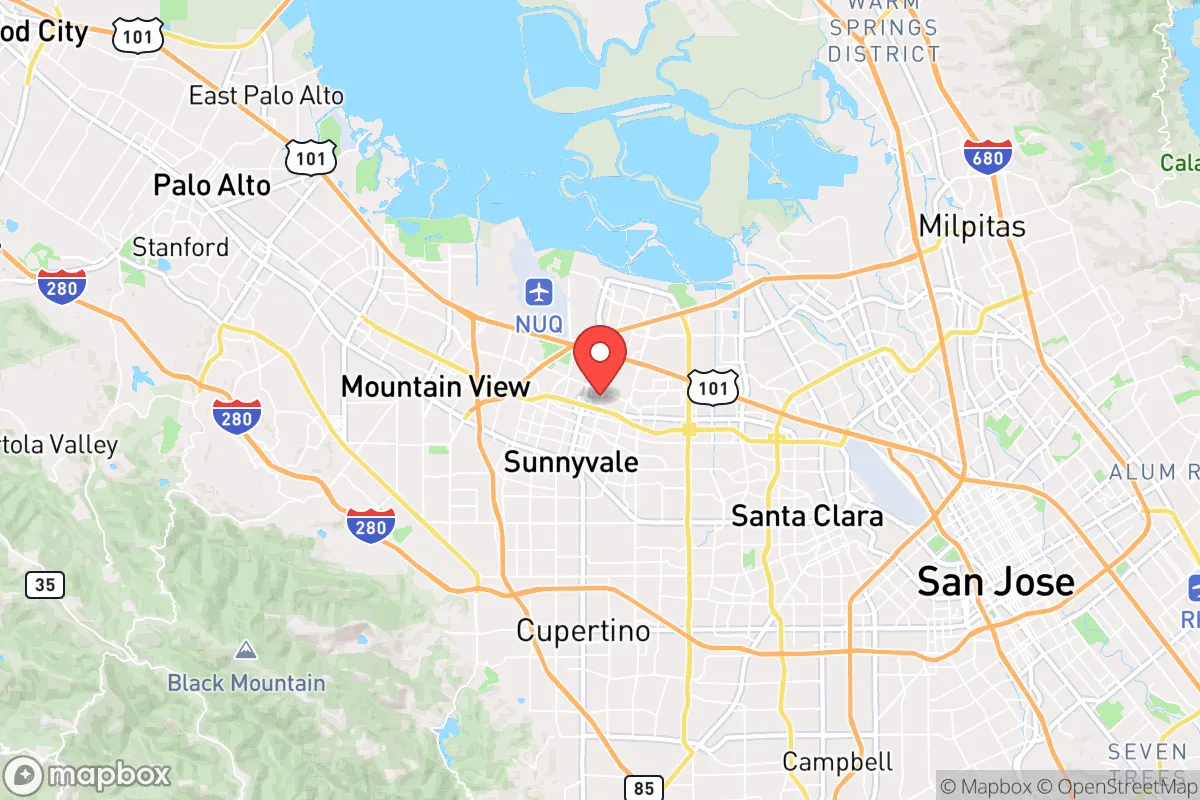
Photo: Wikipedia
Demographics of Sunnyvale, CA
Affluence Level in Sunnyvale, CA
A wealthy area with high-earning, well-educated households. Incomes, home values, and educational attainment meaningfully outpace national averages.
People of Sunnyvale, CA
Sunnyvale, California, is a city of 153,455 residents defined by its high-tech workforce, extreme ethnic diversity, and a population that is majority foreign-born or the children of immigrants. With 69.2% of adults holding a college degree, it is one of the most educated cities in the nation, yet its character is less about a single dominant culture and more about a mosaic of distinct, often self-segregating communities. The city’s identity is shaped by a clear tri-polar demographic structure: a large East/Southeast Asian population (30.5%), a substantial Indian-subcontinent community (18.6%), and a smaller but stable Hispanic population (16.7%), with non-Hispanic whites now a minority at 27.5%.
How the city was settled and grew
Sunnyvale’s human history is almost entirely a 20th-century story. Before 1900, the area was a sparsely populated agricultural district of orchards and ranches, part of the vast Rancho Pastoria de las Borregas land grant. The first real population wave came after the 1906 San Francisco earthquake, when displaced families moved south. These early settlers were predominantly white, native-born Americans of Northern European descent, and they clustered in the Murphy Station neighborhood (the original downtown core around Murphy Avenue) and the Lakewood area near the southern edge. The arrival of the Southern Pacific Railroad in the 1910s cemented Sunnyvale as a fruit-packing and shipping hub, drawing a small but significant wave of Mexican and Filipino agricultural laborers who settled in the Ponderosa and De Anza neighborhoods near the orchards. World War II transformed the city: the Navy’s Moffett Field (opened 1933) and the rapid expansion of defense contractors like Lockheed (which opened a major plant in 1956) brought a massive influx of white engineers and technicians from the Midwest and East Coast. These families filled the new tract homes of Cherry Orchard and Fair Oaks, creating a solidly middle-class, white, suburban character that lasted through the 1960s.
Modern era (post-1965)
The 1965 Hart-Cellar Immigration Act fundamentally remade Sunnyvale. The first wave of post-1965 arrivals were East/Southeast Asian immigrants—primarily Chinese and Vietnamese—who were drawn by the booming semiconductor industry (AMD, Intel, and National Semiconductor all had major facilities in Sunnyvale by the 1970s). These families concentrated in the Lakewood and Ponderosa neighborhoods, where older, affordable housing stock and proximity to the tech campuses on Mathilda Avenue and Arques Avenue made settlement practical. By 1990, the Asian share of the population had risen to roughly 20%, while the white share had fallen to 60%. The 1990s and 2000s brought a second, even larger wave: Indian-subcontinent immigrants, overwhelmingly from Gujarat, Andhra Pradesh, and Karnataka, recruited by the dot-com boom and later by the expansion of Apple, Google, and LinkedIn (all headquartered within a 10-mile radius). Unlike the earlier Asian wave, Indian families gravitated toward the newer, larger homes in West Murphy and the Raynor Park area, as well as the upscale Heritage District near the Caltrain station. This created a visible economic and spatial divide: East/Southeast Asian communities are more dispersed across the city’s older central and eastern tracts, while Indian-subcontinent families are heavily concentrated in the western half. The Hispanic population, meanwhile, has remained stable at around 16-17% since 2000, concentrated in the Fair Oaks corridor and the Ponderosa area, where many families have lived for three generations.
The future
Sunnyvale’s demographic trajectory points toward continued diversification, but with a clear pattern of ethnic clustering rather than full integration. The white population is projected to fall below 20% by 2035, while the East/Southeast Asian share is likely to plateau near 32-33% as second-generation families age out and some move to cheaper suburbs like Milpitas or Fremont. The Indian-subcontinent community is the fastest-growing segment, driven by continued H-1B recruitment and family reunification; it could reach 22-24% by 2035, with new arrivals bypassing older neighborhoods entirely and settling directly in the West Murphy and Heritage District luxury condos and townhomes. The Hispanic population is aging and slowly declining in share, as younger families are priced out of Sunnyvale’s housing market and move to Tracy or Patterson. The city is not homogenizing—it is tribalizing into distinct, economically stratified enclaves. For a new resident, this means choosing a neighborhood is effectively choosing a community: Lakewood offers a predominantly East/Southeast Asian, middle-class environment; West Murphy offers a wealthy, Indian-subcontinent professional milieu; and Fair Oaks remains the heart of Hispanic Sunnyvale.
Sunnyvale is becoming a city of high-achieving, highly educated ethnic enclaves, where the public schools are excellent and the civic culture is transactional rather than communal. For a conservative-leaning individual or parent, the city offers strong public safety, low crime, and top-tier schools, but the social fabric is fragmented along ethnic and economic lines. The move-in decision is less about whether Sunnyvale is a good fit and more about which Sunnyvale neighborhood aligns with your family’s cultural and professional priorities.

* Values derived from national, state, county, city and local statistics and may differ in a specific area. Last updated: 2026-04-30T00:09:39.000Z
Narrative content on this page is AI-generated and may contain mistakes. Verify any details that matter before acting on them.
ReloMaps may earn a commission from affiliate links at no extra cost to you.

