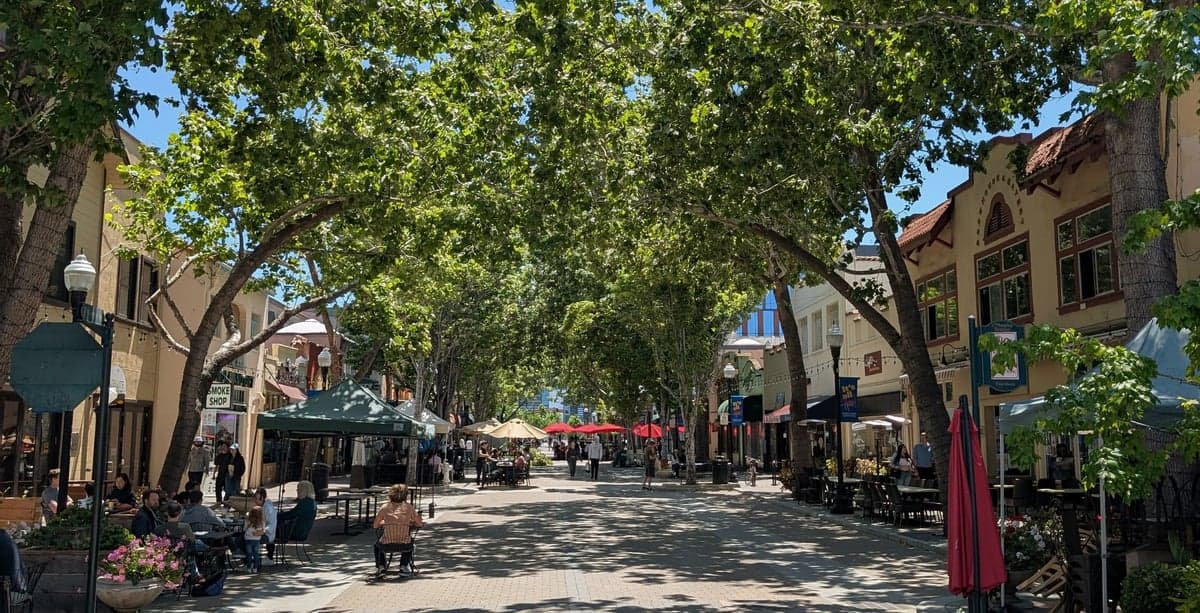
Photo: Wikipedia
Strategic Assessment of Sunnyvale, CA
High tactical risk. This location is likely close to major population centers, strategic targets, or sits in a high-disaster corridor. A retreat property and careful exit planning is required.
What does the Strategic Assessment tell us?
Our Strategic Assessment grades tactical survivability of an area. Major population centers, military targets, fallout zones, natural disasters, and border exposure all drive risk — lower exposure means a more defensible position in a crisis.
This is heavily inspired by Joel Skousen's Strategic Relocation book. Highly recommended you checkout the book ($)What does this tell us?
Our Strategic Assessment grades tactical survivability of an area. Major population centers, military targets, fallout zones, natural disasters, and border exposure all drive risk — lower exposure means a more defensible position in a crisis.
This is heavily inspired by Joel Skousen's Strategic Relocation book. Highly recommended you checkout the book ($)Strategic Pillars

Key Distances
Regional Safe Places
Below is our recommended "safe zones" in California and the surrounding area based on our strategic heuristics. For most people, it's unrealistic to live in a “safe zone” full-time due to work, family or other personal reasons. They tend to be more rural. However, many of these areas are perfect for second homes and retreat properties that double as a vacation home or even a short-term rental.

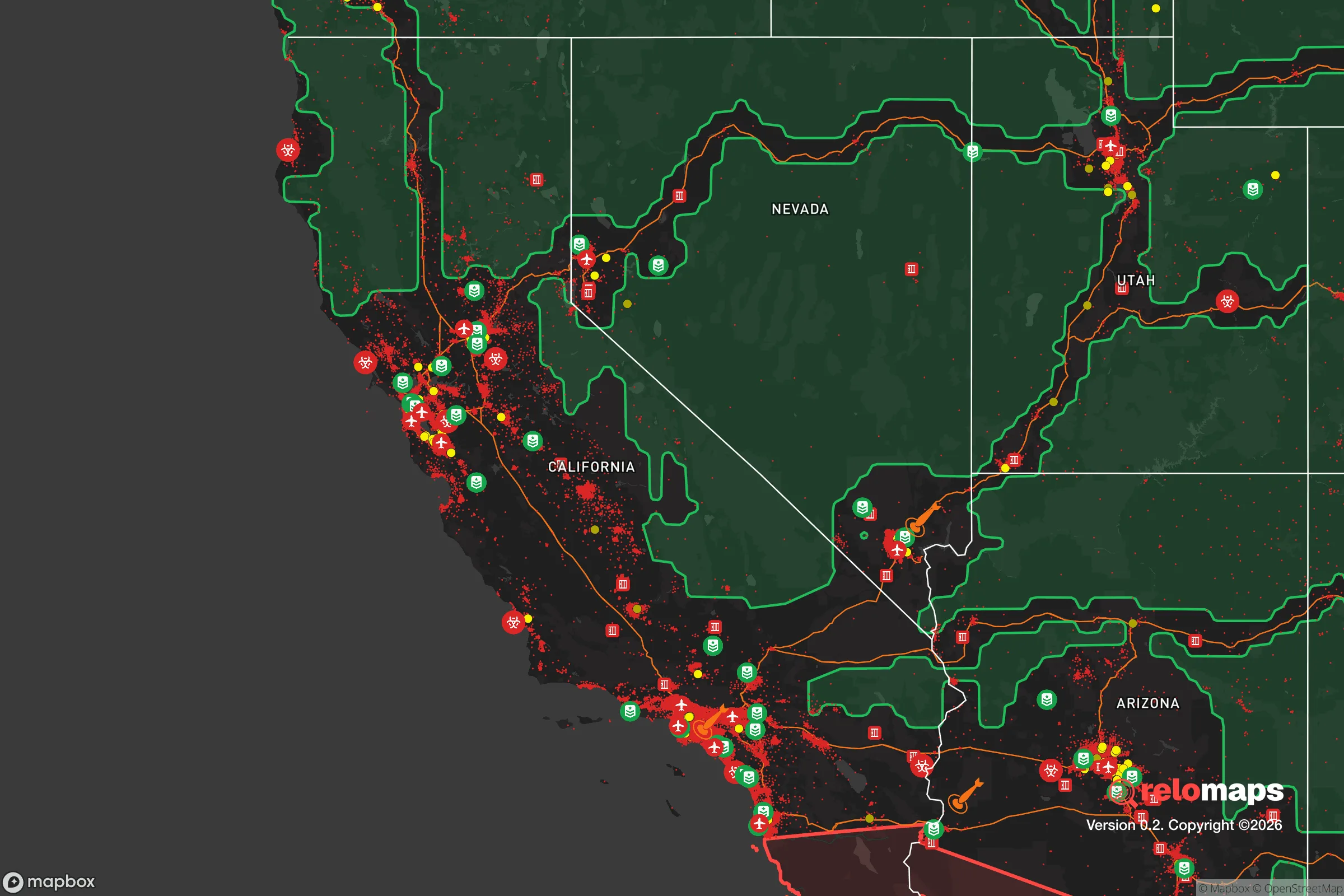


Important Note: For informational purposes only. This does not mean nothing bad ever happens in the green zones. Please use common sense. This is based on public data and modeled with AI. We tried to take a conservative approach but mistakes happen. We update this regularly as new information becomes available.
Solar Generator Recommendations
Backup power matters more here than in safer locations. We've picked three solar generators across budgets and capacity tiers — start with the budget unit if you only need a few essentials, or step up if you want to run a fridge and HVAC for days at a time.

Jackery Portable Power Station Explorer 300
Budget OptionPower on the Go: Weighing only 11 lbs, it's convenient to set up and store with book-sized foldable solar panels

BLUETTI Portable Power Station AC180
Designed for both indoor and outdoor scenarios, AC180 is highly capable as it has a robost capacity and continuous output power.

EF ECOFLOW DELTA Pro Ultra Power Station
Upgraded PickEcoFlow DELTA Pro Ultra is a whole-home energy system designed to grow with your family. Integrated with the Smart Home Panel 2, it scales to meet your evolving energy needs — keeping your home powered, intelligent, and secure through every stage of life.
We earn a commission, at no additional cost to you.
Strategic Assessment Analysis
Sunnyvale, California, sits in the heart of Silicon Valley, a region that is simultaneously a hub of technological resilience and a high-risk target for civil unrest, infrastructure collapse, and geopolitical fallout. For the conservative prepper or survivalist, this city presents a paradox: its economic engines and proximity to resources are offset by extreme population density, vulnerability to natural disasters, and its location within a state whose political trajectory many in this audience view as unstable. A strategic assessment must weigh the area’s genuine logistical advantages—world-class medical infrastructure, robust water systems, and a climate that rarely threatens survival—against the very real risks of being a primary fallout zone in a major crisis. The bottom line: Sunnyvale offers strong day-to-day resilience for a prepared individual, but its strategic depth is shallow, and its position near multiple high-value targets makes it a place to have a solid bug-out plan, not a final redoubt.
Geographic position and natural advantages for long-term survival
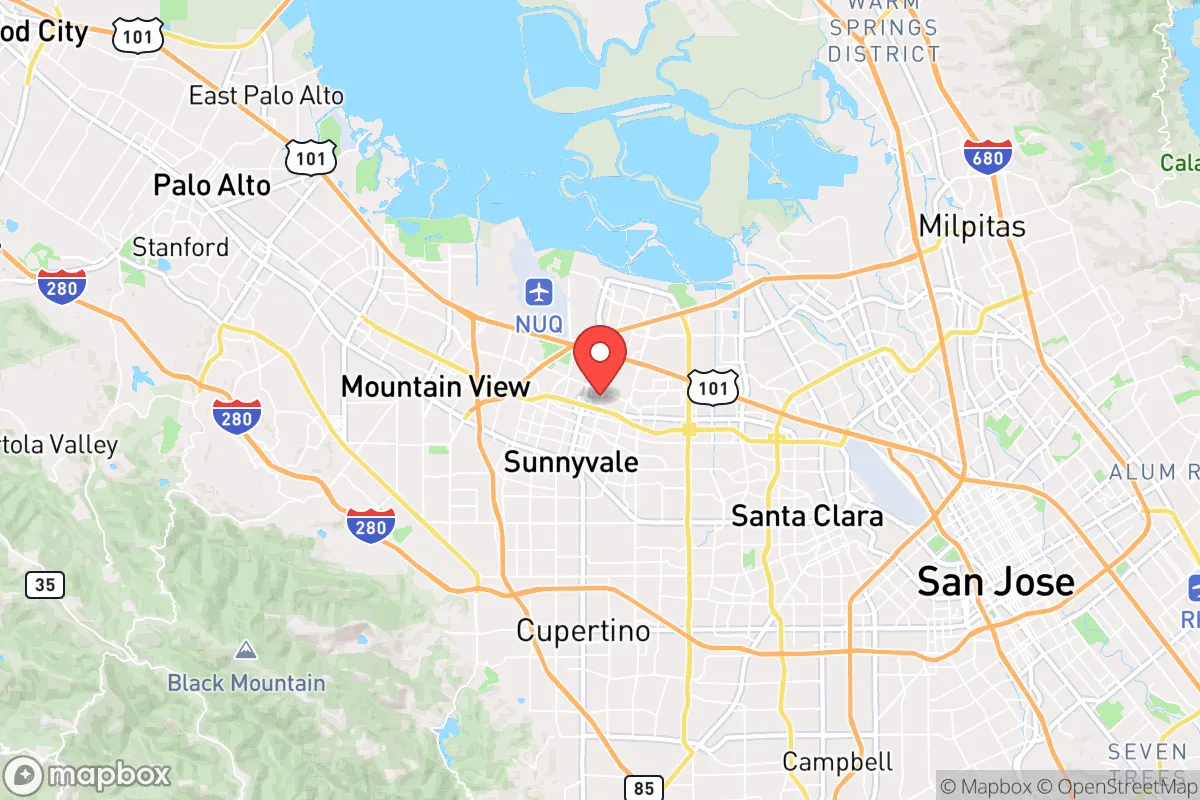
Sunnyvale’s geography is a double-edged sword. On the plus side, the city sits on the western edge of the Santa Clara Valley, with the Santa Cruz Mountains to the west and the Diablo Range to the east. This provides natural barriers that could slow the spread of a ground-level threat—whether that’s a riot, a chemical release, or a panicked population surge from San Francisco or San Jose. The climate is Mediterranean: mild, wet winters and dry summers mean you’re unlikely to face hypothermia or heatstroke as primary survival threats. Average annual rainfall is about 15 inches, which is low but not desert-level, and the region’s groundwater basins—particularly the Santa Clara Valley groundwater subbasin—are managed by the Santa Clara Valley Water District, one of the most sophisticated water utilities in the country. For a relocator, this means that in a non-catastrophic scenario (e.g., a weeks-long power outage or supply chain disruption), you can reasonably store water and rely on a system that has multiple redundancy layers. The area also benefits from the nearby Coyote Creek and Guadalupe River watersheds, which offer potential off-grid water sources if you know where to look and have proper filtration. However, the valley floor is flat and highly developed, offering little in the way of defensible terrain or natural cover. The mountains are close but are also heavily trafficked and patrolled, and many access points are choked with suburban sprawl. For a survivalist, the natural advantages here are about sustaining a temporary crisis, not holding out indefinitely.
Risks, exposures, and proximity to high-value fallout targets
This is where Sunnyvale’s strategic picture darkens significantly. The city is surrounded by what any prepper would consider primary and secondary targets in a major conflict or terror event. Directly to the north is Moffett Federal Airfield, a joint-use civil-military airport that houses the 129th Rescue Wing of the California Air National Guard and is a key hub for NASA Ames Research Center. To the east, San Jose International Airport and the massive concentration of tech campuses—Apple, Google, Intel, Lockheed Martin—are all within a 15-minute drive. To the west, the Santa Cruz Mountains host critical communications infrastructure and are a known corridor for potential seismic or wildfire cascades. In a scenario involving a coordinated attack, EMP, or civil unrest targeting government and corporate symbols, Sunnyvale is effectively in the blast radius of multiple high-value assets. The city’s own population density is roughly 6,000 people per square mile, which means that even a localized event—like a major earthquake on the San Andreas Fault (which runs just 10 miles west) or a wildfire pushing down from the hills—could trigger a chaotic evacuation involving hundreds of thousands of people. The major evacuation routes (Highways 101, 85, and 280) are notorious for gridlock even on a normal Tuesday afternoon. In a crisis, they become parking lots. For a conservative relocator concerned with societal breakdown, Sunnyvale’s proximity to so many critical infrastructure nodes makes it a high-risk location for any event that targets the American tech or military apparatus. The very things that make the area economically vibrant also make it a prime target.
Practical resilience for a relocator: food, water, energy, and defensibility
Let’s get practical. For a single individual or family looking to hunker down in Sunnyvale, you need to assess four pillars: food, water, energy, and security. On water, the situation is better than most of California. The Santa Clara Valley Water District operates a system of reservoirs, groundwater recharge facilities, and imported water from the State Water Project and Hetch Hetchy. In a short-term grid-down scenario, your tap water will likely still flow for a few days, but you should have at least a two-week supply stored (one gallon per person per day). On food, the area has a high density of grocery stores, but supply chains are fragile—during the 2020 panic, shelves were stripped in hours. Local farmers’ markets and the nearby agricultural areas of Gilroy and Hollister offer some local food resilience, but you cannot rely on them in a crisis. Energy is a mixed bag. PG&E’s grid is notoriously unreliable, with Public Safety Power Shutoffs (PSPS) becoming a regular occurrence during fire season. Solar is a strong option here—Sunnyvale averages 260 sunny days per year—but you’ll need battery storage to be truly off-grid. Natural gas is widely available, but in a major earthquake, gas lines are a hazard, not a benefit. Defensibility is the weakest link. Sunnyvale is a suburban grid of single-family homes, cul-de-sacs, and apartment complexes. There is no natural chokepoint, no high ground, and no rural buffer. Your home’s security depends entirely on your own preparations: reinforced doors, window film, a well-stocked safe room, and a neighborhood watch that actually functions. The city’s police force is well-funded (Sunnyvale Department of Public Safety is a combined police-fire agency), but in a widespread civil unrest event, response times will stretch to hours or days. For a prepper, Sunnyvale is a location where you can survive a short-term disruption with solid planning, but it is not a place to make a last stand.
The overall strategic picture for Sunnyvale is one of calculated risk. If you are a conservative relocator who works in the tech sector or needs access to world-class medical care (Stanford Hospital is 20 minutes away), and you are willing to invest in a robust home preparedness setup—solar, water storage, food reserves, and a solid bug-out vehicle—Sunnyvale can work as a base of operations for the next 5-10 years. But you must accept that you are living in a high-value target zone. The city’s resilience is tactical, not strategic: it can handle a week-long power outage or a moderate earthquake, but it is not designed to withstand a prolonged societal collapse, a nuclear event, or a coordinated attack on Silicon Valley infrastructure. Your best move is to treat Sunnyvale as a forward operating base. Have a secondary location—ideally in the Sierra Nevada foothills, the Central Coast, or even rural Oregon—that is at least a 4-6 hour drive away, and keep that bug-out bag ready. The climate and economy are excellent for daily life, but the strategic depth is shallow. Sunnyvale is a place to live well, not a place to survive long. Plan accordingly.

* Values derived from national, state, county, city and local statistics and may differ in a specific area. Last updated: 2026-04-30T00:09:39.000Z
Narrative content on this page is AI-generated and may contain mistakes. Verify any details that matter before acting on them.
ReloMaps may earn a commission from affiliate links at no extra cost to you.

