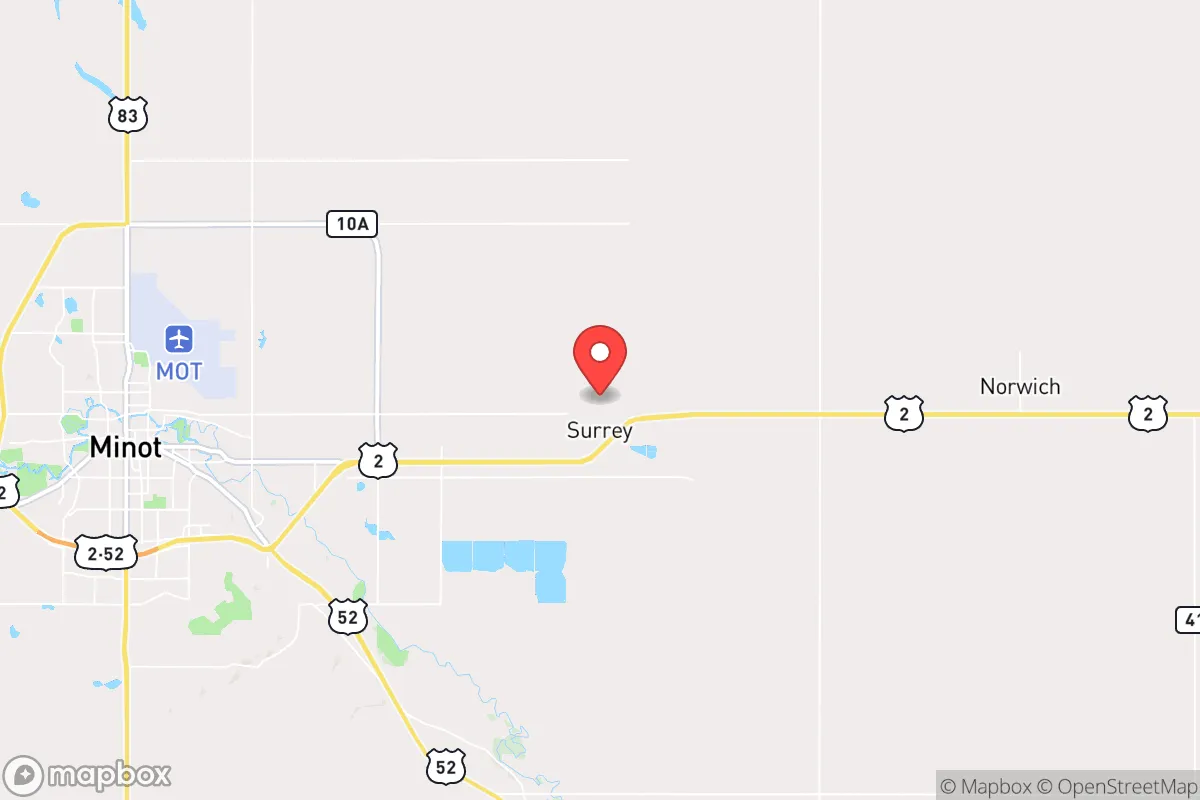
Demographics of Surrey, ND
Affluence Level in Surrey, ND
An upper-middle-class area. Household wealth, education levels, and homeownership run ahead of national benchmarks.
People of Surrey, ND
The people of Surrey, North Dakota, today form a tight-knit, predominantly white community of 1,672 residents, characterized by a strong agricultural and energy-sector work ethic and a low foreign-born population of just 0.4%. With 92.9% of residents identifying as white and 2.6% as Hispanic, the city retains a largely homogeneous character, while 28.8% of adults hold a college degree, reflecting a modest but present professional class. Distinctive markers include a family-oriented, conservative social fabric and a population density that feels rural despite its city status, with daily life revolving around local schools, churches, and nearby employment in Minot’s oil fields and service industries.
How the city was settled and grew
Surrey was founded in the early 1900s as a railroad stop along the Great Northern Railway, drawing its first permanent settlers primarily from Scandinavian and German immigrant stock. These homesteaders were attracted by the promise of fertile land under the Homestead Act, and they built the city’s original core around the rail depot in what is now the Old Town District, a historic neighborhood of early 20th-century wood-frame houses and grain elevators. A second wave arrived during the 1930s and 1940s, consisting of Dust Bowl refugees from the Great Plains who sought work on area farms and in the expanding rail infrastructure; many settled in the Railroad Addition, a modest subdivision of small lots and bungalows just north of the tracks. By mid-century, Surrey’s population hovered around 300, with the Southside Farms area—a loose collection of family homesteads along the Souris River—anchoring the agricultural identity that defined the community for decades.
Modern era (post-1965)
The post-1965 era brought gradual change as the Bakken oil boom of the 2000s and 2010s triggered a wave of domestic in-migration from other parts of North Dakota and the upper Midwest. This influx, largely of white, working-age men and families seeking high-wage oilfield jobs, concentrated in newer subdivisions like Prairie View Estates, a development of ranch-style homes and townhouses built on former farmland east of Highway 2. The city’s Hispanic population, now 2.6%, grew modestly during this period, with many families settling in the West End area near the grain elevators, where rental housing and proximity to agricultural work provided a foothold. Unlike many U.S. cities, Surrey saw virtually no growth in East/Southeast Asian (0.1%), Black (0.7%), or Indian subcontinent (0.0%) populations, reflecting its limited economic diversity beyond energy and agriculture. The Surrey Heights neighborhood, developed in the 2010s with larger lots and newer construction, became a magnet for oilfield professionals and commuters to Minot, reinforcing the city’s white, middle-class character.
The future
Surrey’s population is projected to remain stable or grow slowly, driven by continued energy-sector employment and spillover from Minot’s housing market, but demographic homogenization is likely to persist. The foreign-born share, at 0.4%, is among the lowest in the state and shows no signs of significant increase, as the city lacks the industrial or service-sector diversity to attract immigrant communities. The Hispanic population may grow incrementally through agricultural labor and construction work, but it will likely remain a small minority concentrated in the West End and older rental stock. The Prairie View Estates and Surrey Heights neighborhoods will continue to absorb white, middle-class families, while the Old Town District may see gradual turnover as older residents age out and younger families move in. Over the next 10-20 years, Surrey will likely become slightly more suburban in character but remain a predominantly white, conservative, and family-oriented enclave with limited racial or ethnic diversification.
For someone moving in now, Surrey offers a stable, low-crime, and community-focused environment where neighbors know each other and local institutions like the Surrey Public School and St. John’s Lutheran Church anchor social life. The city is becoming a quieter, more residential alternative to Minot, with a population that values self-reliance and traditional values—ideal for conservative singles and parents seeking a predictable, safe, and affordable place to raise a family.

* Values derived from national, state, county, city and local statistics and may differ in a specific area. Last updated: 2026-04-19T05:15:57.000Z
Narrative content on this page is AI-generated and may contain mistakes. Verify any details that matter before acting on them.
ReloMaps may earn a commission from affiliate links at no extra cost to you.

