Political ClimatePolitical Climate in Surrey, ND
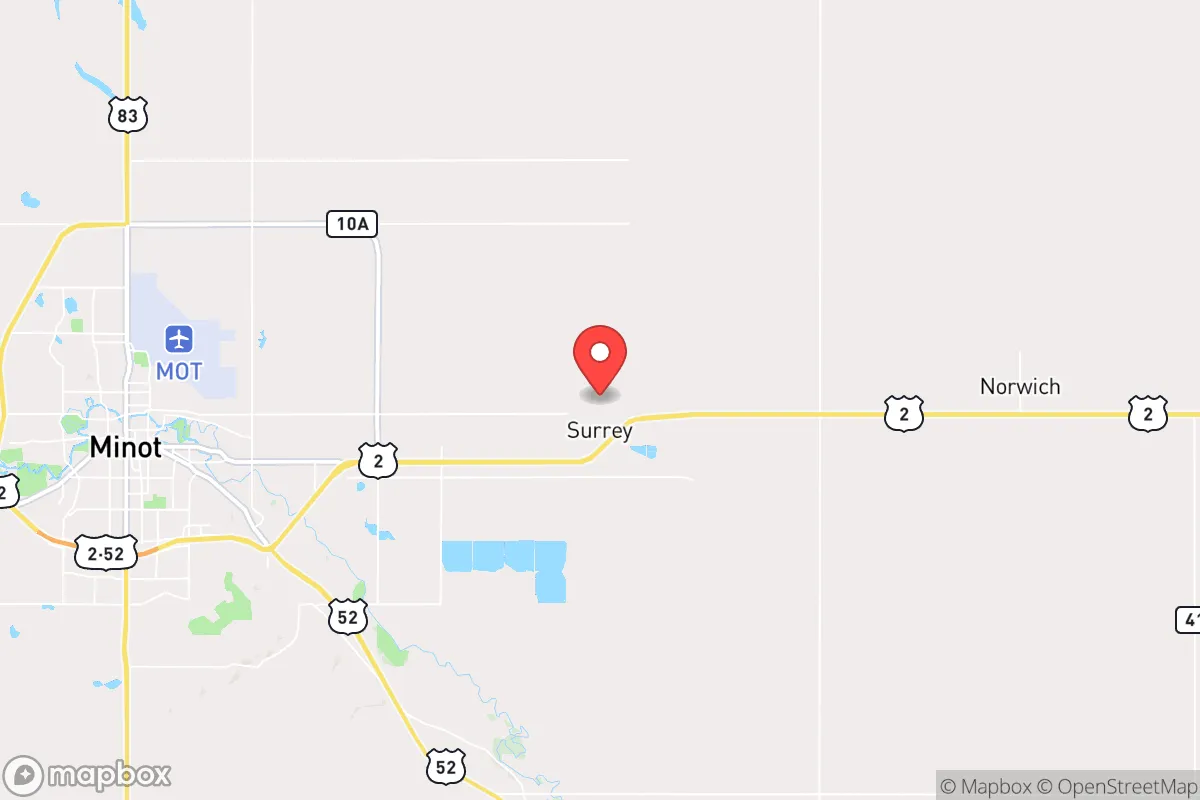
District shown is the primary district for this city’s centroid. Cities may span multiple districts.
Inherited from parent state — no local data available.
Local Political AnalysisPolitical Analysis of Surrey, ND
Surrey, North Dakota, is about as reliably conservative as it gets, with a Cook PVI of R+18 that puts it firmly in the deep-red column. This isn't a purple area that flips back and forth—it's a place where Republican candidates routinely win by double digits, and the local culture reflects that. If you're looking at the political climate here, you're looking at a community that values personal responsibility, limited government, and a no-nonsense approach to life. The trajectory has been steady for decades, though there's a quiet concern among longtime residents about outside influences creeping in from the larger cities like Minot, just a few miles east, which has seen some more progressive leanings in recent years.
How it compares
Surrey sits in Ward County, and while the county as a whole is solidly red—voting +36 for Trump in 2020—Surrey itself is even more conservative than its immediate neighbor, Minot. Minot, being the regional hub with a university and a larger population, has a slightly more mixed political scene, with pockets of younger voters and transient military families from the Air Force base who can sometimes tilt local elections toward the center. Drive 20 minutes west to Burlington, and you'll find a similar conservative vibe, but head south to towns like Velva or Garrison, and the politics stay just as red. The contrast is subtle but real: Surrey feels like a place where people know their neighbors and expect the government to stay out of their business, while Minot has a bit more of that "big city" energy where you'll hear talk of bike lanes and zoning ordinances that would never fly out here.
What this means for residents
For folks living in Surrey, the political climate means lower taxes, fewer regulations, and a general sense that your personal freedoms aren't under constant threat. You won't see the kind of government overreach that's become common in blue states—no mask mandates that drag on for years, no heavy-handed business closures, and no one telling you what you can or can't do with your property. The local school board and city council are filled with people who understand that the best government is the one closest to the people, and they're not interested in importing progressive experiments from the coasts. That said, there's a growing unease about the direction of the state as a whole, especially with the oil boom bringing in new residents from places like California and Colorado who don't always share the same values. If you're worried about your Second Amendment rights, your ability to homeschool your kids, or your freedom to run a business without a pile of red tape, Surrey is still a safe haven—but it's one worth keeping an eye on.
Culturally, Surrey is a place where church potlucks, high school football games, and hunting season are the real social calendar. There's no push for "diversity, equity, and inclusion" programs in the schools, no talk of defunding the police, and no one trying to rename streets or tear down statues. The biggest political fights here are about property taxes and road maintenance, not the kind of culture war nonsense you see on the news. That's the way most folks like it, and they're determined to keep it that way. If you're looking for a place where you can live your life without the government breathing down your neck, Surrey is about as good as it gets in North Dakota—but don't take it for granted. The winds of change are blowing, and it's up to the people here to make sure they don't turn into a storm.

State Political ClimatePolitical Climate in North Dakota
State Political AnalysisPolitical Environment in the State
North Dakota is a deeply conservative state, with a Republican trifecta that has held the governorship and both legislative chambers for over a decade, and a partisan lean of roughly +20 points in federal elections. The state’s political identity is rooted in a mix of agrarian populism, energy-sector libertarianism, and a strong cultural resistance to federal overreach. Over the past 20 years, the trend has been a steady rightward shift, driven by the oil boom in the Bakken region and a rural exodus that has concentrated conservative voters in smaller towns while the few urban centers—namely Fargo and Grand Forks—have become slightly more moderate but remain solidly red in statewide races.
Urban vs. rural divide
The political map of North Dakota is defined by a stark urban-rural split, but with a twist: even the “blue” areas are only light red. Fargo (Cass County) is the state’s largest metro and the most moderate, often voting within 5-10 points of the national average, but it still went for Trump in 2024 by about 12 points. Grand Forks (Grand Forks County), home to the University of North Dakota, is similarly moderate but leans right, driven by a mix of military families from the Grand Forks Air Force Base and agricultural interests. In contrast, the rural counties in the western half of the state—Williams County (Williston), McKenzie County (Watford City), and Mountrail County (Stanley)—are among the most Republican in the nation, routinely voting 80-85% for GOP candidates. The oil patch has brought in a wave of out-of-state workers, many from Texas and Oklahoma, who have reinforced the conservative tilt. The only real political outlier is Rolette County (Rolls), home to the Turtle Mountain Band of Chippewa, which leans Democratic due to tribal voting patterns, but its population is too small to shift statewide results.
Policy environment
North Dakota’s policy environment is a textbook example of small-government conservatism. The state has no state income tax (since 2016), a flat property tax structure, and a sales tax capped at 5% for most items. The regulatory posture is aggressively pro-business, especially in energy and agriculture—permitting for oil drilling is streamlined, and the state has fought EPA overreach on methane rules and water quality standards. Education policy is dominated by school choice: the state has a robust private school voucher program (the “Opportunity Scholarship”) and no common core mandates, though local control remains strong. Healthcare is a mixed bag—Medicaid expansion was accepted in 2013 under a Republican governor, but the state has since imposed work requirements and a 36-month lifetime limit. Election laws are among the most secure in the nation: voter ID is required (with a photo ID or a sworn affidavit), same-day registration is allowed, and absentee voting is available but not universal mail-in. The state has also passed a constitutional amendment requiring a two-thirds legislative supermajority to raise taxes, a lock-in that makes future tax hikes nearly impossible.
Trajectory & freedom
North Dakota is becoming more free in several key areas, but not without some concerning backsliding. On the positive side, the state passed a constitutional carry law in 2017, allowing permitless concealed carry, and in 2023 expanded it to include the right to carry on college campuses and in most government buildings. Parental rights were strengthened with a 2021 law requiring schools to notify parents of any curriculum involving “sex education” and to obtain opt-in consent. Medical autonomy took a hit, however, with the 2023 ban on nearly all abortions (with exceptions for rape, incest, and life of the mother), which some conservatives see as a necessary protection of life but others view as a government overreach into private medical decisions. Property rights remain strong—the state has a robust “right to farm” law that limits nuisance lawsuits against agricultural operations, and eminent domain for pipelines has been a flashpoint, with the Dakota Access Pipeline protests in 2016-2017 exposing tensions between energy development and tribal sovereignty. The biggest freedom concern is the state’s COVID-era emergency powers, which were used to impose business closures and mask mandates in 2020; the legislature has since passed a law limiting emergency orders to 30 days unless renewed by the legislature, a clear win for personal liberty.
Civil unrest & political movements
North Dakota has seen its share of political flashpoints, most notably the Dakota Access Pipeline protests (2016-2017) near the Standing Rock Reservation, which drew thousands of activists from across the country and resulted in clashes with law enforcement. The state’s response—mass arrests, use of water cannons in freezing temperatures, and a heavy National Guard presence—was controversial, but most residents saw it as a necessary defense of property rights and energy development. On the right, the “Bismarck Tea Party” movement has been active since 2009, pushing for term limits and spending caps, and the state’s Republican Party has become more populist, with figures like Governor Doug Burgum (a moderate) facing primary challenges from further-right candidates. Immigration politics are relatively quiet—the state has a small immigrant population, mostly in the oil patch and agricultural sectors, and has passed a law requiring E-Verify for all employers, but there’s no sanctuary city movement. Election integrity controversies are minimal; the state’s voter ID law has been upheld in court, and there have been no major fraud allegations. A new resident would notice a general lack of visible protest culture—most political activity happens at county fairs and church potlucks, not street demonstrations.
Projection
Over the next 5-10 years, North Dakota is likely to remain one of the most conservative states in the union, but with some demographic shifts that could moderate the edge. The oil boom has brought in a younger, more diverse workforce to places like Williston and Dickinson, but these newcomers tend to be libertarian-leaning rather than progressive. The biggest wildcard is the aging rural population—as small towns shrink, the political weight of Fargo and Grand Forks will grow, potentially making the state slightly less red in presidential races (think from +20 to +15). However, the state’s in-migration patterns are overwhelmingly from other red states (Texas, Montana, Wyoming), so the cultural and political character is likely to stay conservative. The biggest threat to freedom could come from federal overreach—Biden-era EPA rules on methane and water quality have already triggered lawsuits from the state, and a future Democratic administration could impose carbon caps that would devastate the oil industry. A resident moving in now should expect a state that is fiercely independent, with low taxes, strong gun rights, and a government that mostly stays out of your life, but with a growing tension between energy-driven prosperity and environmental regulation.
For a conservative individual or family looking to relocate, North Dakota offers a rare combination of low taxes, strong property rights, and a culture that values self-reliance. The winters are brutal, but the political climate is stable and predictable. You won’t find the culture war intensity of a Texas or Florida, but you also won’t find the progressive overreach of a Minnesota or Colorado. If you’re looking for a place where your vote actually counts and your freedoms are respected, North Dakota is a solid bet—just bring a good coat and a willingness to drive 20 miles for a grocery store.
* Values derived from national, state, county, city and local statistics and may differ in a specific area. Last updated: 2026-04-19T05:15:57.000Z
Narrative content on this page is AI-generated and may contain mistakes. Verify any details that matter before acting on them.
ReloMaps may earn a commission from affiliate links at no extra cost to you.

