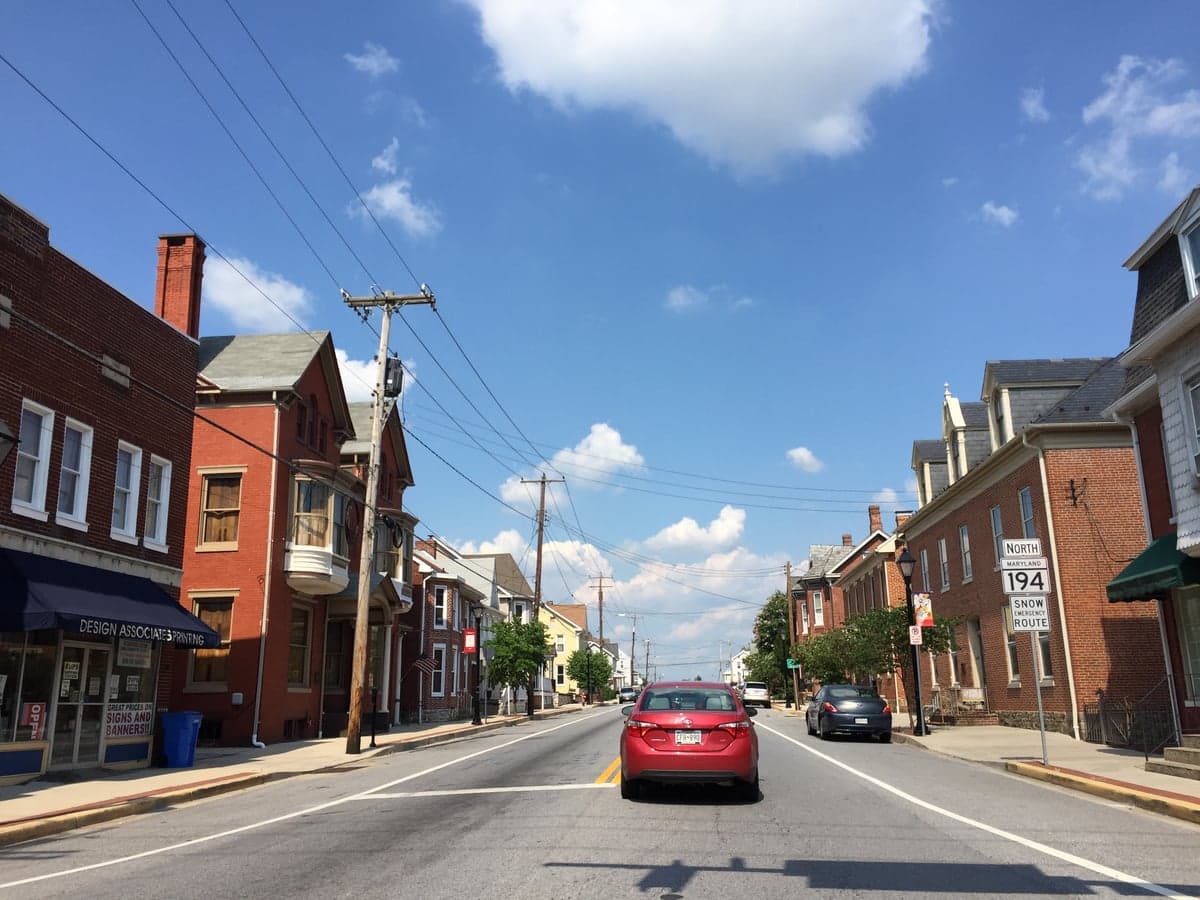
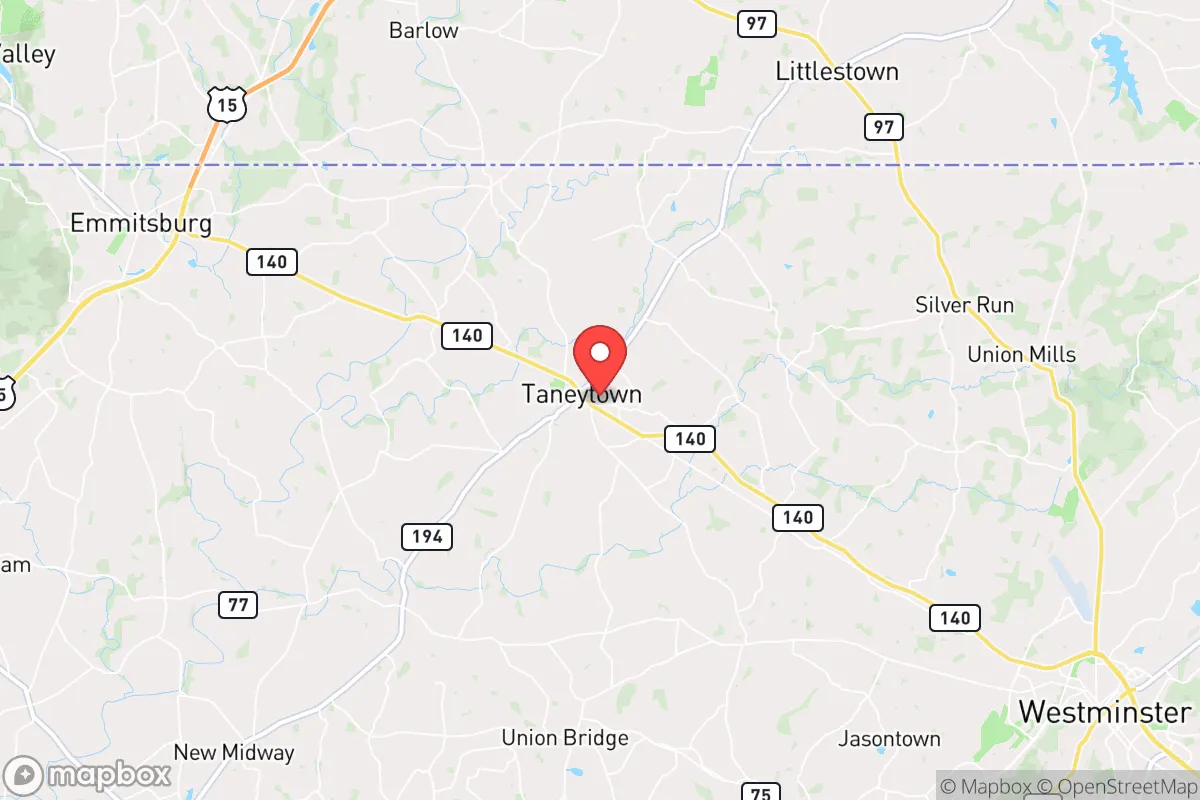
Photo: Wikipedia
Demographics of Taneytown, MD
Affluence Level in Taneytown, MD
A middle-class area roughly in line with national averages across income, home values, education, and employment.
People of Taneytown, MD
Taneytown, Maryland, is a small, historically tight-knit city of 7,295 residents that remains overwhelmingly white (85.3%) and native-born, with a foreign-born population of just 0.6%. The city’s identity is rooted in its German and Scots-Irish founding families, a modest manufacturing and agricultural past, and a present-day character that leans conservative, family-oriented, and locally focused. With a college attainment rate of 21.8%, Taneytown is a working-to-middle-class community where generational roots run deep and new arrivals are predominantly domestic migrants seeking affordable housing and a slower pace within commuting distance of Baltimore and Frederick.
How the city was settled and grew
Taneytown was laid out in 1754 by German and Scots-Irish settlers drawn to the fertile Piedmont land grants of western Maryland. The original town plat centered on the intersection of what is now Baltimore Street and Frederick Street, with lots sold to farmers, millers, and tradesmen. The early population was almost entirely of German and Scots-Irish stock, with families like the Taney, Leister, and Bowers names appearing in the earliest records. The town’s growth in the 19th century was modest, driven by its role as a market center for surrounding farms and by the arrival of the Western Maryland Railway in the 1860s. The historic Downtown Taneytown district, anchored by the 19th-century Taneytown Bank and the stone houses along Frederick Street, was built by these founding families and their descendants. A second wave of growth came in the early 20th century with the establishment of local canneries and a shirt factory, which attracted a small number of Italian and Polish immigrant families, though the town remained overwhelmingly white and native-born through the mid-20th century. The West End neighborhood, west of Baltimore Street, developed in the 1920s and 1930s as a modest working-class area housing factory workers and railroad employees.
Modern era (post-1965)
After the 1965 Hart-Cellar Act, Taneytown saw virtually no new immigration; the foreign-born share remains below 1% today. Instead, the city’s modern demographic story is one of domestic in-migration from the Baltimore and Washington, D.C., metro areas, driven by the search for affordable single-family homes. The Taneytown Village subdivision, built in the 1970s and 1980s off Bollinger Road, absorbed many of these new arrivals—mostly white families from Baltimore County seeking lower taxes and larger lots. The Elderberry Lane area and the Pleasant Valley neighborhood, developed in the 1990s and 2000s, continued this pattern, attracting a mix of white and a growing number of Black families (now 8.2% of the population). The Hispanic share (3.6%) is small but has grown slightly since 2010, concentrated in rental properties near the East End along East Baltimore Street, where some seasonal agricultural and light industrial workers have settled. The East/Southeast Asian population (0.7%) and Indian subcontinent population (0.0%) are negligible. The city’s racial and ethnic composition has shifted only modestly since 2000: the white share has declined from roughly 93% to 85.3%, while the Black and Hispanic shares have each risen a few points, reflecting broader national trends but at a much slower pace than in nearby Frederick or Baltimore.
The future
Taneytown’s population is projected to grow slowly, likely reaching 8,000–8,500 by 2040, driven by continued domestic in-migration from the Baltimore and Frederick exurbs. The city is not homogenizing into a single identity; rather, it is developing distinct enclaves. The older Downtown and West End neighborhoods remain overwhelmingly white and aging, with many long-term residents. The newer subdivisions like Taneytown Village and Pleasant Valley are more diverse, with a growing Black middle class and a small but stable Hispanic presence. The immigrant communities are not growing—the foreign-born share is flat—and the small Hispanic population is assimilating into the broader working-class culture. Over the next 10–20 years, Taneytown will likely remain a predominantly white, native-born city with a modestly increasing Black and Hispanic minority, but without the rapid diversification seen in larger Maryland cities. The city’s character will stay conservative and family-oriented, with new residents drawn by affordability and safety rather than ethnic or cultural diversity.
For a conservative-leaning individual or family moving in now, Taneytown offers a stable, slow-growing community where the population is overwhelmingly native-born, English-speaking, and rooted in traditional values. The city is not becoming a tribalized patchwork of ethnic enclaves; instead, it is gradually absorbing a small number of Black and Hispanic families into its existing neighborhoods, while remaining demographically anchored by its white, working-to-middle-class majority. The bottom line: Taneytown is a place where the population is aging in place, new arrivals are domestic and family-oriented, and the next decade will look much like the last—quiet, affordable, and culturally homogeneous.

* Values derived from national, state, county, city and local statistics and may differ in a specific area. Last updated: 2026-04-22T04:05:42.000Z
Narrative content on this page is AI-generated and may contain mistakes. Verify any details that matter before acting on them.
ReloMaps may earn a commission from affiliate links at no extra cost to you.

