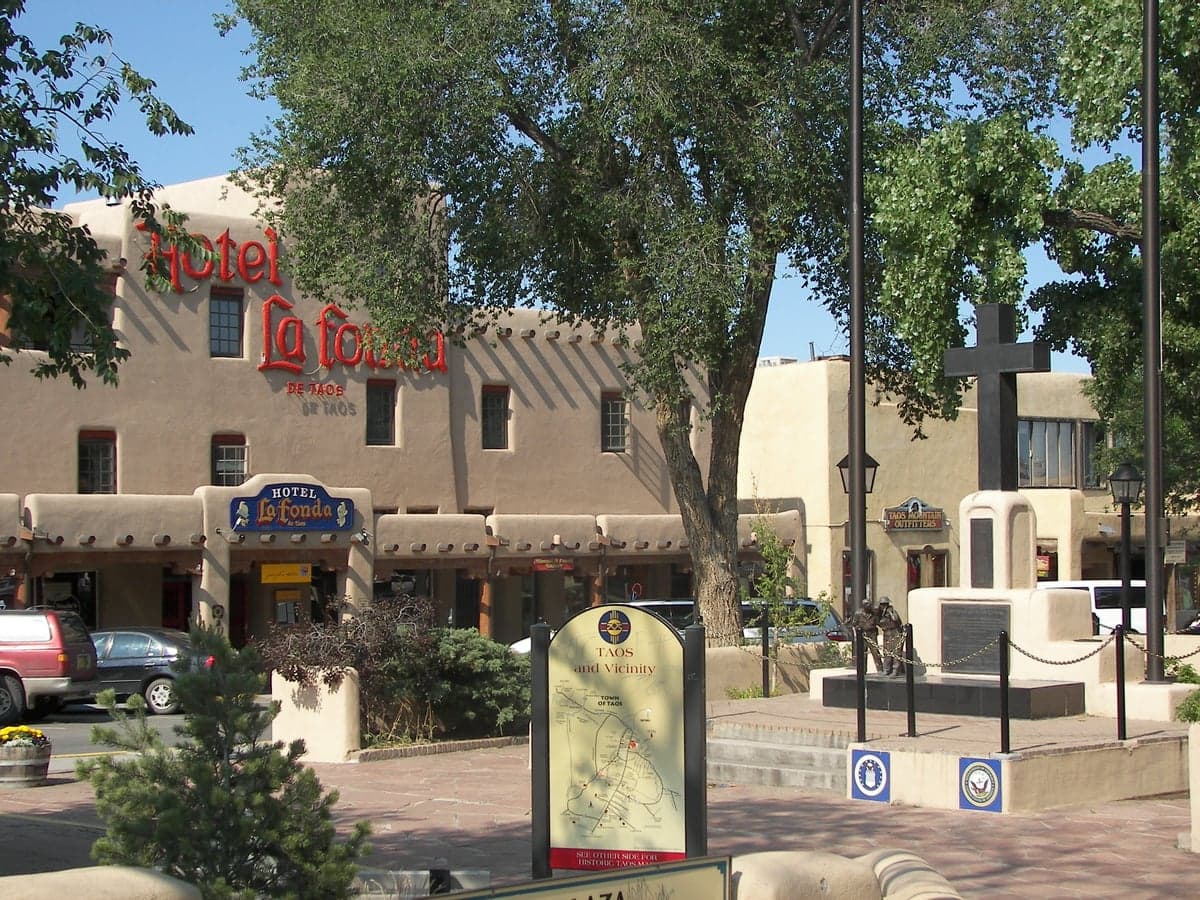
Photo: Wikipedia
Personal Sovereignty in Taos, NM
Viable for self-reliance. Generally workable, though some barriers may limit total independence.
What does Personal Sovereignty tell us?
Personal Sovereignty measures your capacity for self-reliance and independence with minimal government friction. Higher scores mean fewer barriers between you and the way you want to live... but it assumes you have the space you need and good neighbors.
What does this tell us?
Personal Sovereignty measures your capacity for self-reliance and independence with minimal government friction. Higher scores mean fewer barriers between you and the way you want to live... but it assumes you have the space you need and good neighbors.
State Policy
Energy independence: Net exporter (250% of energy produced in-state)
Personal Liberty
Homesteading

Personal Liberty Analysis
For the liberty-minded individual or family evaluating Taos, New Mexico as a potential relocation hub, the personal sovereignty picture is a complex one that demands careful scrutiny. While the high desert landscape and remote mountain setting offer a tangible sense of physical autonomy and distance from urban centers, the legal and regulatory environment in Taos County is heavily influenced by state-level policies that can significantly constrain personal freedoms. The area presents a paradox: a place where you can live off-grid in relative seclusion, yet face some of the most restrictive gun laws in the West and a tax burden that, while not crushing, is trending in a concerning direction. For a survivalist or prepper, the key question is whether the natural advantages of the region outweigh the encroachments of state and local governance.
Tax burden and regulatory posture in Taos County
New Mexico’s overall tax climate is a mixed bag for those seeking to minimize government reach. There is no state inheritance or estate tax, which is a clear win for preserving generational wealth. However, the state’s gross receipts tax (GRT) is a hidden burden that effectively taxes business-to-business transactions, driving up the cost of everything from building materials to groceries. In Taos, the combined state and local GRT rate hovers around 8.5%, one of the higher rates in the state, directly impacting the cost of self-reliance projects like constructing a root cellar or buying bulk supplies. Property taxes are relatively low, with an effective rate around 0.8% of assessed value, which is a plus for landowners. But the regulatory posture is less friendly. New Mexico has a state-level building code that applies even in unincorporated areas of Taos County, and the county itself has zoning ordinances that can complicate off-grid setups, particularly regarding wastewater systems and accessory dwelling units. The state’s environmental review process for new wells or septic systems can be slow and costly, a direct obstacle to self-sufficiency.
Self-defense and gun law specifics in New Mexico
For those who view the Second Amendment as a cornerstone of personal sovereignty, New Mexico presents a significant downgrade from neighboring states like Texas or Arizona. The state requires a permit for concealed carry, and while it is a "shall-issue" state, the process involves a background check, a firearms training course, and a fee. More critically, in 2021, New Mexico enacted a "red flag" law (Extreme Risk Firearm Protection Order) that allows law enforcement or family members to petition a court to temporarily seize firearms from an individual deemed a risk. For the prepper mindset, this represents a direct threat to the right to keep and bear arms based on subjective criteria. Open carry is legal without a permit for those 19 and older, but local ordinances in Taos can be restrictive. The town of Taos itself has a municipal code that prohibits discharging a firearm within city limits, which limits defensive use on smaller properties. Magazine capacity is not restricted at the state level, and there is no state-level registry, but the legal landscape is fragile and subject to change with each election cycle. For the liberty-minded, this is not a gun-friendly sanctuary.
Self-reliance and homesteading viability: lot sizes, zoning, and off-grid feasibility
The physical environment of Taos County is arguably its strongest asset for the self-reliant individual. The county is vast and sparsely populated, with large tracts of land available at relatively affordable prices compared to the Front Range or the West Coast. Minimum lot sizes in unincorporated areas can be as small as one acre in some zones, but many parcels are five acres or larger, offering genuine buffer space. Zoning in the county is generally permissive regarding agricultural use, including livestock, gardening, and small-scale farming. However, off-grid living is not a free-for-all. New Mexico state law requires a permit for any new well, and the process can take months. Solar power is widely accepted and encouraged, but connecting to the grid or installing a battery system requires compliance with the local electric cooperative’s standards. Rainwater harvesting is legal and even incentivized in some areas, but there are strict regulations on greywater systems. The biggest hurdle is wastewater: Taos County requires a permitted septic system for any dwelling, and composting toilets are not universally accepted as a substitute. For the serious prepper, the land is there, but the path to true off-grid independence is paved with permits and inspections.
Personal liberties: parental rights, medical autonomy, speech, and property
On the spectrum of personal liberties, New Mexico leans heavily toward state intervention in several key areas. Parental rights are a flashpoint: the state has mandatory vaccination requirements for school attendance (with limited exemptions), and during the COVID-19 era, school mask mandates were enforced aggressively. Medical autonomy is similarly constrained. New Mexico has a state-run health insurance exchange and has expanded Medicaid, which some view as an overreach. More concerning for the liberty-minded is the state’s stance on emergency powers: the governor has broad authority to issue executive orders during a declared emergency, including mandates on businesses and gatherings. On property rights, the situation is mixed. There is no state-level property tax on food, but the GRT applies to most goods. Eminent domain is a real concern, particularly with the state’s interest in water rights and infrastructure projects. Free speech is protected, but local politics in Taos can be intensely progressive, creating a social environment where dissenting views on topics like land use or public health may be met with ostracism. For the individualist, the legal framework is a constant reminder that the state’s hand is never far away.
In the final analysis, Taos offers a unique but compromised sovereignty proposition. The natural advantages—cheap land, low population density, a climate suited for dryland farming, and distance from federal power centers—are real and valuable for the prepper or survivalist. But the state-level legal environment is a persistent drag on personal autonomy, with restrictive gun laws, a red flag statute, and a regulatory apparatus that complicates off-grid living. Compared to a place like rural Idaho or Montana, Taos falls short on legal freedom. Compared to the coastal blue states, it is a step up. For the strategic relocator, the calculus is simple: if you value physical seclusion and are willing to navigate a hostile state government, Taos can work. If you want a legal sanctuary where your rights are explicitly protected from government overreach, you will need to look further north or east. The land is free, but the law is not.

* Values derived from national, state, county, city and local statistics and may differ in a specific area. Last updated: 2026-04-19T07:02:03.000Z
Narrative content on this page is AI-generated and may contain mistakes. Verify any details that matter before acting on them.
ReloMaps may earn a commission from affiliate links at no extra cost to you.

