
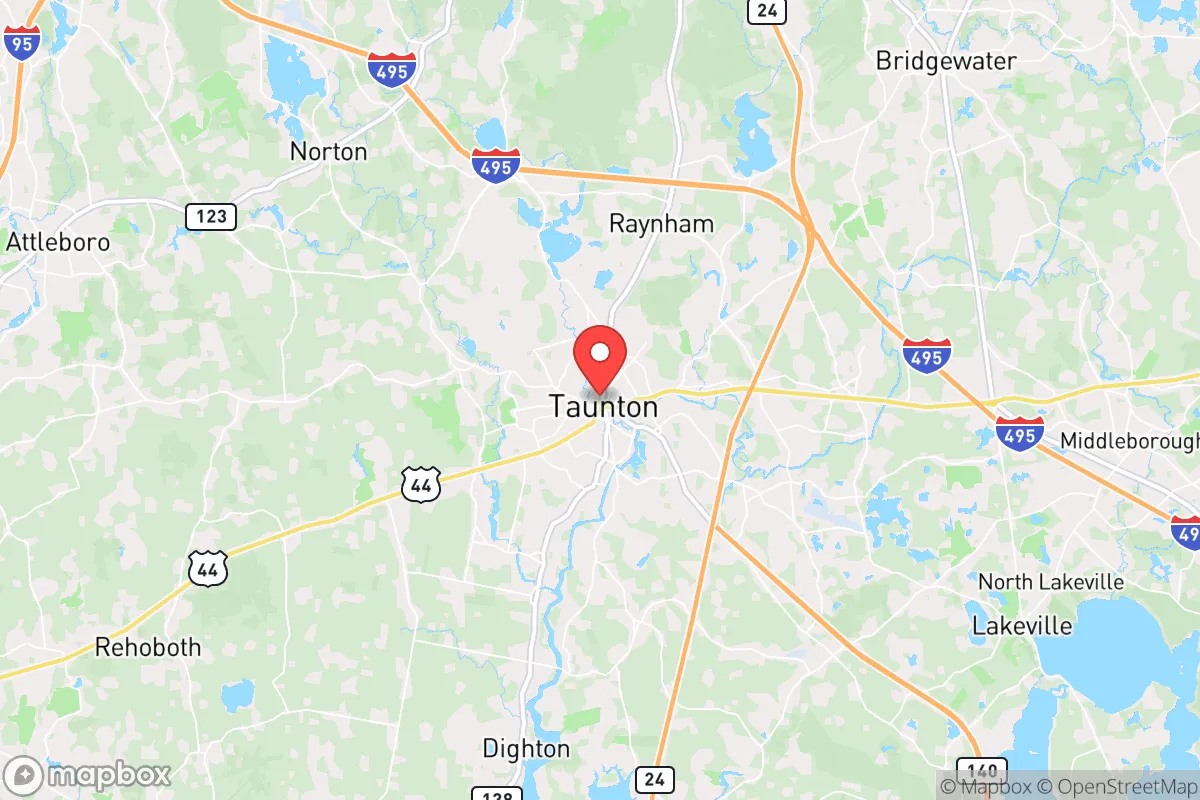
Photo: Wikipedia
Personal Sovereignty in Taunton, MA
Viable for self-reliance. Generally workable, though some barriers may limit total independence.
What does Personal Sovereignty tell us?
Personal Sovereignty measures your capacity for self-reliance and independence with minimal government friction. Higher scores mean fewer barriers between you and the way you want to live... but it assumes you have the space you need and good neighbors.
What does this tell us?
Personal Sovereignty measures your capacity for self-reliance and independence with minimal government friction. Higher scores mean fewer barriers between you and the way you want to live... but it assumes you have the space you need and good neighbors.
State Policy
Energy independence: Importer (5% of energy produced in-state)
Personal Liberty
Homesteading

Personal Liberty Analysis
Taunton, Massachusetts, presents a complex picture for those prioritizing personal sovereignty. While the city itself offers a more grounded, working-class atmosphere than Boston’s orbit, it operates entirely under the thumb of one of the most restrictive state governments in the nation regarding self-defense, taxation, and individual liberty. For a survivalist or prepper mindset, Taunton’s location provides some strategic advantages—proximity to the coast, access to freshwater, and a lower population density than the capital—but the legal and regulatory environment from Beacon Hill creates a constant headwind against true autonomy. You are not free here in the way you would be in New Hampshire or much of the Midwest; you are operating within a system that assumes the state knows better than you do.
Tax burden and regulatory posture in Taunton
Massachusetts carries a heavy tax load, and Taunton residents feel it directly. The state income tax is a flat 5.0% on all earned income, and the state sales tax sits at 6.25%, with no local option to reduce it. Property taxes in Taunton are moderate for the state—around $14.50 per $1,000 of assessed value—but that still translates to a significant annual bill on a median home valued near $450,000. More concerning for the self-reliant is the regulatory posture: Massachusetts has some of the strictest building codes, environmental regulations, and vehicle inspection standards in New England. If you want to build a workshop, install a backup generator, or modify your property without permits, you are taking a real risk. The state’s MassSave program mandates energy audits and efficiency upgrades for many home sales, and local boards of health have broad authority over wells and septic systems. This is not a jurisdiction where you can quietly improve your land without paperwork.
Self-defense and gun law specifics in Taunton
This is the most critical area for anyone concerned with personal sovereignty. Massachusetts is a may-issue state for License to Carry (LTC) firearms, and while Bristol County (where Taunton sits) has historically been more reasonable than Suffolk or Middlesex counties, the process remains burdensome. You must complete a state-approved firearms safety course, submit fingerprints, pass a background check, and pay fees—then wait months for approval. The state bans so-called "assault weapons" by name and feature, limits magazine capacity to 10 rounds, and requires a separate Firearms Identification Card (FID) for long guns if you do not hold an LTC. There is no constitutional carry; open carry is effectively illegal, and concealed carry requires the LTC. Stand-your-ground laws do not exist in Massachusetts; you have a duty to retreat if possible before using deadly force, even in your own home in some interpretations. For a prepper, this means your defensive options are legally constrained, and any self-defense incident will be scrutinized by a state that is not friendly to armed citizens. Stockpiling ammunition is legal, but buying it requires a firearms license, and online ammo sales are heavily restricted.
Self-reliance and homesteading viability in Taunton
Taunton offers more land than most Boston suburbs, but it is not a homesteading haven. Typical residential lots in the city proper are 0.25 to 0.5 acres, though some outlying areas near the Raynham and Berkley borders have parcels of 1 to 3 acres. Zoning is generally suburban; raising chickens is allowed in many residential zones with a permit, but pigs, goats, or cattle are restricted to agricultural zones. Off-grid living is effectively impossible within city limits—the city requires connection to municipal water and sewer where available, and building codes mandate grid-tied electrical systems. Rainwater collection for potable use is regulated by the state Department of Environmental Protection, and solar panel installation requires permits and utility approval. For serious self-sufficiency—large gardens, livestock, wood heat, independent water—you would need to look at the rural fringes of Berkley, Dighton, or Rehoboth, which are a 15-20 minute drive from central Taunton. Even there, Massachusetts' Title 5 septic regulations and wetland protection laws make developing raw land expensive and slow.
Personal liberties in Taunton: parental rights, medical autonomy, speech, and property
Massachusetts is a blue state, and that shows in its approach to personal liberties. Parental rights are under consistent pressure: the state has broad authority over child welfare, and schools are required to follow state curriculum frameworks that include comprehensive sex education and LGBTQ+ inclusive materials, with no opt-out for parents on certain topics. Medical autonomy is similarly constrained—Massachusetts had one of the strictest COVID-19 vaccine mandates in the country, and the state maintains a mandatory vaccine schedule for school attendance with very limited religious exemptions. Medical freedom is not a given here; the state Board of Registration in Medicine has broad disciplinary power, and alternative treatments are heavily regulated. Free speech is protected by the First Amendment, but Massachusetts has some of the nation's strictest anti-SLAPP laws and a history of aggressive enforcement of "hate speech" statutes in public forums. Property rights are limited by the state's strong Chapter 40B affordable housing law, which can override local zoning to allow dense development, and by the Wetlands Protection Act, which restricts what you can do on your own land near water or wetlands. For a conservative individualist, these are not minor annoyances—they are structural limits on how you can live, raise your children, and defend your family.
Compared to other areas in the Northeast, Taunton offers a middle ground that may appeal to those who need to stay in Massachusetts for work or family but want more breathing room than Boston. However, for the survivalist or prepper who values true sovereignty, the state-level constraints on firearms, medical choice, parental authority, and property use are significant liabilities. New Hampshire is a two-hour drive north and offers no income tax, constitutional carry, and far greater homesteading freedom. Rhode Island is slightly more permissive on some regulations but still restrictive on firearms. If your priority is maximum personal autonomy, Taunton is a compromise location—better than the urban core, but still operating under a government that views individual preparedness as a problem to be managed rather than a right to be protected.

* Values derived from national, state, county, city and local statistics and may differ in a specific area. Last updated: 2026-05-01T07:34:21.000Z
Narrative content on this page is AI-generated and may contain mistakes. Verify any details that matter before acting on them.
ReloMaps may earn a commission from affiliate links at no extra cost to you.

