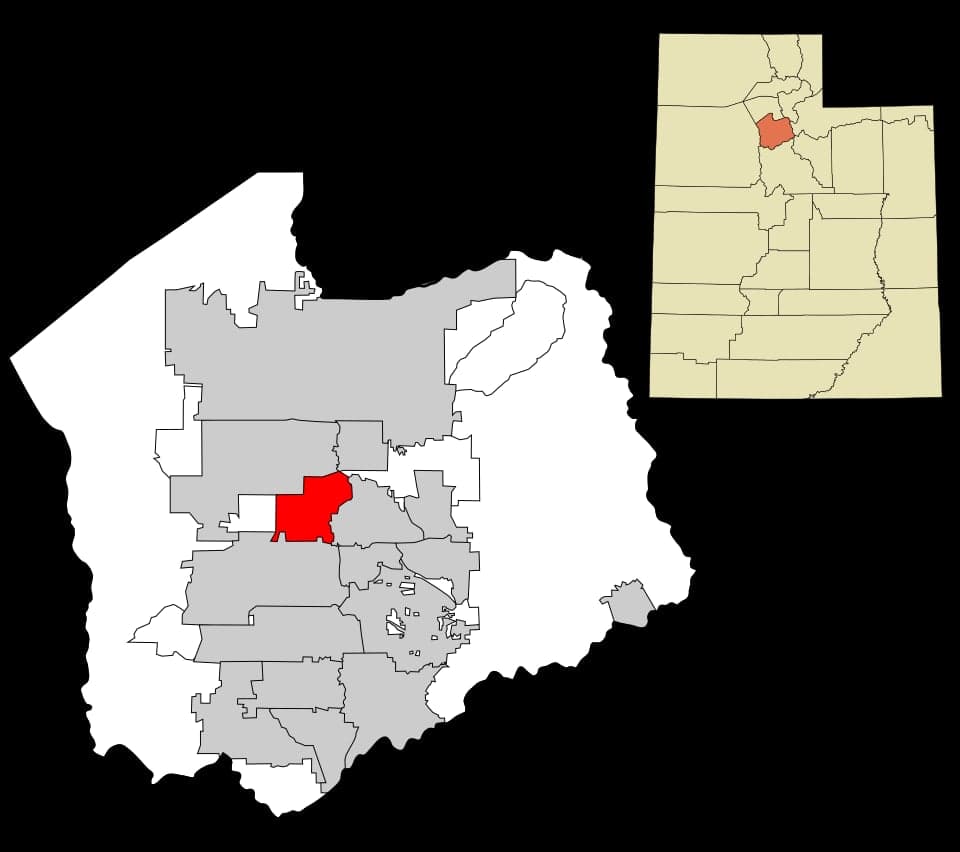
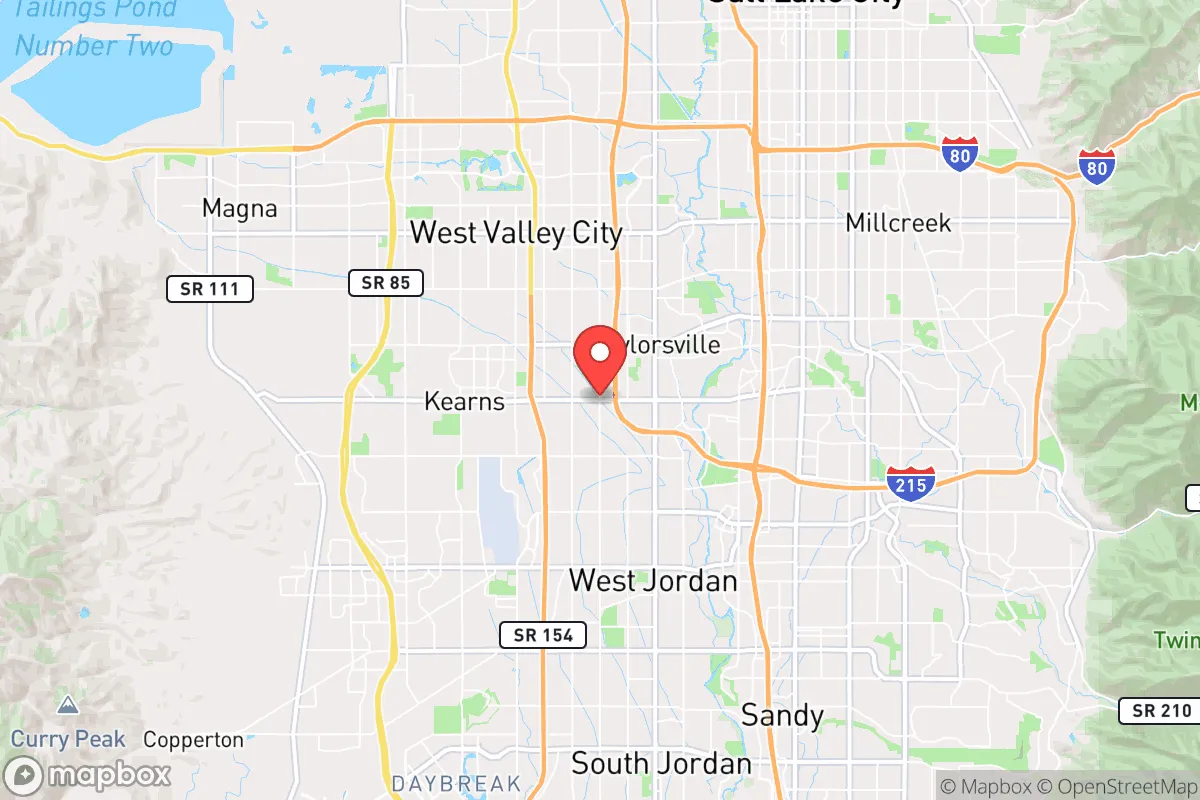
Photo: Wikipedia
Demographics of Taylorsville, UT
Affluence Level in Taylorsville, UT
A middle-class area roughly in line with national averages across income, home values, education, and employment.
People of Taylorsville, UT
Taylorsville, Utah, is a densely settled suburban city of roughly 59,000 residents, characterized by a predominantly white (60.4%) and increasingly Hispanic (26.0%) population. It is a family-oriented community with a strong Latter-day Saint cultural influence, reflected in its relatively low college attainment rate (23.8%) and a housing stock dominated by mid-century ranches and 1970s split-levels. The city feels more like a stable, middle-class bedroom community than a transient hub, with a foreign-born share (8.9%) that is modest by national standards but concentrated in specific enclaves.
How the city was settled and grew
Taylorsville was not a pioneer settlement but a late-19th-century agricultural offshoot of nearby Salt Lake City and Murray. The area was originally part of the larger Taylorsville Precinct, named after early Mormon settler John Taylor, and was subdivided into dry-farm plots by LDS Church members in the 1850s and 1860s. The first permanent residents were predominantly of English and Scandinavian descent, drawn by the promise of irrigated farmland along the Jordan River. The historic Old Taylorsville district, centered around 4800 South and 2700 West, contains the oldest homes and the original Taylorsville Cemetery, where many of these founding families are buried. A second wave arrived in the 1910s and 1920s, when the railroad and sugar-beet industry brought a small number of Italian and Greek laborers, who settled in the Redwood Road corridor near the rail lines. By 1950, Taylorsville remained a rural farming community of fewer than 2,000 people, overwhelmingly white and native-born.
Modern era (post-1965)
The city’s explosive growth began in the 1970s and 1980s, driven by Salt Lake City’s suburban expansion and the construction of I-215. This period saw the arrival of middle-class white families moving from Salt Lake City’s east side and from rural Utah, filling thousands of new tract homes in subdivisions like Bennion Glen and Westbrook. The 1990s and 2000s brought the first significant Hispanic influx, as Mexican and Central American immigrants were drawn to construction, landscaping, and service jobs in the booming Wasatch Front economy. This community concentrated in the Southwest Taylorsville area, roughly between 5400 South and 6200 South, west of Redwood Road, where older, more affordable housing stock and multi-family rentals are common. The East/Southeast Asian population (5.6%) is smaller but visible, with a notable cluster of Vietnamese and Filipino families in the Lake Ridge neighborhood near 4700 South, many of whom arrived as refugees or through family reunification in the 1980s and 1990s. The Indian-subcontinent community (1.0%) is a more recent, professional cohort, many working in tech and healthcare, and is scattered rather than forming a distinct ethnic enclave. The Black population remains very small (1.4%), with no single neighborhood concentration.
The future
Taylorsville’s demographic trajectory points toward continued Hispanic growth and a gradual decline in the white share, mirroring trends across Salt Lake County. The Hispanic population, now 26.0%, is projected to approach 35-40% by 2040, driven by both immigration and higher birth rates. This group is not tribalizing into a permanent enclave; second- and third-generation Hispanic residents are increasingly moving into previously white-majority neighborhoods like Bennion Glen and Westbrook, suggesting assimilation rather than segregation. The East/Southeast Asian and Indian communities are likely to grow slowly through professional migration but will remain small. The city’s housing stock—dominated by single-family homes with limited new construction—means population growth will be modest, likely topping out around 65,000. The biggest wildcard is whether Taylorsville can attract and retain younger, college-educated families, given its below-average educational attainment and the pull of newer suburbs to the south and west.
For someone moving in now, Taylorsville offers a stable, affordable, and culturally conservative environment with a growing Hispanic presence that is integrating rather than fragmenting. It is not a place of rapid change or ethnic tension, but rather a middle-class suburb where the white majority is slowly diversifying, and where the next generation will likely be more mixed than the last. The city’s identity remains rooted in its LDS and agricultural past, but its future is increasingly defined by the families—both white and Hispanic—who choose it for its schools, safety, and proximity to Salt Lake City jobs.

* Values derived from national, state, county, city and local statistics and may differ in a specific area. Last updated: 2026-05-03T20:37:38.000Z
Narrative content on this page is AI-generated and may contain mistakes. Verify any details that matter before acting on them.
ReloMaps may earn a commission from affiliate links at no extra cost to you.

