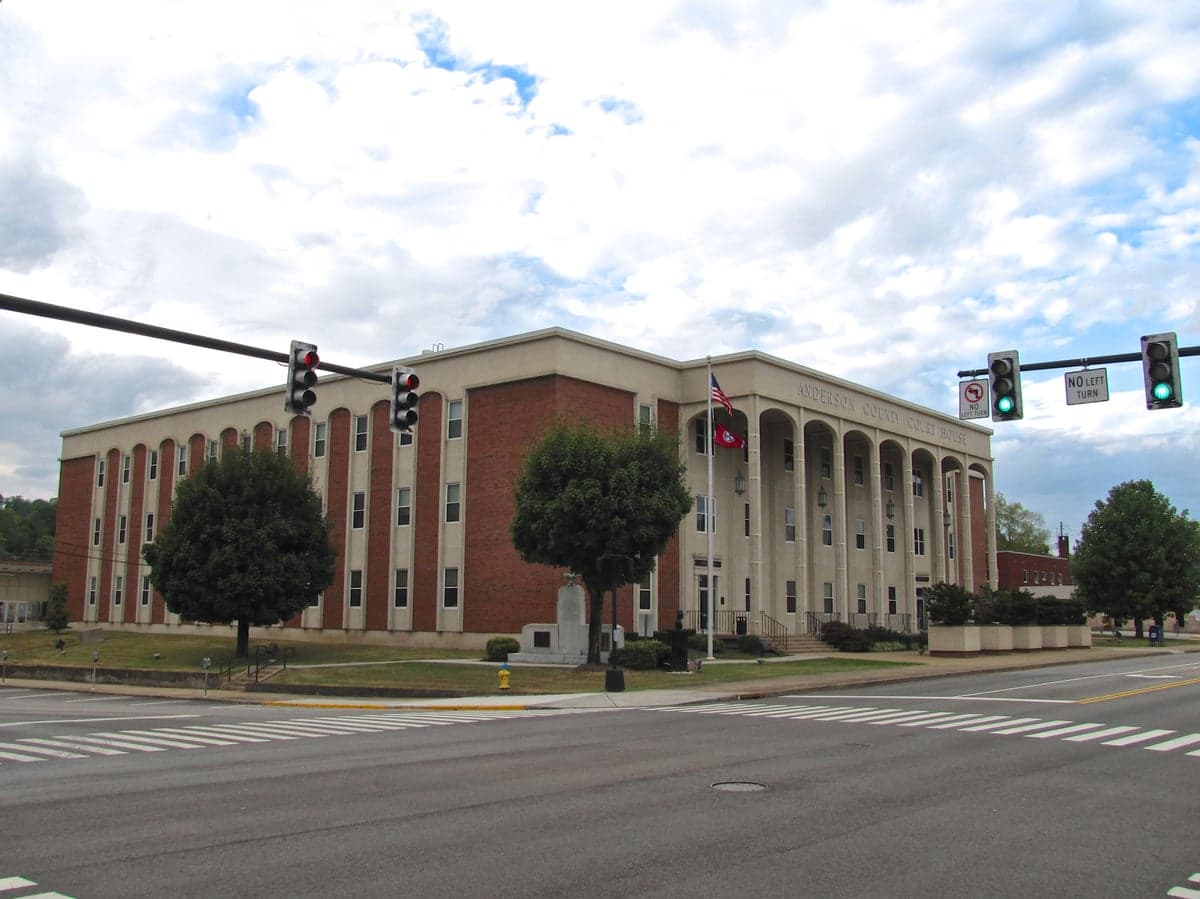
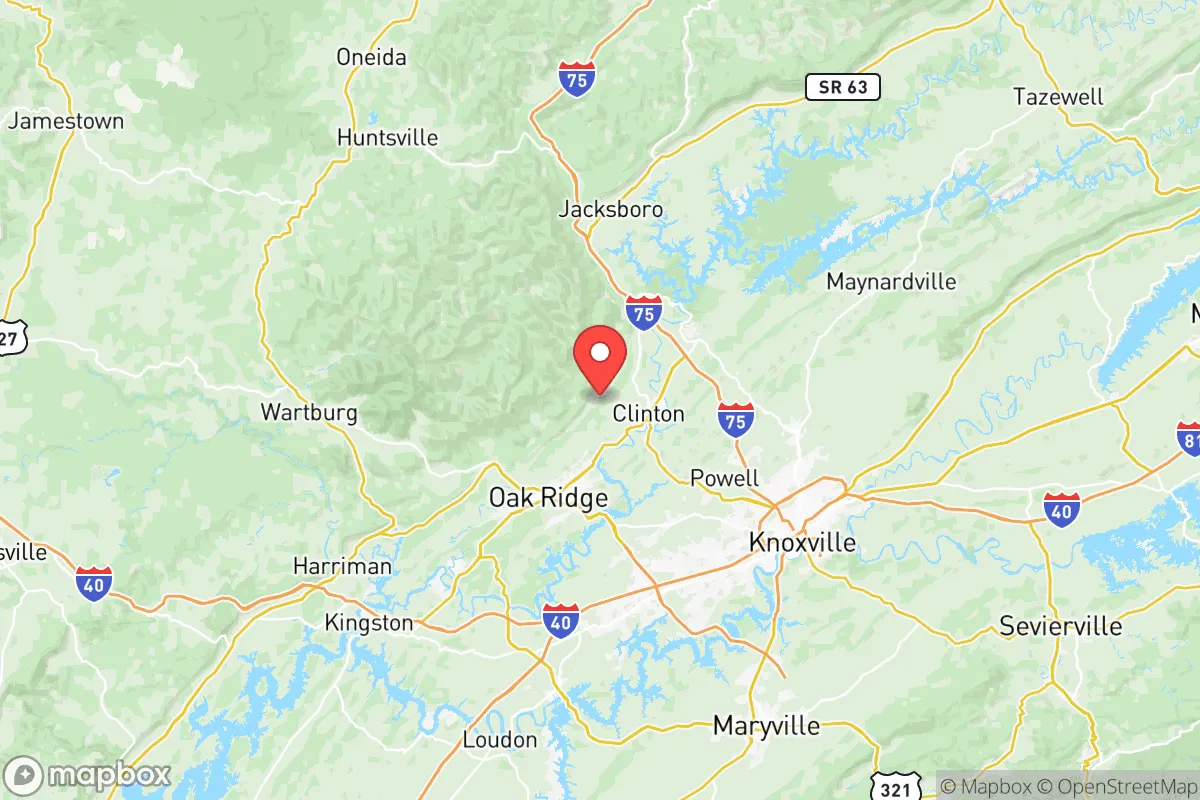
Photo: Wikipedia
Demographics of Anderson County
Affluence Level in Anderson County
A middle-class area roughly in line with national averages across income, home values, education, and employment.
People of Anderson County
The people of Anderson County, Tennessee, today number 78,175 and form a predominantly white (87.0%), native-born population with a notably low foreign-born share of just 1.8%. The county’s character is rooted in Appalachian and Southern traditions, shaped by a history of energy and industrial employment at the Oak Ridge National Laboratory and the Tennessee Valley Authority, giving it a distinctive blend of rural conservatism and high-tech science. With a college-educated rate of 26.3%, slightly below the national average, the population is older and more settled than the fast-growing suburbs of nearby Knoxville, yet it retains a strong sense of place centered on communities like Clinton, Oak Ridge, and Lake City.
Settlement & growth (pre-1960)
Long before European settlement, the land that is now Anderson County was part of the traditional territory of the Cherokee Nation, who used the Clinch River and its tributaries for travel and hunting. The Cherokee maintained Cherokee towns and improved Cherokee Path, a major trading route, passed through the area, connecting the Overhill Cherokee towns to the east with the Ohio River Valley. The first permanent European settlers arrived in the 1770s and 1780s, predominantly Scots-Irish and English pioneers moving west from Virginia and North Carolina through the Cumberland Gap. These early families, such as the Fousts and the Crosses, were drawn by the promise of fertile bottomland along the Clinch River and the availability of land grants for Revolutionary War service. They established small farming communities, with the town of Clinton, founded in 1801 as the county seat, becoming the early commercial and political hub.
The 19th century saw a slow, steady influx of additional Scots-Irish and German settlers, who established subsistence farms and small mills. The county remained overwhelmingly rural and agricultural until the arrival of the railroad in the 1850s, which connected Clinton and the smaller settlement of Oliver Springs to regional markets. Coal mining emerged as a significant industry in the late 1800s, particularly around the communities of Coal Creek (now Rocky Top) and Briceville, drawing a wave of white Appalachian miners from neighboring counties. This period also saw a small number of African American families, mostly former slaves and their descendants, who settled in Clinton and worked as laborers, domestics, and in the mines. By 1900, the population was nearly entirely native-born white, with a tiny Black minority of roughly 5%.
The single most transformative event in Anderson County’s history was the Manhattan Project during World War II. In 1942, the U.S. government selected the rural area west of Clinton to build the Oak Ridge site, a secret city for uranium enrichment. Overnight, tens of thousands of workers—scientists, engineers, construction laborers, and support staff—poured in from across the country. This was a domestic migration wave unlike any other in Tennessee history. The new city of Oak Ridge was built from scratch, and its population soared to over 75,000 by 1945. This influx was overwhelmingly white and native-born, but it included a significant number of highly educated professionals from the Northeast and Midwest, as well as a smaller number of African American workers who were housed in segregated "hutments." After the war, the population of Oak Ridge dropped sharply but stabilized as the site transitioned to peacetime nuclear research and the Oak Ridge National Laboratory. This event permanently shifted the county’s demographic center of gravity from the agricultural seat of Clinton to the planned, federally managed city of Oak Ridge.
Modern era (post-1965)
The 1965 Hart-Cellar Act, which dramatically reshaped U.S. immigration, had a very muted effect on Anderson County. The county’s foreign-born population today is just 1.8%, far below the national average of roughly 14%. The small immigrant community that does exist is concentrated almost entirely in Oak Ridge, drawn by employment at the national laboratory and the nearby University of Tennessee in Knoxville. This group is disproportionately composed of highly skilled professionals—scientists, engineers, and researchers—from East and Southeast Asia (1.2% of the total population), including Chinese, Indian (0.1%), and Korean nationals. There is no visible ethnic enclave or "Chinatown" in Oak Ridge; these families are dispersed throughout the city’s suburban neighborhoods, often living near the lab campus. The Hispanic population (3.8%) is the fastest-growing minority group, but it remains small and is largely composed of Mexican-American families working in construction, landscaping, and agriculture, with modest concentrations in Clinton and Rocky Top.
Domestic migration has been the far more significant driver of demographic change since 1965. The county experienced a steady outflow of younger residents to the Knoxville metropolitan area for jobs and education through the 1970s and 1980s. However, since the 1990s, Anderson County has seen a modest but consistent in-migration of retirees and families from the Rust Belt—particularly Ohio, Michigan, and Illinois—seeking a lower cost of living, milder winters, and a more conservative political environment. This "half-back" migration (people moving halfway back to the South after retiring from the North) has settled primarily in the lakefront communities along Norris Lake, such as Norris and Andersonville, and in the newer subdivisions around Oak Ridge. The Black population (3.3%) has remained stable and is concentrated in Oak Ridge and Clinton, with a historic community in the Scarboro neighborhood of Oak Ridge, originally built for African American Manhattan Project workers. Suburbanization has been limited compared to Knox County; most growth has occurred as low-density sprawl along the Highway 61 corridor between Clinton and Oak Ridge.
The future
The population of Anderson County is projected to grow slowly, perhaps 5-10% over the next two decades, driven primarily by continued domestic in-migration of retirees and remote workers from higher-cost states. The county is not homogenizing into a generic suburb; instead, it is tribalizing into distinct enclaves. Oak Ridge will remain the cosmopolitan, highly educated, and slightly more diverse anchor, while Clinton and the rural areas will retain their traditional Appalachian and Southern character. The immigrant community, though small, will likely grow slowly as Oak Ridge National Laboratory continues to recruit international talent, but it will remain a thin layer of highly skilled professionals rather than a broad-based ethnic community. The Hispanic population will likely increase modestly, but it will be absorbed into the existing cultural fabric rather than forming a distinct enclave. The most significant cultural tension will be between the long-standing local population and the influx of out-of-state retirees and remote workers, who bring different political and social expectations but are largely absorbed into the county’s conservative lean.
For someone moving to Anderson County today, the bottom line is this: you are entering a place that is overwhelmingly white, native-born, and culturally conservative, with a strong sense of local history rooted in the Manhattan Project and Appalachian farming. The county offers a stable, low-crime, and affordable environment with access to outdoor recreation on Norris Lake and the Cumberland Plateau, but it lacks the ethnic diversity and rapid growth of the broader Knoxville metro. The future is one of slow, steady, and culturally conservative change, where the existing identity will largely absorb newcomers rather than being transformed by them.

* Values derived from national, state, county, city and local statistics and may differ in a specific area. Last updated: 2026-05-18T16:00:49.000Z
Narrative content on this page is AI-generated and may contain mistakes. Verify any details that matter before acting on them.
ReloMaps may earn a commission from affiliate links at no extra cost to you.

