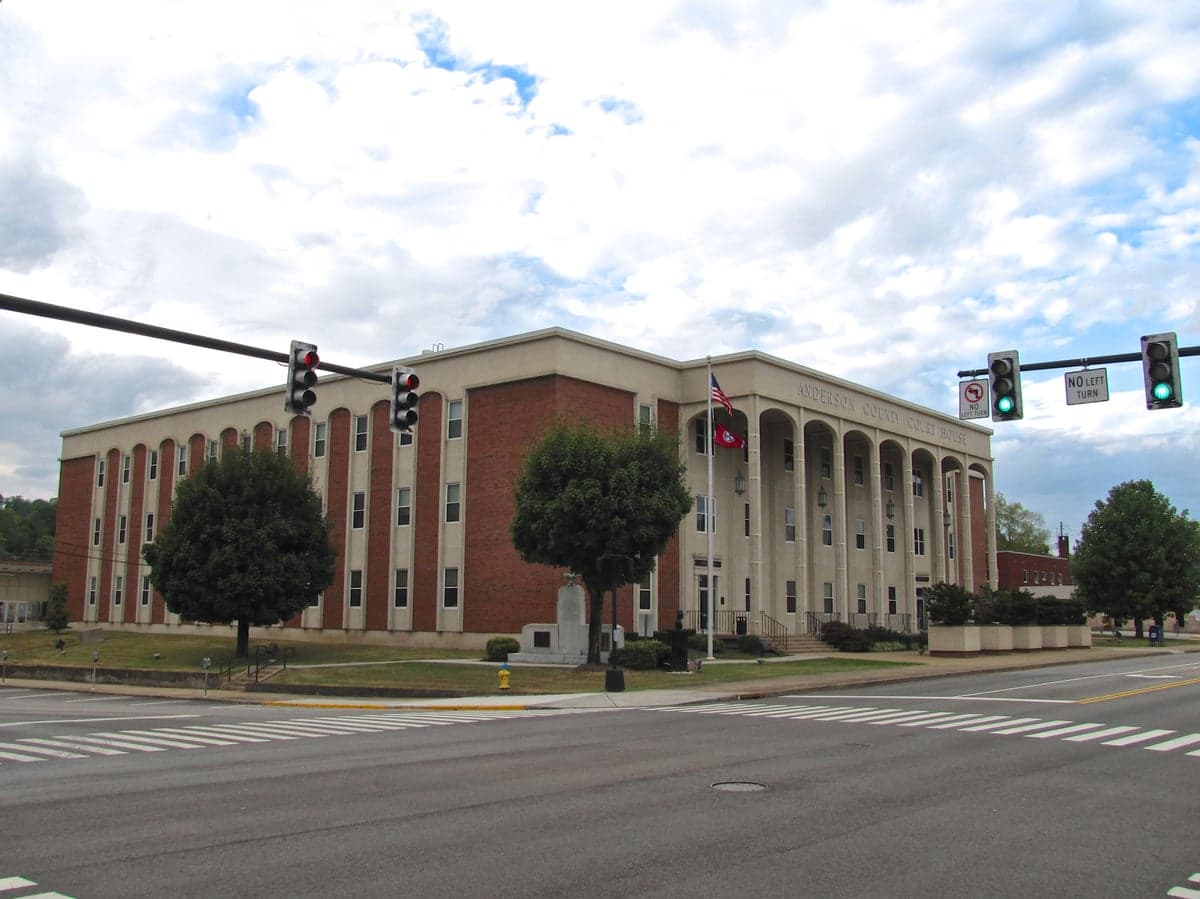
Photo: Wikipedia
Political ClimatePolitical Climate in Anderson County
Showing district-level results — no local-only data available.
Local Political AnalysisPolitical Analysis of Anderson County
Anderson County has long been a reliably conservative stronghold, with a Cook PVI of R+18 that puts it five points to the right of Tennessee as a whole. That R+13 statewide rating already makes Tennessee one of the redder states in the country, so Anderson County is deep red even by that standard. But if you’ve seen some subtle shifts over the past decade—Clinton Township and parts of Oak Ridge have trended a little more purple, while rural precincts around Rocky Top and Lake City have stayed rock-ribbed Republican. The county commission and school board remain overwhelmingly conservative, though a few seats in the Oak Ridge city limits have flipped to Democrats in recent cycles. That’s something to keep an eye on, because if the progressive wave that’s washing over Knoxville starts creeping north up I-75, it could change the local dynamic faster than folks expect.
How it compares
Compared to Tennessee’s overall R+13, Anderson County’s R+18 means it’s one of the most reliably Republican counties in East Tennessee, but not the most extreme—neighboring Morgan County is R+24, and Campbell County is R+22. The real difference shows up in how the county votes on state-level races. In 2024, Anderson County gave Donald Trump 68% of the vote, while Tennessee statewide was around 62%. That extra six points comes from the rural precincts outside Oak Ridge. Inside Oak Ridge itself, the vote was closer to 55-45 Republican, thanks to the influence of the Oak Ridge National Laboratory workforce and a more educated, moderate-leaning population. The towns of Clinton and Norris tend to split the difference—Clinton is reliably red but not overwhelmingly so, while Norris, with its TVA history and lakefront retirees, leans conservative but with a libertarian streak that sometimes bucks the party line on property rights and local zoning.
What this means for residents
For folks living here, the conservative tilt means local government generally stays out of your business—property taxes are low, gun laws are respected, and there’s no appetite for the kind of progressive social engineering you see in Nashville or Knoxville. The county commission has consistently rejected proposals for mask mandates, vaccine passports, and DEI training in schools. That’s a relief if you value personal freedom and don’t want bureaucrats telling you how to raise your kids or run your small business. But the flip side is that as the Oak Ridge corridor grows—new subdivisions, more remote workers from Knoxville—there’s pressure to adopt more urban-style regulations. The recent debate over short-term rental ordinances in Clinton was a preview: some residents wanted strict limits to preserve neighborhood character, while others saw it as government overreach. So far, the conservative majority has held the line, but the demographic shift is real. If you’re moving here, expect a community that values independence and tradition, but keep an eye on local elections—they matter more than national ones for your day-to-day freedoms.
Culturally, Anderson County still feels like old Tennessee: church potlucks, Friday night football at Clinton High or Oak Ridge High, and a general distrust of anything that smacks of federal overreach. The Oak Ridge National Laboratory brings in a lot of PhDs and federal contractors, which creates a unique blend of high-tech conservatism—people who are pro-science but anti-regulation. That’s different from the more rural, agrarian conservatism you find in Rocky Top or Briceville. Policy-wise, the county has been a leader in Second Amendment sanctuary resolutions and has pushed back against state-level efforts to expand Medicaid or impose statewide zoning. If you’re looking for a place where the government stays small and the neighbors keep to themselves, Anderson County still delivers—but the pressure from Knoxville’s growth means you can’t take it for granted. The next five years will tell whether this corner of East Tennessee stays true to its roots or starts drifting toward the progressive mainstream.

State Political ClimatePolitical Climate in Tennessee
State Political AnalysisPolitical Environment in the State
Tennessee is a reliably conservative state with a Cook PVI of R+13, meaning it votes about 13 points more Republican than the national average in presidential elections. The dominant coalition is a mix of rural and suburban voters who prioritize limited government, traditional values, and economic freedom, though the state has shifted rightward over the past 20 years as Democratic strongholds in rural West Tennessee and parts of Nashville have eroded. The 2024 election saw Donald Trump win the state by roughly 30 points, and Republicans hold supermajorities in both chambers of the state legislature—a position they’ve maintained since 2010.
Urban vs. rural divide
The political map of Tennessee is a study in contrasts. The three major metros—Nashville, Memphis, and Knoxville—each tell a different story. Nashville (Davidson County) has become a deep blue island in a red sea, driven by rapid in-migration of young professionals and creative-class workers; it voted for Joe Biden by 30 points in 2020 and for Kamala Harris by a similar margin in 2024. Memphis (Shelby County) remains reliably Democratic, powered by its large African American population, but its influence is waning as population growth stagnates. Knoxville (Knox County) is a conservative stronghold, voting Republican by about 20 points, though the city itself has a small but vocal progressive enclave around the University of Tennessee campus. The real engine of Tennessee’s conservatism is the vast rural and exurban expanse: counties like Williamson (south of Nashville), Rutherford (east of Nashville), and Hamilton (Chattanooga) are among the fastest-growing and most reliably Republican in the state. Williamson County, in particular, is a national bellwether for affluent suburban conservatism, voting +30 R in 2024. The divide is stark: drive 30 minutes outside any metro center, and you’re in deep-red territory where Trump flags fly year-round and local politics revolve around school boards and property taxes.
Policy environment
Tennessee’s policy environment is among the most conservative in the country, and it’s been deliberately engineered that way. The state has no income tax on wages—only a 6.5% tax on interest and dividends, which is being phased out by 2029. Sales tax is high (7% state, plus local add-ons up to 2.75%), but the overall tax burden is low. The regulatory posture is aggressively pro-business: Tennessee is a right-to-work state, has no state-level minimum wage (it defaults to the federal $7.25), and has some of the weakest labor union protections in the nation. Education policy has been a flashpoint: the state passed a universal school voucher program in 2024, allowing families to use public funds for private or homeschool expenses, and it has a robust charter school sector, especially in Memphis and Nashville. Healthcare is a mixed bag: Tennessee did not expand Medicaid under the Affordable Care Act, leaving roughly 300,000 residents in the coverage gap, but the state has leaned into deregulation for telehealth and direct-primary care models. Election laws are strict: voter ID is required, early voting is limited to two weeks, and the state purged over 100,000 inactive voters from rolls in 2023. Abortion is effectively banned after six weeks (the “Heartbeat” law, SB 1257, passed in 2023), with no exceptions for rape or incest—only to save the mother’s life. This is a state that has consciously chosen a small-government, culturally conservative path, and it shows no signs of wavering.
Trajectory & freedom
Tennessee has been moving decisively toward greater personal freedom in several key areas, but with some notable exceptions. On gun rights, the state became a constitutional carry state in 2021 (SB 765), meaning no permit is needed to carry a concealed handgun for anyone 21 or older who can legally possess a firearm. In 2023, the legislature passed a law allowing teachers to carry firearms on school grounds with minimal training. On parental rights, Tennessee was one of the first states to pass a “Don’t Say Gay” law (HB 800, 2023), restricting classroom discussion of sexual orientation and gender identity through 12th grade, and it also passed a law requiring schools to notify parents of any changes to a student’s mental or physical health—a move that has drawn both praise from conservatives and lawsuits from civil liberties groups. Medical freedom has been a mixed bag: the state banned COVID-19 vaccine mandates for state employees and contractors (SB 9012, 2021), but it also passed a law in 2023 restricting gender-affirming care for minors, which has been challenged in court. Property rights are generally strong, with no statewide zoning mandates and a robust “right to farm” law protecting agricultural operations from nuisance lawsuits. The trajectory is clear: Tennessee is becoming more libertarian on economic and Second Amendment issues, but more interventionist on social and cultural matters, particularly around education and medical choices for minors. For a conservative-leaning family, this is largely a positive trend—the state is actively pushing back against federal overreach and progressive cultural norms.
Civil unrest & political movements
Tennessee has seen its share of political flashpoints, but they’ve been more localized than in states like Oregon or New York. The most visible recent unrest was the 2023 Nashville Covenant School shooting, which sparked a massive protest at the state capitol—led by a group of Democratic lawmakers known as the “Tennessee Three” (Justin Jones, Justin Pearson, and Gloria Johnson)—demanding stricter gun laws. The Republican supermajority expelled Jones and Pearson (both Black men) but narrowly failed to expel Johnson (a white woman), a move that drew national attention and accusations of racial bias. The expulsion vote itself became a rallying point for progressive activists, but it also galvanized conservative voters who saw it as a necessary defense of legislative order. Immigration politics are relatively quiet: Tennessee has no sanctuary cities, and the state passed a law in 2024 requiring local law enforcement to cooperate with federal immigration authorities (HB 2120). There’s been no serious secession or nullification rhetoric, though some rural counties have passed symbolic “Second Amendment sanctuary” resolutions. Election integrity controversies have been minimal compared to states like Georgia or Arizona; the 2020 and 2022 elections were largely uncontested, though the legislature did pass a law in 2023 requiring hand-count audits of a random sample of precincts. Overall, the political temperature is warm but not boiling—most Tennesseans are more concerned with the cost of living and school quality than with street protests.
Projection
Over the next 5-10 years, Tennessee is likely to become even more conservative, but with a shifting flavor. The biggest demographic driver is in-migration: roughly 100,000 new residents per year, mostly from California, Illinois, and New York, drawn by low taxes and housing costs. These newcomers tend to be economically conservative but socially moderate—they want low taxes and light regulation, but they’re less enthusiastic about culture-war battles. This could create tension the Republican supermajority, as rural legislators push for stricter abortion bans and school prayer laws while suburban voters in Williamson and Rutherford counties prioritize school funding and infrastructure. The Democratic Party is unlikely to become competitive statewide relevance anytime soon, but Nashville and Memphis will continue to deepen their blue hue, creating a more polarized state. The biggest wildcard is the state’s growing Hispanic population, which is concentrated in Nashville and Memphis, which could shift the electorate leftward over a longer horizon. For now, expect more of the same: tax cuts, school choice expansion, and cultural conservatism, with occasional flare-ups over gun policy issues like gun rights and transgender rights. A new resident moving in today should expect to find a state that is stable, predictable, and broadly aligned with conservative values, but with a growing suburban moderation that could that may moderate the edges over time.
For a conservative-leaning individual or family, Tennessee offers a rare combination of low taxes, strong Second Amendment protections, and a cultural environment that respects traditional values traditional family structures. The state is not perfect—the sales tax is regressive, healthcare access is limited in rural areas, and the political climate can feel insular—but it is one of the few states where the government is actively trying to get out of your way rather than micromanage your life. If you’re looking for a place where your vote actually counts in a conservative direction, where your kids won’t be exposed to progressive curricula without your consent, and where you can keep more of what you earn, Tennessee is a solid bet. Just be prepared for the humidity and the fact that everyone will ask you which high school you went to.
* Values derived from national, state, county, city and local statistics and may differ in a specific area. Last updated: 2026-05-18T16:00:49.000Z
Narrative content on this page is AI-generated and may contain mistakes. Verify any details that matter before acting on them.
ReloMaps may earn a commission from affiliate links at no extra cost to you.

