
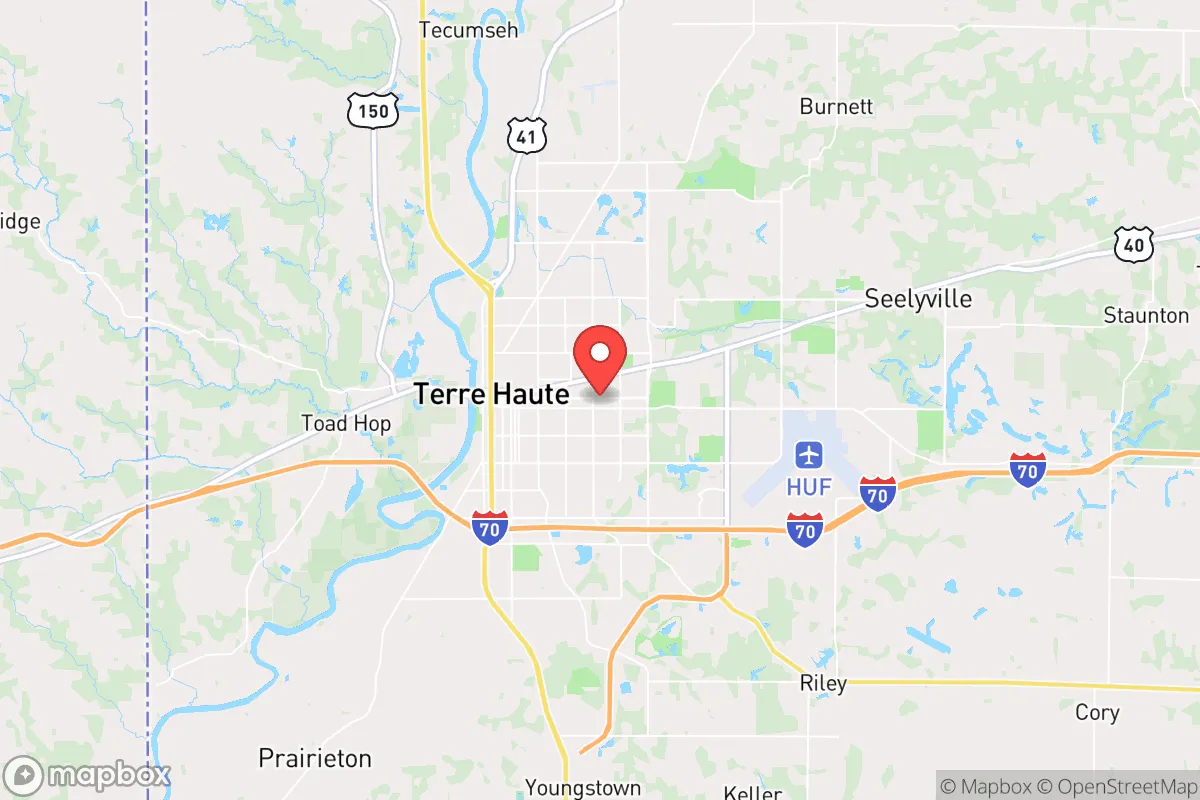
Photo: Wikipedia
Personal Sovereignty in Terre Haute, IN
Viable for self-reliance. Generally workable, though some barriers may limit total independence.
What does Personal Sovereignty tell us?
Personal Sovereignty measures your capacity for self-reliance and independence with minimal government friction. Higher scores mean fewer barriers between you and the way you want to live... but it assumes you have the space you need and good neighbors.
What does this tell us?
Personal Sovereignty measures your capacity for self-reliance and independence with minimal government friction. Higher scores mean fewer barriers between you and the way you want to live... but it assumes you have the space you need and good neighbors.
State Policy
Energy independence: Importer (35% of energy produced in-state)
Personal Liberty
Homesteading

Personal Liberty Analysis
Terre Haute, Indiana, offers a notably high degree of personal sovereignty for those seeking to minimize government overreach, particularly when compared to coastal states or even neighboring Illinois. The city sits in Vigo County, a region where a conservative, live-and-let-live ethos still largely prevails, though it is not without its local bureaucratic friction. For the prepper or survivalist-minded individual, the key question is whether the state’s generally pro-liberty framework translates into real-world autonomy on the ground in Terre Haute. The answer is a qualified yes: you’ll find a low tax burden, permissive gun laws, and a regulatory environment that largely leaves you alone, but you must navigate a few local ordinances and a county-level political landscape that is not uniformly conservative.
Tax burden and regulatory posture: How much of your income and property stays yours
Indiana’s state-level tax structure is a major draw for those prioritizing financial sovereignty. The state imposes a flat income tax rate of 3.15% as of 2026, one of the lowest in the Midwest, and there is no inheritance or estate tax. Property taxes in Vigo County are also relatively low, with an effective rate around 0.9% of assessed value, meaning a $200,000 home would incur roughly $1,800 annually. This is significantly less than the burden in Illinois or California. However, the regulatory posture at the local level is a mixed bag. Terre Haute has a city government that leans slightly more interventionist than the surrounding county, particularly regarding building permits and zoning. For example, the city requires permits for most structural changes, and the process can be slow. But if you buy land in unincorporated Vigo County, you’ll find far fewer hoops to jump through. The state’s right-to-work status and lack of prevailing wage laws on many local projects also mean you can hire contractors or do work yourself without excessive cost or red tape. For the prepper, the key takeaway is that your money goes further here, and the state government is not actively hostile to your financial independence.
Self-defense and gun law specifics: What you can carry, where, and without a permit
Indiana is a constitutional carry state, meaning that as of July 2022, any law-abiding adult 18 or older can carry a handgun openly or concealed without a permit. This is a non-negotiable advantage for personal sovereignty. In Terre Haute, you will not encounter the draconian restrictions found in states like New York or California. There is no state-level red flag law, no magazine capacity limit, and no firearm registration. The city itself has no additional gun control ordinances beyond state law, though private businesses can post signs prohibiting firearms. For the survivalist, this means you can maintain a fully equipped home defense arsenal and carry daily without government permission. The local sheriff’s office in Vigo County is generally pro-Second Amendment, and the county has a strong culture of hunting and sport shooting. There are several gun ranges within a 30-minute drive, including the Wabash Valley Gun Club. The only notable limitation is that Indiana does not have a “stand your ground” law in the purest sense; it has a “castle doctrine” for your home and vehicle, but a duty to retreat applies in public spaces. This is a nuance worth understanding, but overall, Terre Haute offers one of the most permissive self-defense environments in the Midwest.
Self-reliance and homesteading viability: Lot sizes, zoning, and off-grid feasibility
For those looking to reduce dependence on the grid, Terre Haute and its surrounding rural areas present solid opportunities. Within the city limits, standard residential lots are typically 0.15 to 0.25 acres, which is enough for a substantial garden but not for livestock or significant off-grid infrastructure. The city’s zoning code does allow for backyard chickens (hens only, no roosters) and beekeeping with a permit, but it prohibits larger animals like goats or pigs. The real potential lies in the unincorporated areas of Vigo County, where you can find parcels of 1 to 10 acres for $5,000 to $15,000 per acre. These areas have minimal zoning restrictions; you can build a pole barn, install a septic system, and keep livestock without much interference. Off-grid living is legally feasible in the county, as there is no county-wide mandate to connect to municipal water or sewer. You can drill a well, install solar panels, and use a composting toilet without harassment. However, the county does enforce the state’s building code for new structures, so you cannot simply throw up a shack. For the prepper, the sweet spot is buying 5+ acres in the southern part of the county, near the Wabash River, where you can achieve a high degree of self-sufficiency while still being 15 minutes from a grocery store.
Personal liberties: Parental rights, medical autonomy, speech, and property
Indiana has become a battleground for personal liberties, and the outcomes have been largely favorable for conservative-minded individuals. Parental rights are strongly protected by state law; Indiana Code 20-33-8-12 gives parents the explicit right to direct the upbringing, education, and health care of their children. This means you can opt your child out of any curriculum you find objectionable, and the state does not have a universal vaccine mandate for school attendance. Medical autonomy is also robust: Indiana has no state-level mask or vaccine mandates, and the state passed a law in 2023 prohibiting employers from requiring COVID-19 vaccinations as a condition of employment. For the survivalist, this means you can make medical decisions for your family without state interference. Free speech is protected as strongly as anywhere in the country, and Terre Haute has no local ordinances restricting political expression. Property rights are also solid, with Indiana having a strong eminent domain law that requires just compensation and a public purpose. The only notable concern is that Vigo County has a relatively high property tax assessment rate compared to some neighboring counties, but this is offset by the low overall tax burden. In terms of personal sovereignty, Terre Haute offers a legal environment where you can live your life largely as you see fit, without the state dictating your choices.
Overall, Terre Haute ranks as a strong contender for personal sovereignty relative to other Midwestern cities of similar size. It is not a libertarian utopia—you still have to deal with property taxes, building permits in the city, and a county government that is not always efficient. But compared to the overreach seen in states like Illinois, Michigan, or Colorado, Terre Haute offers a refreshing degree of autonomy. The low tax burden, constitutional carry, viable homesteading options, and strong parental rights create a foundation for a self-reliant lifestyle. For the prepper or survivalist who wants to be left alone to prepare, stockpile, and live according to their own values, Terre Haute provides a solid base of operations with minimal government friction. The key is to buy land in the county, not the city, and to understand the local zoning nuances. If you do that, you can achieve a level of personal sovereignty that is increasingly rare in modern America.

* Values derived from national, state, county, city and local statistics and may differ in a specific area. Last updated: 2026-04-22T07:55:25.000Z
Narrative content on this page is AI-generated and may contain mistakes. Verify any details that matter before acting on them.
ReloMaps may earn a commission from affiliate links at no extra cost to you.

