Photo: Wikipedia
Strategic Assessment of Terre Haute, IN
Meaningful friction. Expect exposure to either population pressure, blast zones, or natural disaster risk. Consider buying a retreat property.
What does the Strategic Assessment tell us?
Our Strategic Assessment grades tactical survivability of an area. Major population centers, military targets, fallout zones, natural disasters, and border exposure all drive risk — lower exposure means a more defensible position in a crisis.
This is heavily inspired by Joel Skousen's Strategic Relocation book. Highly recommended you checkout the book ($)What does this tell us?
Our Strategic Assessment grades tactical survivability of an area. Major population centers, military targets, fallout zones, natural disasters, and border exposure all drive risk — lower exposure means a more defensible position in a crisis.
This is heavily inspired by Joel Skousen's Strategic Relocation book. Highly recommended you checkout the book ($)Strategic Pillars

Key Distances
Regional Safe Places
Below is our recommended "safe zones" in Indiana and the surrounding area based on our strategic heuristics. For most people, it's unrealistic to live in a “safe zone” full-time due to work, family or other personal reasons. They tend to be more rural. However, many of these areas are perfect for second homes and retreat properties that double as a vacation home or even a short-term rental.

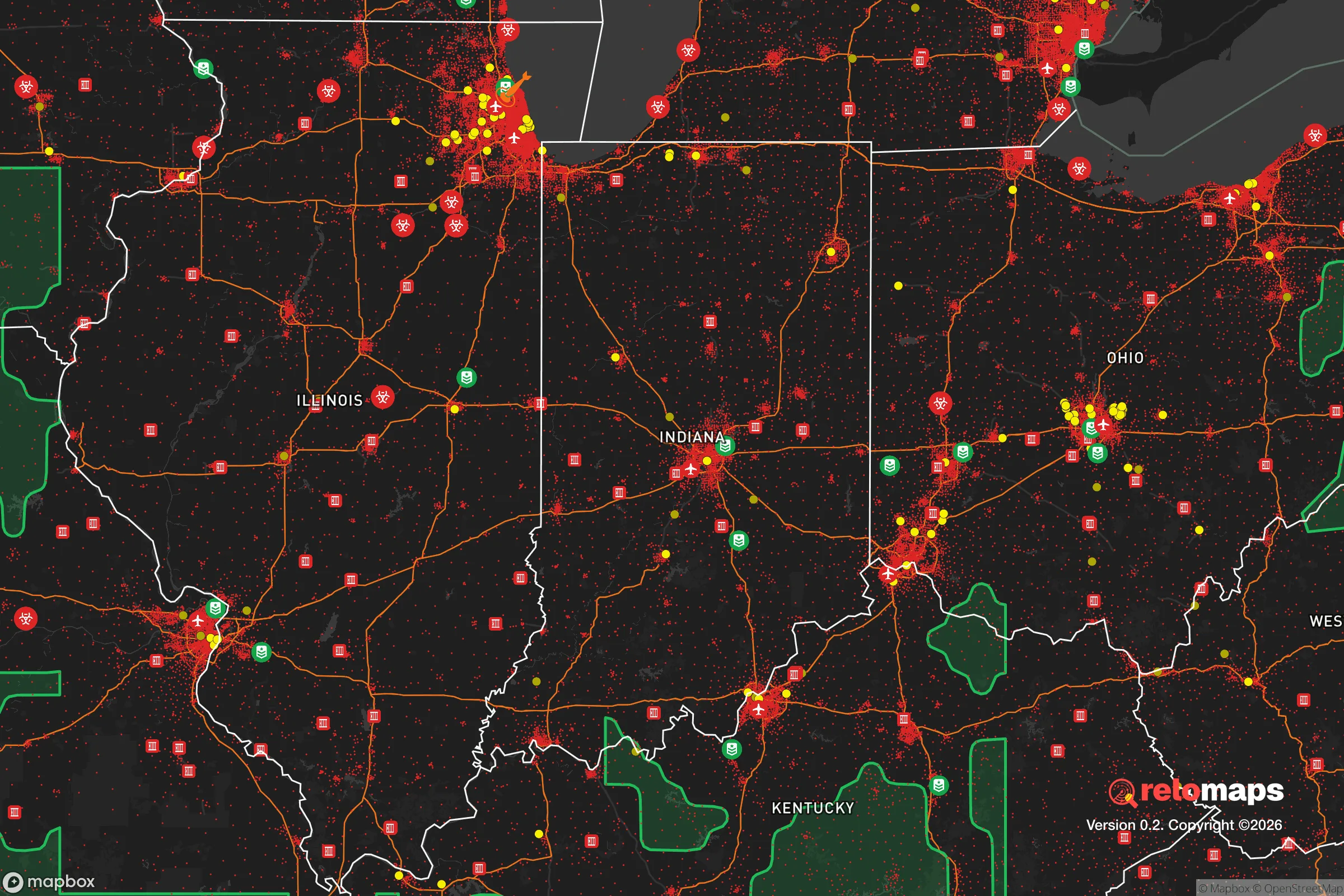


Important Note: For informational purposes only. This does not mean nothing bad ever happens in the green zones. Please use common sense. This is based on public data and modeled with AI. We tried to take a conservative approach but mistakes happen. We update this regularly as new information becomes available.
Solar Generator Recommendations
Backup power matters more here than in safer locations. We've picked three solar generators across budgets and capacity tiers — start with the budget unit if you only need a few essentials, or step up if you want to run a fridge and HVAC for days at a time.

Jackery Portable Power Station Explorer 300
Budget OptionPower on the Go: Weighing only 11 lbs, it's convenient to set up and store with book-sized foldable solar panels

BLUETTI Portable Power Station AC180
Designed for both indoor and outdoor scenarios, AC180 is highly capable as it has a robost capacity and continuous output power.

EF ECOFLOW DELTA Pro Ultra Power Station
Upgraded PickEcoFlow DELTA Pro Ultra is a whole-home energy system designed to grow with your family. Integrated with the Smart Home Panel 2, it scales to meet your evolving energy needs — keeping your home powered, intelligent, and secure through every stage of life.
We earn a commission, at no additional cost to you.
Strategic Assessment Analysis
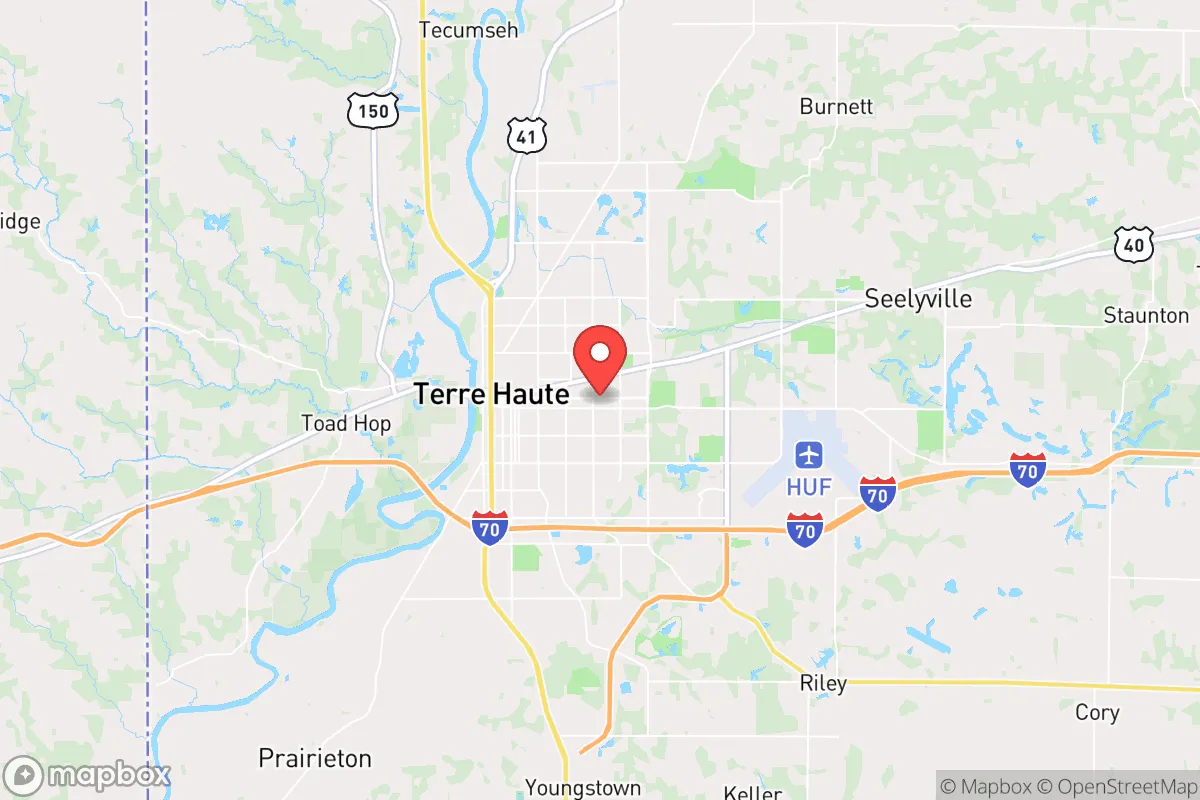
Terre Haute sits in a strategic pocket of the Wabash Valley that offers genuine resilience advantages for those thinking through long-term preparedness. Its location—roughly 70 miles west of Indianapolis and 90 miles north of Evansville—places it far enough from major metropolitan blast zones to avoid immediate fallout dangers, yet close enough to access supply chains and medical infrastructure when conditions are stable. The city’s historical role as a rail and manufacturing hub means the bones of a self-sufficient community are still here, even if the population has shrunk from its peak of 70,000 to around 58,000 today. For a relocator weighing civic unrest, mass casualty events, or natural disasters, Terre Haute offers a mix of geographic insulation and practical assets that many Midwestern towns of similar size lack.
Geographic position and natural advantages for long-term survival
Terre Haute’s natural defenses begin with the Wabash River, which forms its western boundary and provides a reliable water source that isn’t dependent on municipal treatment plants. The surrounding terrain is mostly flat to gently rolling farmland, which means good soil for subsistence agriculture and open sightlines—no dense forests to hide threats, but also no chokepoints that could be easily blocked. The city sits on the eastern edge of the Illinois Basin, a geological formation that contains significant coal reserves, and while coal mining has declined, the presence of underground aquifers and the Wabash River itself means water scarcity is unlikely even during extended grid-down scenarios. The area’s position in USDA hardiness zone 6a allows for a growing season of roughly 170 days, enough for corn, beans, squash, and cold-hardy greens. For a prepper, the key takeaway is that Terre Haute is not a coastal target, not a nuclear power plant neighbor (the nearest major reactor is 50 miles away at Clinton, Illinois), and not a major transportation chokepoint that would attract civil unrest. It’s a secondary city that can function as a staging ground for deeper rural retreats in Sullivan or Vermillion counties to the south and west.
Risks, exposures, and proximity to fallout-relevant landmarks
The most significant risk for Terre Haute is its proximity to the Newport Chemical Depot, located about 25 miles northwest in Vermillion County. This facility once stored VX nerve agent and is now undergoing remediation, but any accident or deliberate attack during a mass casualty event could release hazardous materials into the Wabash Valley airshed. Additionally, the city lies within 100 miles of the Clinton Nuclear Generating Station and the now-shuttered Zion Nuclear Plant in Illinois—both are within the 50-mile ingestion exposure zone for radioactive fallout. Interstate 70 runs directly through Terre Haute, which is a double-edged sword: it provides evacuation routes east to Indianapolis or west to St. Louis, but it also makes the city a potential corridor for fleeing populations during a crisis. The nearby Terre Haute International Airport (HUF) is a joint civil-military facility that hosts the 181st Intelligence Wing of the Indiana Air National Guard, which could make it a target in a conflict scenario. For the survivalist, these risks are manageable if you have a plan to move 30-40 miles southwest into the rural hill country of Sullivan County, where population density drops below 30 people per square mile and the Wabash River widens into more defensible bottomlands.
Practical resilience for a relocator: food, water, energy, and defensibility
Food security in Terre Haute is better than most cities its size because of the surrounding agricultural base. Vigo County has over 1,200 farms producing corn, soybeans, wheat, and livestock, and the city itself hosts a regional farmers’ market that operates from April through October. For long-term storage, the nearby town of Brazil (15 miles east) has a grain elevator network that could be tapped in a collapse scenario, though you’d want to establish relationships with local growers before things get tight. Water is the strongest asset: the Wabash River flows at an average of 10,000 cubic feet per second, and the city’s water treatment plant draws from it directly. A simple Berkey filter or sand filtration system would make river water potable indefinitely. Energy resilience is mixed—Duke Energy provides grid power from a mix of coal and natural gas, but the area has decent solar potential (4.5 peak sun hours per day) and abundant firewood from the hardwood forests in the surrounding state parks like Turkey Run and Shakamak. Defensibility is where Terre Haute falls short for a single relocator: it’s a spread-out city with multiple entry points via I-70, US-41, and SR-46. You’d want to secure a property on the outskirts, preferably in the hilly terrain south of the river near the town of West Terre Haute, where the winding roads and limited bridges create natural chokepoints. The local gun culture is strong—Indiana is a constitutional carry state, and Vigo County has a sheriff’s department that is generally supportive of Second Amendment rights, which matters if you’re preparing for civil unrest.
The overall strategic picture for Terre Haute is that of a solid B-tier relocation option for the conservative prepper. It’s not as isolated as the Ozarks or the Upper Peninsula, but it offers a realistic balance of access to resources and distance from the most likely flashpoints of national instability. The city’s shrinking population means housing is affordable—median home prices hover around $120,000—and the local economy is diversified enough with manufacturing (Pfizer, Duke Energy, and several logistics firms) that you can maintain a low-profile job while building out your retreat. The biggest blind spot is the lack of a strong, organized prepper community; you’ll likely be on your own or building a network from scratch. If you’re willing to trade the extreme isolation of a mountain cabin for the practical advantages of river access, farmland, and a low-cost base of operations, Terre Haute deserves a serious look. Just don’t plan to stay in the city limits when the lights go out—use it as a supply hub and a place to maintain a normal life until the moment you need to bug out to the surrounding countryside.

* Values derived from national, state, county, city and local statistics and may differ in a specific area. Last updated: 2026-04-22T07:55:25.000Z
Narrative content on this page is AI-generated and may contain mistakes. Verify any details that matter before acting on them.
ReloMaps may earn a commission from affiliate links at no extra cost to you.

