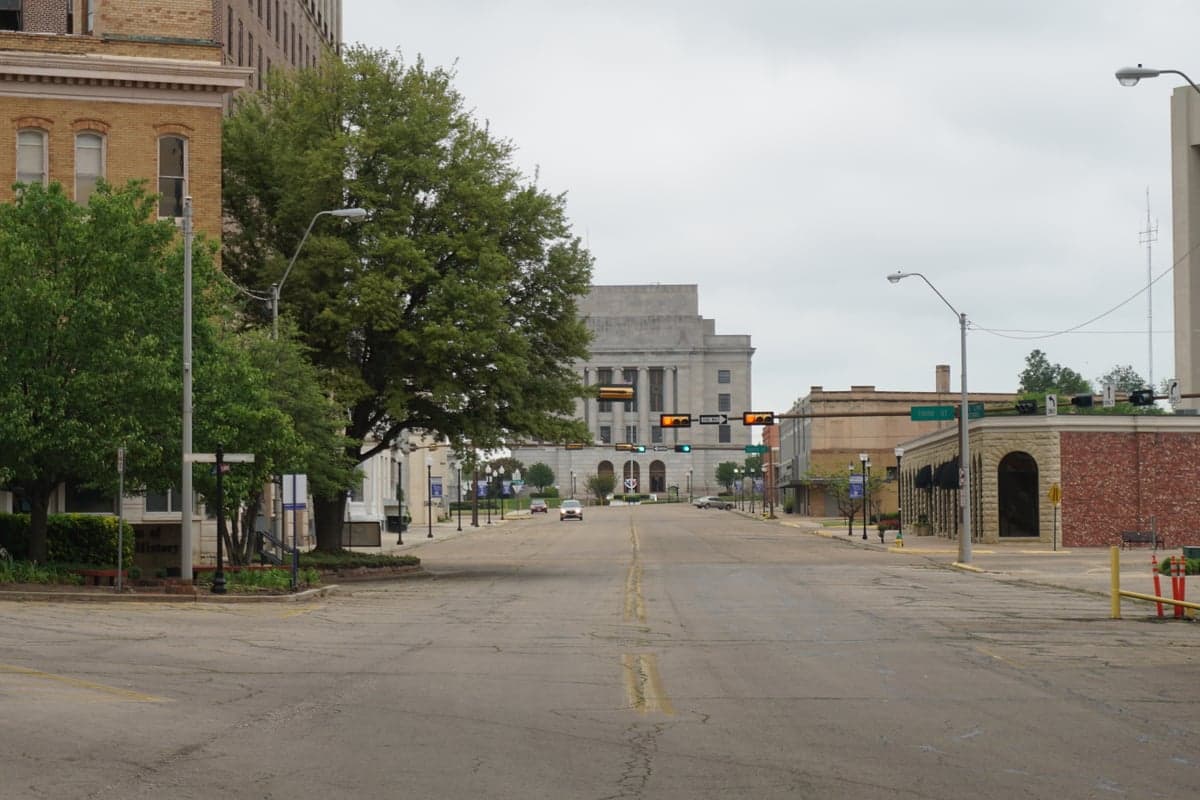
Photo: Wikipedia
Political ClimatePolitical Climate in Texarkana, AR
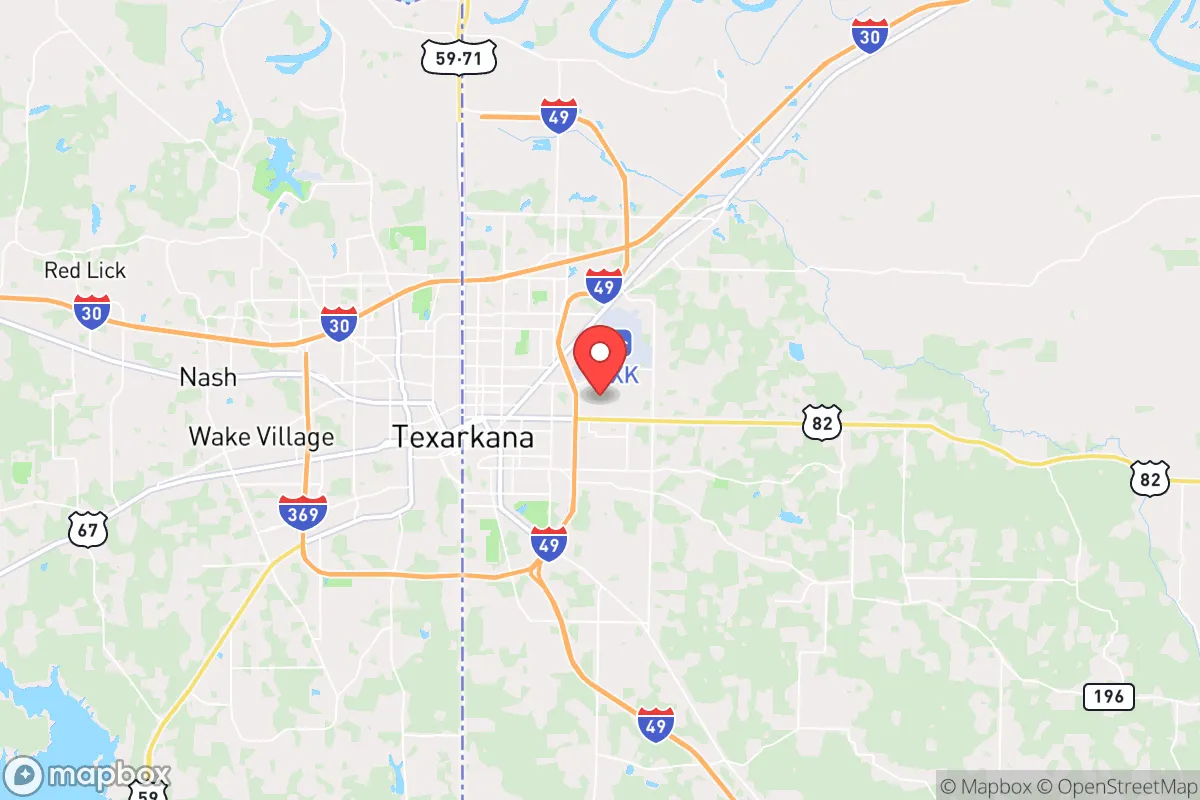
District shown is the primary district for this city’s centroid. Cities may span multiple districts.
Local Political AnalysisPolitical Analysis of Texarkana, AR
Texarkana, Arkansas, has long been a solidly conservative community, and the numbers back that up with a Cook PVI of R+20. That means the area votes about 20 points more Republican than the national average, and it’s not just a recent trend—this has been the political bedrock here for decades. You’ll find that most folks around here lean right on the big issues, especially when it comes to keeping government out of our personal lives and businesses. The local culture still values self-reliance and traditional freedoms, and while you might see a few more progressive voices pop up in nearby cities like Little Rock or even across the state line in Texarkana, Texas, the Arkansas side has held its ground pretty well.
How it compares
When you look at the surrounding area, Texarkana stands out as a conservative anchor compared to some of the more moderate or even liberal-leaning spots in the region. For instance, head north to Fayetteville or Bentonville, and you’ll find a much more progressive vibe, especially among younger transplants and the university crowd. Even Shreveport, Louisiana, just an hour south, has a more mixed political scene with a stronger Democratic base. But here in Texarkana, AR, the political climate feels more like a throwback to a time when personal responsibility and limited government were the norm. The contrast is sharpest when you cross into Texas—while both sides of the state line lean conservative, the Arkansas side tends to be a bit more consistent in its voting patterns, with fewer of the suburban shifts toward the left that you see in places like Dallas or Houston. It’s a place where the old-school values still hold sway, and that’s something a lot of us take pride in.
What this means for residents
For the people living here, the conservative tilt translates into a few key things in daily life. First, you’re less likely to see heavy-handed government overreach in areas like business regulations or property rights—most folks here expect the county and city to stay out of the way. Second, the local schools and community events tend to reflect traditional values, with less pressure to adopt the latest progressive curriculum or social experiments. That said, there’s a growing concern among long-time residents about the slow creep of outside influence, especially as more people move in from bluer states. You can feel it in local elections sometimes, where a candidate might try to push for more government control under the guise of “progress.” The key is staying vigilant, because once those progressive ideas take root—like higher taxes or stricter zoning—they’re hard to roll back. Most of us see this as a place where we can still raise a family without the government breathing down our necks, but it takes active participation to keep it that way.
Culturally, Texarkana has a few distinctions that set it apart from other parts of the state. For one, the city’s unique position straddling two states means you get a blend of Arkansas and Texas influences, but the Arkansas side tends to be a bit more laid-back and less prone to the big-city political drama you see in places like Little Rock. There’s a strong sense of community here, with local churches and civic groups playing a big role in shaping public opinion. Policy-wise, you’ll find that the area leans toward low taxes and a hands-off approach to personal freedoms, like gun rights and property use. The biggest worry among locals is that as the region grows, we might see more pressure to adopt policies that prioritize government control over individual choice—things like mask mandates or business shutdowns that we saw during the pandemic. For now, though, Texarkana remains a place where conservative values are the norm, and most of us plan to keep it that way for the long haul.

State Political ClimatePolitical Climate in Arkansas
State Political AnalysisPolitical Environment in the State
Arkansas has been a reliably red state for decades, with a strong Republican lean that has only deepened since the early 2000s. The state hasn’t voted for a Democratic presidential candidate since Bill Clinton’s 1996 re-election, and the GOP now holds every statewide office, both U.S. Senate seats, and a supermajority in the state legislature. The shift has been dramatic: as recently as 2008, Democrats still controlled the state House and Senate, but a combination of cultural realignment and population movement has turned Arkansas into one of the most conservative states in the country, with a 2024 presidential margin of roughly +30 points for the Republican ticket.
Urban vs. rural divide
The political map of Arkansas is a textbook case of the urban-rural split. The state’s two major population centers—Little Rock and its suburbs in Pulaski County, and the Fayetteville-Springdale-Rogers corridor in Northwest Arkansas—are the only real blue or purple areas. Pulaski County has trended Democratic in recent cycles, driven by the capital city’s more diverse and professional-class population, while Washington and Benton counties in the northwest have become a fascinating mix: traditionally Republican but now seeing a growing moderate-to-liberal influence from the University of Arkansas and corporate transplants from Walmart, Tyson Foods, and JB Hunt. Outside these two metro areas, the state is deeply red. Counties like Baxter (Mountain Home), Faulkner (Conway), and Craighead (Jonesboro) are solidly Republican, while the Arkansas Delta—places like Lee, Phillips, and St. Francis counties—remains the last Democratic stronghold, though with shrinking populations. The rural-to-urban migration pattern is accelerating, meaning the red rural areas are getting redder and the blue urban islands are getting bluer, but the sheer landmass and population of the rural areas keep the state firmly conservative.
Policy environment
Arkansas’s policy environment is aggressively pro-business and culturally conservative. The state has a flat income tax rate of 4.4% as of 2025, down from 6.9% a decade ago, with a goal of reaching 3.9% by 2027. There is no state property tax, though local property taxes average around 0.6% of assessed value. The regulatory climate is light-touch, particularly for manufacturing and agriculture, which remain the backbone of the economy. On education, the state passed the LEARNS Act in 2023, a sweeping school choice law that created universal Education Freedom Accounts, allowing parents to use state funds for private school, homeschooling, or tutoring—a major win for parental rights. Healthcare is a mixed bag: Arkansas expanded Medicaid under the private option model, but the state has also imposed work requirements for able-bodied adults. Election laws have tightened: voter ID is required, and the state passed Act 249 in 2021, which shortened the absentee ballot request window and banned ballot harvesting. Abortion is effectively banned except to save the mother’s life, following the 2022 trigger law. Gun laws are among the most permissive in the country, with constitutional carry (no permit needed) and no red flag law.
Trajectory & freedom
On the whole, Arkansas is moving toward more personal freedom in several key areas, which is a positive sign for conservative newcomers. The LEARNS Act is the biggest expansion of educational freedom in the state’s history, and it’s already driving competition among schools. In 2023, the state also passed the Arkansas Medical Ethics Act, which prohibits gender transition procedures for minors—a clear stand for parental rights and medical caution. On gun rights, the 2021 constitutional carry law removed the last permit requirement, and there’s no sign of backtracking. However, there are concerns about government overreach in other areas: the state’s Medicaid expansion, while pragmatic, has kept the government deeply involved in healthcare markets, and some conservatives worry it creates a dependency trap. Additionally, the state’s Arkansas Data Privacy Act (2023) gives residents some control over how companies use their data, but it’s weaker than laws in California or Virginia. The biggest freedom concern is property rights: the state has a history of using eminent domain for economic development, particularly in the Delta, though recent reforms have tightened the rules. Overall, the trajectory is toward more liberty in education, medical choice, and self-defense, but with a pragmatic, not libertarian, approach to healthcare and taxation.
Civil unrest & political movements
Arkansas has not seen the kind of large-scale civil unrest that has hit larger states, but there have been notable flashpoints. In 2020, protests in Little Rock over George Floyd’s death turned into some property damage and looting, but they were relatively small compared to Portland or Seattle. The state’s political activism is more organized around grassroots conservative movements. The Arkansas Family Council and Concerned Women for America have been highly effective in pushing parental rights and anti-abortion legislation. On the left, the Indivisible Arkansas network has been active in organizing against school choice and for Medicaid expansion, but their influence is limited to the Little Rock and Fayetteville areas. Immigration politics are less heated than in border states, but the 2023 Arkansas Sovereignty Act prohibits state and local governments from adopting sanctuary policies, and there have been local controversies in Springdale and Rogers over immigration enforcement. Election integrity remains a hot topic: the 2020 and 2022 cycles saw no major scandals, but conservative activists continue to push for hand-counting of ballots and paper-only voting, a debate that has been particularly loud in rural counties like Cleburne and Stone. A new resident would notice that political signs and bumper stickers are common, but the tone is generally civil—Arkansans tend to avoid the kind of aggressive confrontation seen in more polarized states.
Projection
Over the next 5-10 years, Arkansas is likely to become even more conservative, but with a growing tension between the traditional rural base and the increasingly moderate-to-liberal Northwest Arkansas corridor. The biggest demographic shift is the influx of corporate transplants to Benton and Washington counties, drawn by jobs at Walmart, Tyson, and the expanding tech sector. These newcomers tend to be more educated and less culturally conservative, which could slowly shift the political balance in the northwest. However, the rest of the state is aging and shrinking, meaning the rural conservative vote will become proportionally more powerful. The state’s Republican supermajority is unlikely to be threatened, but internal GOP fights over school choice funding, tax cuts, and Medicaid could intensify. Expect further tax cuts, continued expansion of school choice, and possibly a push for a state constitutional amendment to require a supermajority for tax increases. The biggest wildcard is whether the state will embrace medical marijuana expansion (already legal but tightly regulated) or move toward full legalization—a debate that splits the conservative coalition. For a new resident, the bottom line is that Arkansas will remain a safe haven for conservative values, with a government that is responsive to those priorities, but the cultural and economic pull of Northwest Arkansas will create an increasingly distinct political subregion within the state.
For someone moving to Arkansas, the practical takeaway is clear: you’ll find a state that respects your right to live your life as you see fit, with low taxes, strong gun rights, and a government that prioritizes parental control over education. The political climate is stable and predictable, with no risk of a sudden leftward shift. The main thing to watch is the growing divide between the northwest and the rest of the state—if you’re moving to Fayetteville or Bentonville, you’ll encounter a more diverse and politically mixed environment than if you settle in Jonesboro, Hot Springs, or Texarkana. Either way, Arkansas offers a level of personal freedom that is increasingly rare in the United States, and the trajectory suggests it will only get better for those who value limited government and traditional values.
* Values derived from national, state, county, city and local statistics and may differ in a specific area. Last updated: 2026-04-23T03:18:26.000Z
Narrative content on this page is AI-generated and may contain mistakes. Verify any details that matter before acting on them.
ReloMaps may earn a commission from affiliate links at no extra cost to you.

