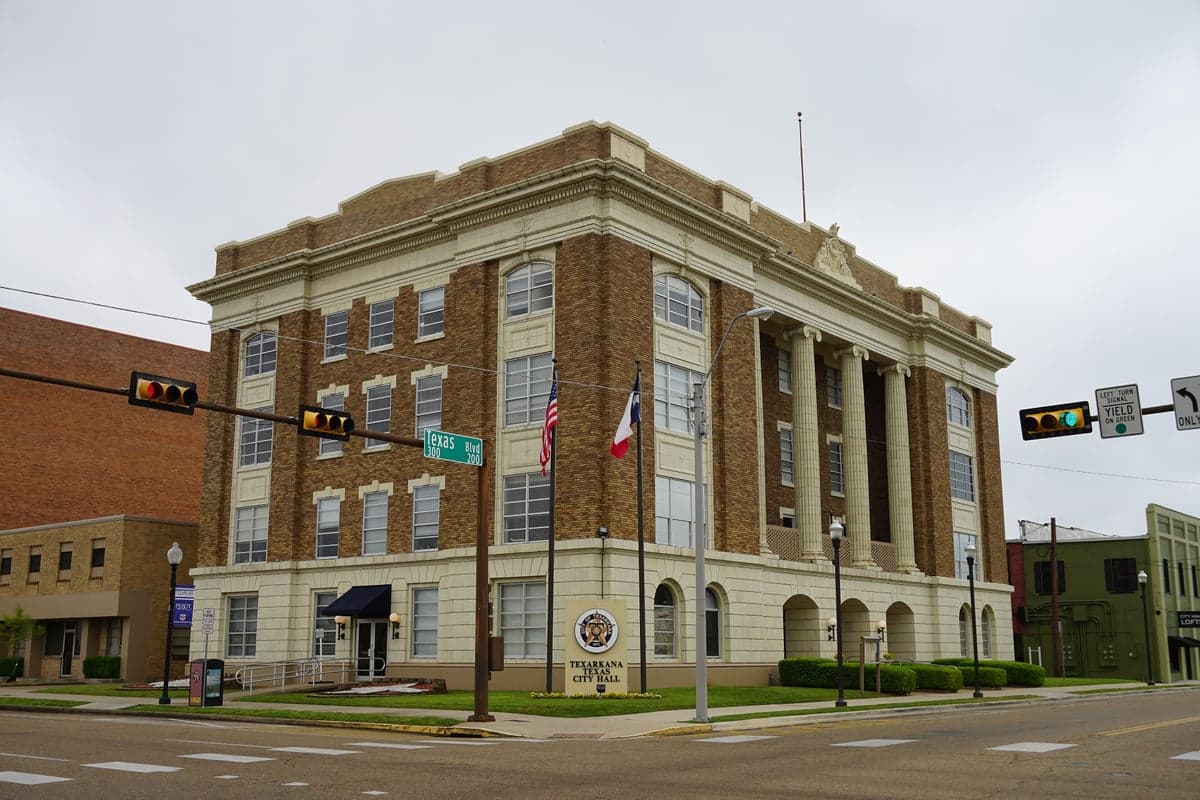
Photo: Wikipedia
Demographics of Texarkana, TX
Affluence Level in Texarkana, TX
A below-average socioeconomic profile. Incomes, home values, and educational attainment trail the U.S., with higher poverty and unemployment.
People of Texarkana, TX
The people of Texarkana, TX today number 36,039, forming a biracial city where White residents (44.9%) and Black residents (38.8%) together account for over 83% of the population, with a growing Hispanic minority (10.0%) and small East/Southeast Asian (1.6%) and Indian subcontinent (0.5%) communities. The city’s character is distinctly Southern and working-class, shaped by its railroad origins and border-economy identity, with a college attainment rate of 24.3% and a foreign-born share of just 3.8%. Texarkana’s population is older and more rooted than the national average, with few newcomers from outside the region. This is a place where family ties and neighborhood reputations matter deeply, and where demographic change has been slow but steady.
How the city was settled and grew
Texarkana was founded in 1873 as a railroad town at the junction of the Texas and Pacific and the St. Louis, Southwestern, and Cotton Belt lines. The original population was overwhelmingly White, drawn by jobs in rail yards, timber, and cotton processing. The first Black residents arrived during Reconstruction, many as freedmen seeking work on the railroads and in the sawmills. They settled in what became known as North Texarkana, a historically Black neighborhood north of the tracks that remains the city’s primary African American enclave today. By 1900, the city had roughly 5,000 residents, split roughly 70% White and 30% Black, with a small number of Mexican laborers working on the rail lines. The early 20th century brought a second wave of White migration from rural East Texas and Arkansas, drawn by the expanding retail and manufacturing base. These families settled in South Texarkana, a predominantly White neighborhood that grew around the downtown commercial core and the new high school. The city’s population peaked at 36,000 in the 1960 census, with the White share around 60% and Black share around 38%, a ratio that has remained remarkably stable for six decades.
Modern era (post-1965)
After the 1965 Hart-Cellar Act, Texarkana saw virtually no new immigration from Asia or Latin America for two decades. The foreign-born share remained below 2% until the 1990s. Instead, the post-1965 story is one of domestic migration: White families began moving to newer subdivisions in Pleasant Grove, a neighborhood in the southwestern part of the city that grew rapidly after 1980. Pleasant Grove is now the most affluent and most White area of Texarkana, with a population that is over 80% White and a median household income roughly 40% above the city average. Meanwhile, Black families expanded into East Texarkana, a historically mixed area that became predominantly Black by the 1990s. The Hispanic population, which was negligible in 1980, grew to 10.0% by 2020, driven largely by Mexican and Central American families moving into West Texarkana, a lower-cost area near the interstate. The East/Southeast Asian community (1.6%) is small but visible, concentrated in the Pleasant Grove area and centered on a few Vietnamese-owned nail salons and restaurants. The Indian subcontinent population (0.5%) is even smaller, mostly professionals in healthcare and engineering who live scattered across the city rather than in a single enclave.
The future
Texarkana’s population is projected to remain flat or grow slowly over the next decade, with the city’s total likely staying between 35,000 and 38,000. The White share is declining gradually, from 60% in 1970 to 44.9% today, as older White residents die and younger ones move to Dallas or Little Rock for jobs. The Black share has held steady at roughly 38-40% since 1960, suggesting a stable community with strong institutional roots. The Hispanic share is the fastest-growing segment, projected to reach 14-16% by 2035, driven by natural increase and continued migration from Texas’s Rio Grande Valley and Mexico. The East/Southeast Asian and Indian communities are likely to remain small, as Texarkana lacks the professional job base that attracts larger Asian populations to Houston or Dallas. The city is not tribalizing into hostile enclaves, but it is spatially sorting by race and class: Pleasant Grove grows whiter and wealthier, North Texarkana remains predominantly Black and lower-income, and West Texarkana becomes the Hispanic gateway. The foreign-born share, currently 3.8%, may rise to 6-7% by 2035, still well below the national average.
For someone moving to Texarkana today, the city offers a stable, slow-changing community where race and neighborhood are still closely linked. The city is becoming slightly more diverse, but the dominant story is continuity: a biracial Southern town with a small but growing Hispanic minority, where most residents were born within 100 miles and intend to stay. The practical implication for a newcomer is that neighborhood choice matters—Pleasant Grove offers the most amenities and the most homogeneous population, while North Texarkana offers lower housing costs and deep community ties. Texarkana is not a melting pot; it is a mosaic of distinct, historically rooted neighborhoods that are changing only at the margins.

* Values derived from national, state, county, city and local statistics and may differ in a specific area. Last updated: 2026-04-29T02:34:15.000Z
Narrative content on this page is AI-generated and may contain mistakes. Verify any details that matter before acting on them.
ReloMaps may earn a commission from affiliate links at no extra cost to you.

