Photo: Wikipedia
Demographics of Hill County
Affluence Level in Hill County
A middle-class area roughly in line with national averages across income, home values, education, and employment.
People of Hill County
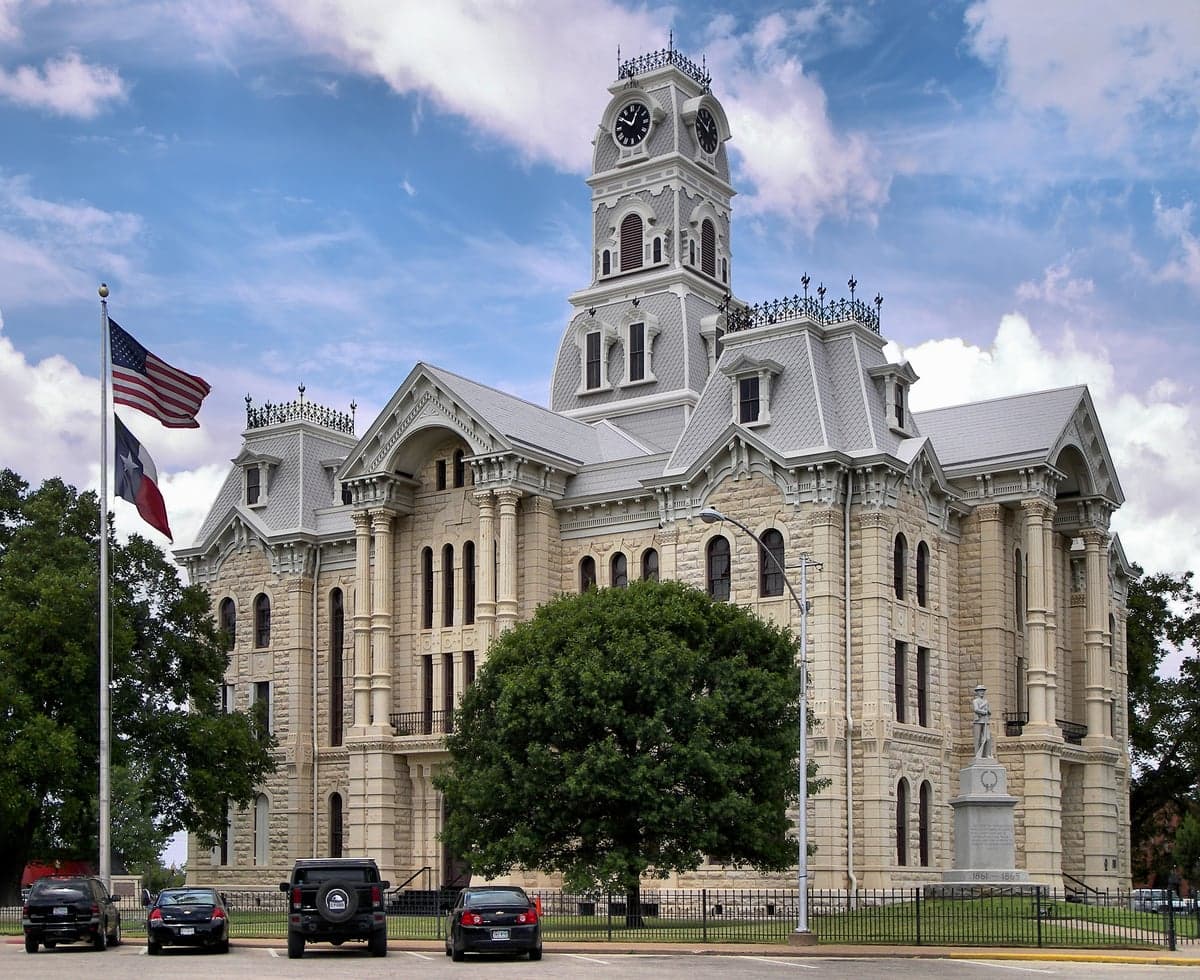
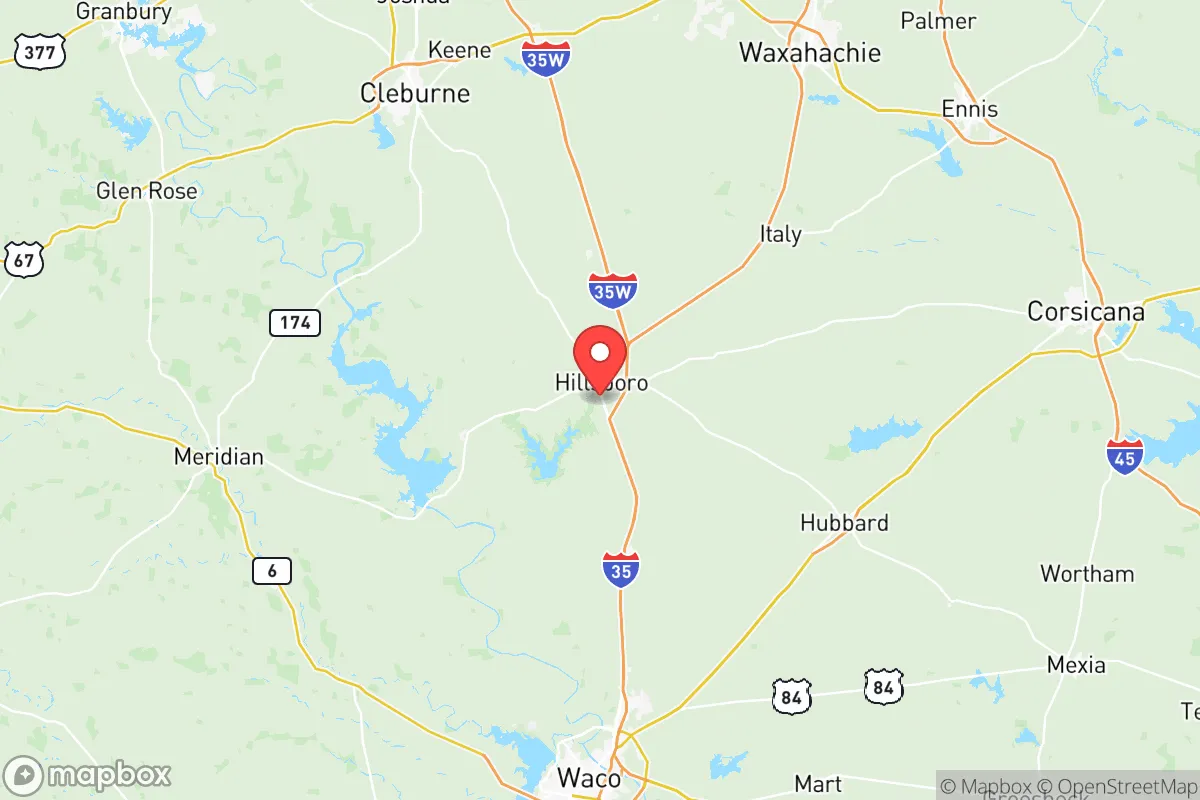
Hill County, Texas, today is a predominantly rural, politically conservative community of 36,664 residents, characterized by a population that is 68.2% White and 22.6% Hispanic, with a notably low foreign-born share of just 3.8%. The county’s identity is rooted in its agricultural heritage and small-town values, with a population density of roughly 30 people per square mile, centered around the county seat of Hillsboro and the smaller communities of Whitney, Itasca, and Hubbard. Distinctive markers include a strong sense of local independence, a reliance on agriculture and manufacturing, and a demographic profile that has remained remarkably stable compared to the rapid diversification seen in Texas’s major metropolitan areas.
Settlement & growth (pre-1960)
Before American settlement, the area now known as Hill County was part of the traditional territory of the Wichita and Tonkawa peoples, who utilized the region’s prairies and river bottoms for hunting and seasonal camps. Spanish and Mexican land grants in the early 19th century brought a sparse ranching presence, but the area saw no permanent European settlement until after Texas independence. The first major wave of American settlers arrived in the 1840s and 1850s, primarily Anglo-American families from the Upper South—Tennessee, Kentucky, and Missouri—drawn by cheap, fertile land along the Brazos River and its tributaries. These settlers established the earliest communities, including Hillsboro (founded 1853) and Itasca (founded 1854), and built an economy based on cotton and corn farming.
The post-Civil War era brought a second wave: freed slaves who remained in the county as sharecroppers and tenant farmers, forming small rural settlements such as the Bynum area and parts of Whitney. By 1880, African Americans made up roughly 25% of the county’s population, a share that would decline steadily over the next century. The arrival of the Missouri-Kansas-Texas Railroad (the Katy) in the 1870s spurred the founding of Hubbard (1881) and Mount Calm (1882), attracting merchants and tradesmen. A smaller but notable group of German and Czech immigrants arrived in the 1880s and 1890s, settling primarily around West and Penelope, where they introduced diversified farming and dairying. The Dust Bowl and Great Depression of the 1930s drove a modest influx of displaced farmers from Oklahoma and the Texas Panhandle, but Hill County’s population peaked early—at 43,211 in 1900—and then began a long decline as mechanized agriculture reduced the need for farm labor and younger generations left for urban jobs.
Modern era (post-1965)
The 1965 Hart-Cellar Act had a minimal direct impact on Hill County, as the area’s economy and culture did not attract the large-scale immigration seen in Houston or Dallas. Instead, the county’s modern demographic story is one of slow, steady Hispanic growth driven by domestic migration from South Texas and Mexico, as well as natural increase. Between 1970 and 2020, the Hispanic share of the population rose from under 5% to 22.6%, with concentrations in Hillsboro and Whitney, where many work in agriculture, construction, and the local poultry processing industry. The Black population, by contrast, has declined to 5.7%, as younger African Americans moved to larger cities for broader economic opportunities. The East/Southeast Asian population (0.3%) and Indian subcontinent population (0.2%) remain negligible, reflecting the county’s limited professional job market and lack of ethnic enclaves. Domestic migration since 2000 has been modest, with some retirees and second-home buyers drawn to Lake Whitney and the surrounding Hill Country scenery, but the county has not experienced the explosive suburban growth seen in neighboring Johnson or Ellis counties. Suburbanization has been limited to a few subdivisions near Hillsboro and along Interstate 35, but the county remains overwhelmingly rural and small-town in character.
The future
The population of Hill County is projected to grow slowly, reaching roughly 40,000 by 2040, driven primarily by natural increase among the Hispanic population and modest in-migration of retirees and commuters seeking lower housing costs. The county is not tribalizing into distinct ethnic enclaves; rather, the Hispanic population is dispersing across existing communities, particularly in Hillsboro and Whitney, while the White population remains the majority in all precincts. The foreign-born share (3.8%) is likely to rise slightly but will remain far below the Texas average, as the county lacks the job diversity and infrastructure to attract significant international immigration. The cultural identity of Hill County is being slowly reshaped by Hispanic growth, with bilingual signage and Mexican restaurants becoming more common, but the dominant political and social character remains conservative and Anglo-Texan. For a new resident moving in, the county offers a stable, low-density environment where demographic change is gradual and assimilation into the existing culture is the norm, rather than the formation of distinct parallel communities.
Hill County is becoming a slightly more diverse, slowly aging rural community where the traditional agricultural and small-town identity persists, but is being gently inflected by Hispanic growth and a trickle of lakefront retirees. For someone moving in now, it offers a predictable, low-cost, and culturally conservative environment with minimal demographic disruption—a place where change comes slowly and the sense of community remains rooted in the county’s 19th-century founding families and their descendants.

* Values derived from national, state, county, city and local statistics and may differ in a specific area. Last updated: 2026-05-22T00:18:25.000Z
Narrative content on this page is AI-generated and may contain mistakes. Verify any details that matter before acting on them.
ReloMaps may earn a commission from affiliate links at no extra cost to you.

