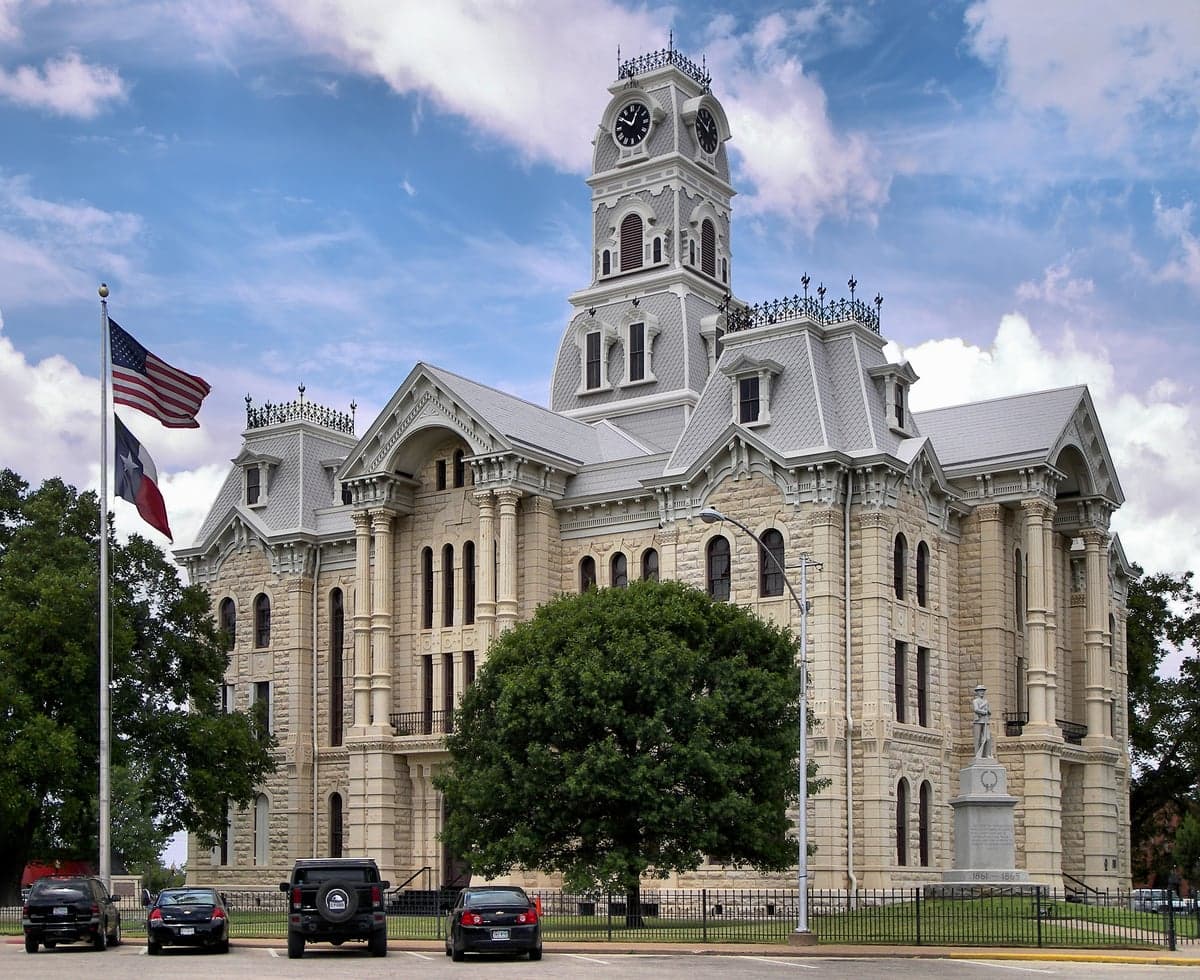
Photo: Wikipedia
Personal Sovereignty in Hill County
Strong independent fundamentals that actively favor personal liberty and low regulation.
What does Personal Sovereignty tell us?
Personal Sovereignty measures your capacity for self-reliance and independence with minimal government friction. Higher scores mean fewer barriers between you and the way you want to live... but it assumes you have the space you need and good neighbors.
What does this tell us?
Personal Sovereignty measures your capacity for self-reliance and independence with minimal government friction. Higher scores mean fewer barriers between you and the way you want to live... but it assumes you have the space you need and good neighbors.
State Policy
Energy independence: Net exporter (220% of energy produced in-state)
Personal Liberty
Homesteading

Personal Liberty Analysis
Hill County, Texas, offers a notably high degree of personal sovereignty relative to most of the United States, particularly when compared to the regulatory-heavy environments of the West Coast, Northeast, or even nearby Travis County. The area’s ethos is rooted in a deep-seated tradition of self-reliance, with local governance generally taking a hands-off approach to individual choices regarding property, defense, and lifestyle. For those seeking to minimize government overreach into daily life—whether through taxation, land use restrictions, or mandates—Hill County presents a compelling option, though specific towns within the county vary in their practical application of these principles.
Tax burden and regulatory posture: How Hill County compares to surrounding areas
Hill County’s tax burden is moderate by Texas standards, but its regulatory posture is decidedly light. The county’s property tax rate hovers around 0.65% to 0.75% of assessed value, depending on the specific city and school district—significantly lower than the 1.5% to 2.0% seen in Austin or Dallas. There is no county-level income tax, and sales tax rates range from 6.75% in unincorporated areas to 8.25% in cities like Hillsboro and Whitney. The real advantage lies in the absence of many state-level overreach policies: no state income tax, no vehicle emissions testing in most of the county (unlike Harris or Bexar counties), and minimal business licensing requirements. Zoning is largely permissive outside city limits—Itasca and Blum have no formal zoning ordinances, allowing property owners to use land for agriculture, workshops, or even small-scale manufacturing without bureaucratic hurdles. This contrasts sharply with Hillsboro, which enforces basic subdivision regulations but still lacks the comprehensive planning codes found in metro areas. For a prepper or survivalist, the key takeaway is that Hill County’s regulatory environment respects property rights and does not actively discourage self-sufficient living.
Self-defense and gun law specifics: What you can carry and where
Texas is a constitutional carry state, and Hill County fully embraces that framework. As of 2026, any law-abiding adult 21 or older can carry a handgun openly or concealed without a permit—no license, no training requirement, no government permission slip. The county sheriff’s office in Hillsboro is known for a pro-Second Amendment stance, with no local ordinances restricting magazine capacity, firearm types, or storage requirements. Stand-your-ground laws apply statewide, meaning there is no duty to retreat before using deadly force in self-defense, whether in your home, vehicle, or any place you have a legal right to be. Castle doctrine protections are robust, covering not just your dwelling but also your vehicle and workplace. The only practical restrictions are federal: felons, domestic violence misdemeanants, and those under certain protective orders cannot possess firearms. For those living in Whitney or Lake Whitney, the rural nature means you can shoot on your own property (subject to noise ordinances in some subdivisions), and there are no county-level waiting periods or background check expansions beyond federal law. This is a stark contrast to states like California or New York, where magazine limits and licensing schemes create de facto bans for many.
Self-reliance and homesteading viability: Lot sizes, zoning, and off-grid feasibility
Hill County is one of the more viable areas in Texas for off-grid living and homesteading, but the specifics depend heavily on which town you choose. Unincorporated areas—especially around Blum and Itasca—have no county-wide zoning, meaning you can build a cabin, install solar panels, dig a well, and set up a septic system without needing a parade of permits. Minimum lot sizes in these areas are typically 1 to 5 acres, though many parcels of 10 to 40 acres are available for under $5,000 per acre. Lake Whitney and Whitney have slightly more restrictions due to lakefront development rules, but still allow rainwater collection, composting toilets, and livestock (chickens, goats, cattle) on parcels of 2 acres or more. Hillsboro is the most restrictive, with a city limit that enforces building codes and requires permits for major construction, but even there, you can keep backyard chickens and grow a substantial garden. The county does not enforce statewide energy code mandates aggressively, and there are no bans on propane tanks, wood stoves, or generators. For those serious about self-reliance, the area’s water rights are favorable: landowners can drill a well for domestic use without a permit (though a water well report is required), and rainwater harvesting is encouraged with no taxation on collected water. The main limitation is that some subdivisions near Whitney have HOA covenants that restrict off-grid systems—so always check deed restrictions before buying.
Personal liberties: Parental rights, medical autonomy, speech, and property
Hill County’s culture strongly supports parental rights and medical autonomy, reflecting broader Texas trends but with a more localized intensity. Parents have the legal right to opt their children out of any school curriculum or activity they find objectionable, including sex education, vaccine mandates, and certain library materials—a right codified in state law and enforced by the Hillsboro ISD and Whitney ISD school boards, which are conservative-leaning. Medical freedom is similarly robust: there are no county-level vaccine mandates for adults, no restrictions on ivermectin or hydroxychloroquine prescriptions, and no bans on alternative or holistic medicine. The county’s health department does not enforce mask mandates or business closures, even during public health emergencies, as local officials have publicly stated they will not infringe on individual choice. Free speech is protected under the First Amendment, and Hill County has no hate speech ordinances or social media censorship laws beyond federal platforms. Property rights are the crown jewel: Texas’s private property rights laws mean that no government entity can take land for economic development (e.g., for a private business) under eminent domain, and the county does not engage in aggressive code enforcement for things like tall grass, parked vehicles, or unpermitted structures—unless they pose a clear safety hazard. This stands in stark contrast to areas like Austin or Dallas, where code enforcement can fine homeowners for minor infractions.
Overall, Hill County ranks among the top 10% of U.S. counties for personal sovereignty, particularly for those prioritizing self-defense, property rights, and minimal government interference. The combination of constitutional carry, permissive zoning, low taxes, and strong parental rights creates an environment where individuals can live largely as they see fit, without the creeping overreach seen in blue states or even in Texas’s own urban centers. For a prepper or survivalist, the area’s main weakness is its proximity to the I-35 corridor, which could bring future development pressure, but for now, towns like Blum, Itasca, and Whitney offer a rare blend of affordability and freedom that is increasingly hard to find in the United States.

* Values derived from national, state, county, city and local statistics and may differ in a specific area. Last updated: 2026-05-22T00:18:25.000Z
Narrative content on this page is AI-generated and may contain mistakes. Verify any details that matter before acting on them.
ReloMaps may earn a commission from affiliate links at no extra cost to you.

