
Photo: Wikipedia
Demographics of Lamar County
Affluence Level in Lamar County
A middle-class area roughly in line with national averages across income, home values, education, and employment.
People of Lamar County
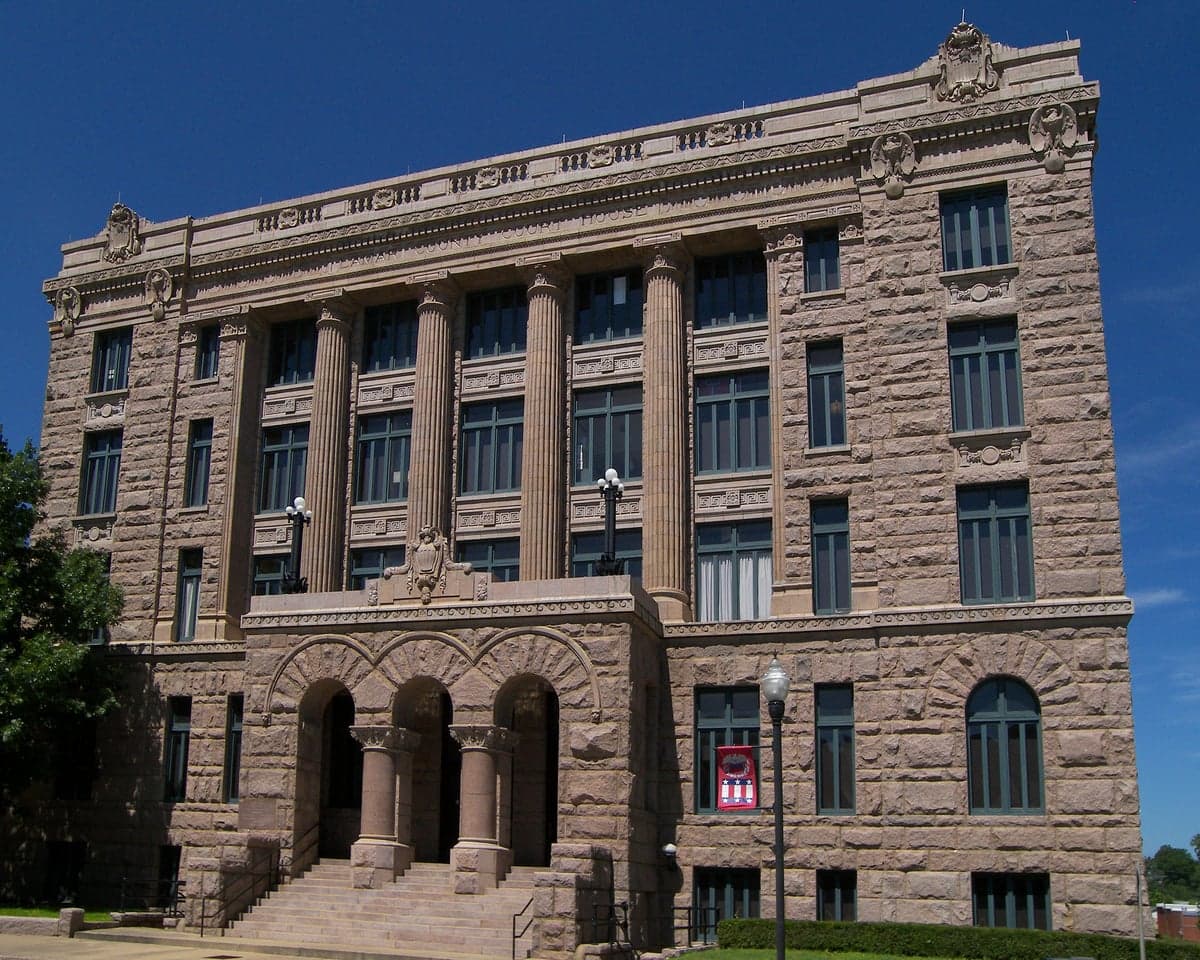
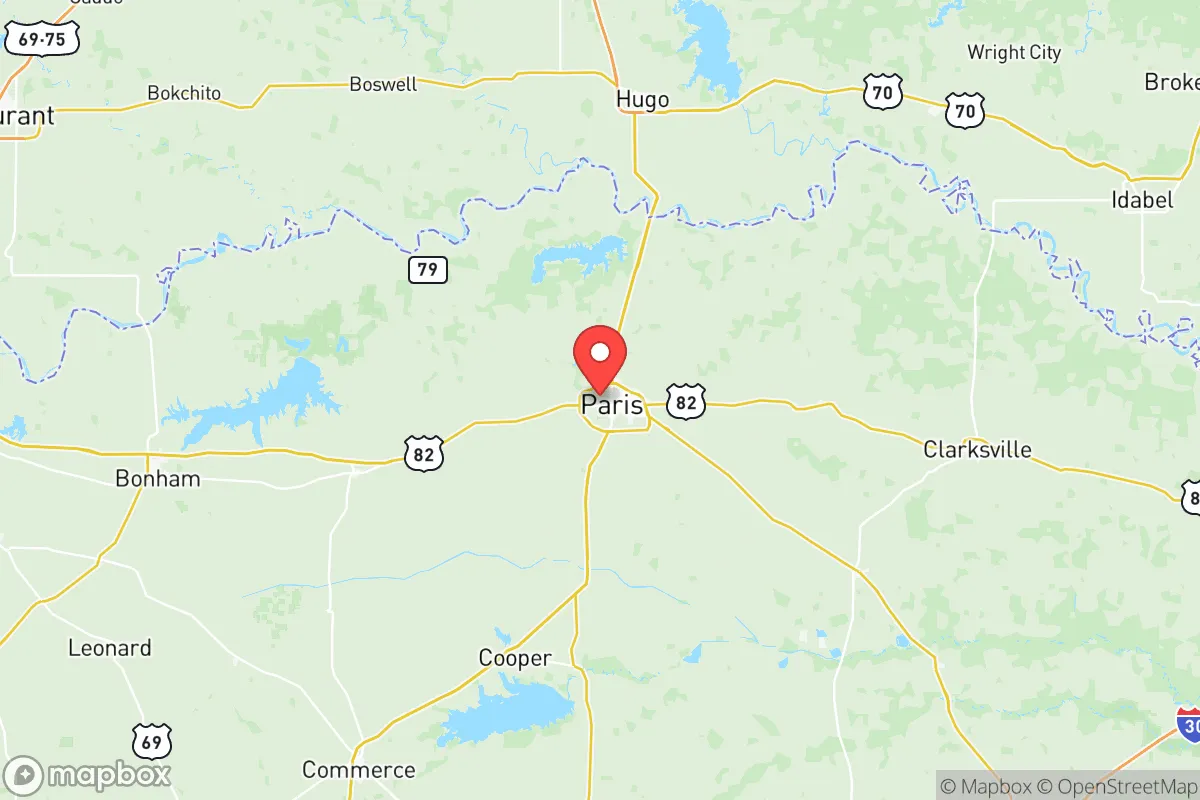
Today, Lamar County, Texas, is home to roughly 50,400 residents, a population that is predominantly white (71.8%) with a significant Black minority (12.4%) and a growing Hispanic community (9.2%). The county’s character is rooted in its rural and small-town identity, anchored by the county seat of Paris, Texas, and shaped by a history of agricultural settlement, industrial booms, and steady domestic migration. With a foreign-born population of just 2.0% and a college attainment rate of 20.6%, Lamar County remains a culturally homogenous, working-class region where family ties and local traditions run deep.
Settlement & growth (pre-1960)
Long before European settlers arrived, the area that is now Lamar County was inhabited by Caddo Native American tribes, particularly the Kadohadacho confederacy, who lived in settled villages along the Red River and its tributaries. These groups were largely displaced by the 1830s through treaties and forced removal, opening the land for Anglo-American colonization. The region was part of the Red River Valley, a fertile area that attracted settlers from the Upper South—primarily Tennessee, Kentucky, and Arkansas—who arrived in the 1830s and 1840s seeking cotton-growing land.
Lamar County was officially created in 1840 from Red River County, and the town of Paris was established as the county seat in 1844. The earliest settlers were predominantly of Scots-Irish and English descent, drawn by the promise of cheap, fertile land under the Republic of Texas’s land grant system. These families established small farms and plantations, and by the 1850s, cotton became the economic backbone, with enslaved African Americans making up a substantial portion of the population. By 1860, enslaved people accounted for roughly 30% of the county’s residents, concentrated on plantations near Paris and along the Sulphur River.
After the Civil War and emancipation, many freed African Americans remained in the county, forming rural communities like Blossom and Roxton, where they worked as sharecroppers and tenant farmers. The post-Reconstruction era saw the arrival of a small number of German and Czech immigrants, who settled in areas like Deport and Reno, though they never formed large ethnic enclaves. The county’s population grew steadily through the early 20th century, reaching 48,000 by 1920, driven by cotton agriculture and the expansion of railroads that connected Paris to regional markets.
The Great Depression and Dust Bowl of the 1930s hit Lamar County hard, causing many farm families—both white and Black—to leave for California and other parts of the West. However, the county’s population stabilized during World War II, when the Camp Maxey training facility (near Paris) brought thousands of soldiers and support workers to the area. After the war, the decline of small-scale cotton farming accelerated, and many rural residents moved into Paris or left the county entirely. By 1960, the population had fallen to 44,000, as mechanization reduced the need for farm labor and younger generations sought opportunities in Dallas and other urban centers.
Modern era (post-1965)
The 1965 Hart-Cellar Act had minimal direct impact on Lamar County, as the region attracted very few international immigrants compared to Texas’s major metropolitan areas. The foreign-born population remains low at 2.0%, and the county’s demographic shifts since the 1960s have been driven primarily by domestic migration and natural change. The most significant trend has been the growth of the Hispanic population, which rose from under 1% in 1970 to 9.2% today, largely through the arrival of Mexican-American families seeking work in agriculture, construction, and the poultry processing industry. These newer residents have concentrated in Paris and the unincorporated areas around Powderly and Brookston.
The Black population, which peaked at around 18% in the 1970s, has declined slightly to 12.4% as younger African Americans have moved to larger cities for better job prospects. However, historic Black communities in Arthur City and Sun Valley (a neighborhood within Paris) remain culturally significant. The white population has also declined proportionally, from over 80% in 1980 to 71.8% today, as outmigration of younger adults has outpaced births. Meanwhile, the Asian population remains tiny at 0.8%, and the Indian subcontinent population is negligible at 0.1%, with no significant enclaves forming.
Suburbanization in Lamar County has been modest compared to the Dallas-Fort Worth metroplex. Paris has seen some growth in subdivisions on its northern and eastern edges, while towns like Honey Grove and Detroit have remained small and stable. The county’s economy has shifted from agriculture to manufacturing, healthcare, and retail, with major employers like Campbell Soup (now closed) and the Paris Regional Medical Center drawing workers from surrounding rural areas. The overall population has remained flat at around 50,000 since 2000, as natural increase has been offset by outmigration of young adults.
The future
Lamar County is likely to remain a predominantly white, rural county with a slowly diversifying population over the next 10-20 years. The Hispanic share is expected to continue rising, potentially reaching 12-15% by 2040, driven by higher birth rates and continued migration from other parts of Texas and Mexico. The Black population will likely stabilize or decline slightly, while the white population will continue its gradual proportional decrease. The foreign-born share may inch up to 3-4%, but the county will remain far less diverse than Texas as a whole.
New residential development is concentrating in the Paris area, particularly along the US 271 corridor and near the new Paris High School campus, while smaller towns like Blossom and Roxton are seeing modest infill. The county’s cultural identity is evolving slowly, with Hispanic festivals and businesses becoming more visible in Paris, though the overall character remains deeply rooted in Southern and rural traditions. For someone moving in now, Lamar County offers a low-cost, family-oriented environment with strong community ties, but limited ethnic diversity and fewer economic opportunities than larger Texas cities.
Lamar County is becoming a slightly more diverse, slowly aging rural community where the pace of change is measured in decades rather than years. For a family or individual seeking a quiet, affordable, and culturally traditional place to live, it offers stability and a strong sense of place—but those looking for rapid growth, cosmopolitan diversity, or a booming job market will find it better suited as a weekend retreat than a long-term destination.

* Values derived from national, state, county, city and local statistics and may differ in a specific area. Last updated: 2026-08-08T11:15:43.000Z
Narrative content on this page is AI-generated and may contain mistakes. Verify any details that matter before acting on them.
ReloMaps may earn a commission from affiliate links at no extra cost to you.

