 Popular
Photo: Wikipedia
Demographics of The Villages, FL
Affluence Level in The Villages, FL
An upper-middle-class area. Household wealth, education levels, and homeownership run ahead of national benchmarks.
People of The Villages, FL
The Villages, Florida, is home to 82,108 residents, making it one of the fastest-growing retirement destinations in the United States. The population is overwhelmingly white (95.7%) and older, with a median age well above the national average, and the city is defined by its active-adult lifestyle, golf-cart culture, and highly organized recreational amenities. With only 0.9% foreign-born residents and minimal racial or ethnic diversity, The Villages stands as a uniquely homogeneous community shaped entirely by domestic in-migration of retirees over the past five decades.
How the city was settled and grew
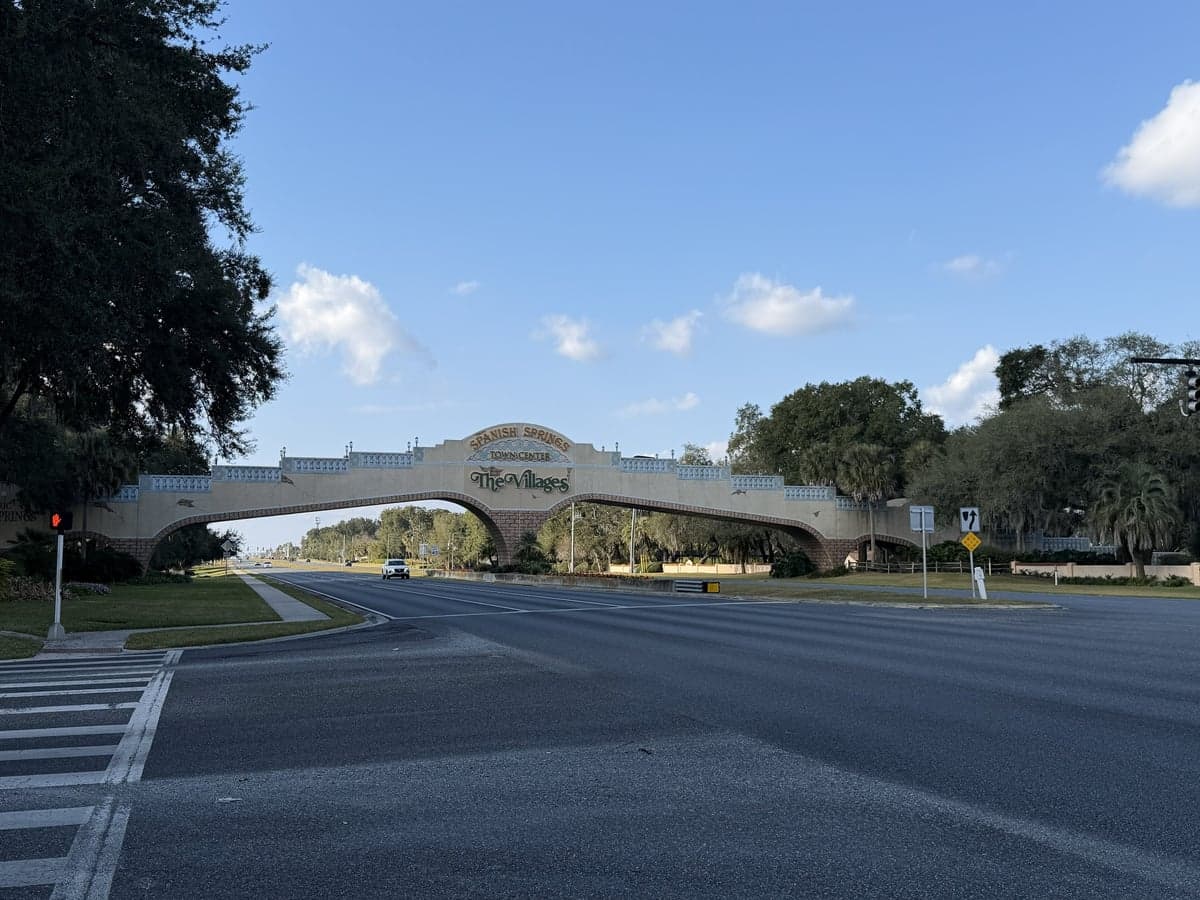
The Villages is a post-1900 planned community with no colonial or pioneer-era history. The land was originally part of central Florida's rural Sumter, Lake, and Marion counties, used primarily for citrus groves and cattle ranching. The modern settlement began in the 1970s when developer Harold Schwartz purchased 2,700 acres of farmland and began building a retirement community designed exclusively for active adults aged 55 and older. The first wave of residents came from the Northeast and Midwest—particularly New York, Ohio, and Michigan—attracted by Florida's low taxes, warm climate, and the promise of a resort-style lifestyle. These early settlers moved into the original neighborhoods of Spanish Springs and Lake Sumter Landing, which remain the historic town squares where the community's social life centers. The population grew steadily through the 1980s and 1990s as word spread among retirees seeking a safe, predictable, and amenity-rich environment.
Modern era (post-1965)
After the 1965 Hart-Cellar Act reshaped U.S. immigration patterns, The Villages saw virtually no impact—its growth remained entirely domestic. The post-1965 era here is defined not by ethnic diversification but by explosive suburban expansion. The developer, now under the Morse family's control, acquired tens of thousands of additional acres and built dozens of new neighborhoods, each with its own recreation center, pools, and golf courses. The population surged from roughly 20,000 in 2000 to over 80,000 by 2020, driven by retiring Baby Boomers from across the United States. Newer neighborhoods such as Village of Fenney and Village of Collier absorbed the bulk of this growth, attracting residents from the South and West who were drawn to the community's low crime rates and structured social calendar. The racial composition remained static: white residents consistently made up 95% or more of the population, with Black residents at 0.7%, Hispanic residents at 1.6%, and East/Southeast Asian communities at 1.2%. Indian-subcontinent residents are statistically nonexistent at 0.0%. The Villages has never been a destination for immigrant communities; its appeal is almost exclusively to native-born Americans seeking a retirement enclave.
The future
The population of The Villages is projected to continue growing, though at a slower pace, as the remaining developable land within the community's boundaries is built out. The demographic future points toward further homogenization rather than diversification. Younger retirees (ages 55–65) moving in today are still overwhelmingly white and native-born, and the community's age-restricted housing covenants and high cost of entry—median home prices exceed $400,000—filter out most younger families or immigrant households. The foreign-born share (0.9%) is among the lowest of any incorporated place in Florida and is unlikely to rise significantly. The Villages is not tribalizing into distinct ethnic enclaves; instead, it is becoming more uniformly white and affluent. The next decade will likely see the community reach its build-out capacity, with population stabilizing around 90,000–100,000, and the median age climbing as the original Baby Boomer cohort ages in place. Neighborhoods like Village of Chatham and Village of Santo Domingo will continue to attract the same demographic profile: married, white, college-educated retirees with above-average household incomes.
For a conservative-leaning individual or parent considering relocation, The Villages offers a highly predictable, safe, and culturally cohesive environment. It is a place where the population is not diversifying but consolidating around a single lifestyle and demographic profile. Anyone moving here should expect a community that is overwhelmingly white, older, and native-born, with little exposure to the ethnic or cultural variety found in most other Florida cities. The trade-off is a meticulously managed, low-crime, amenity-rich retirement experience that remains one of the most sought-after in the country.

* Values derived from national, state, county, city and local statistics and may differ in a specific area. Last updated: 2026-04-24T03:56:38.000Z
Narrative content on this page is AI-generated and may contain mistakes. Verify any details that matter before acting on them.
ReloMaps may earn a commission from affiliate links at no extra cost to you.

