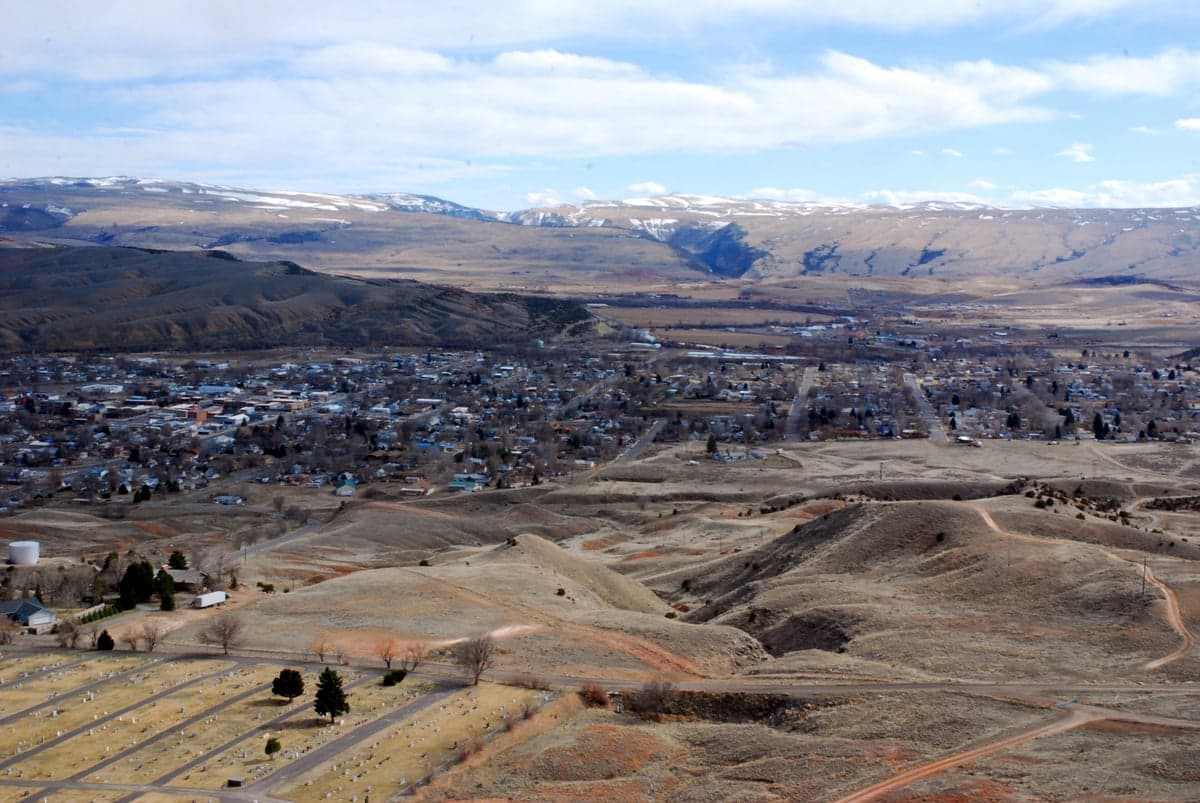
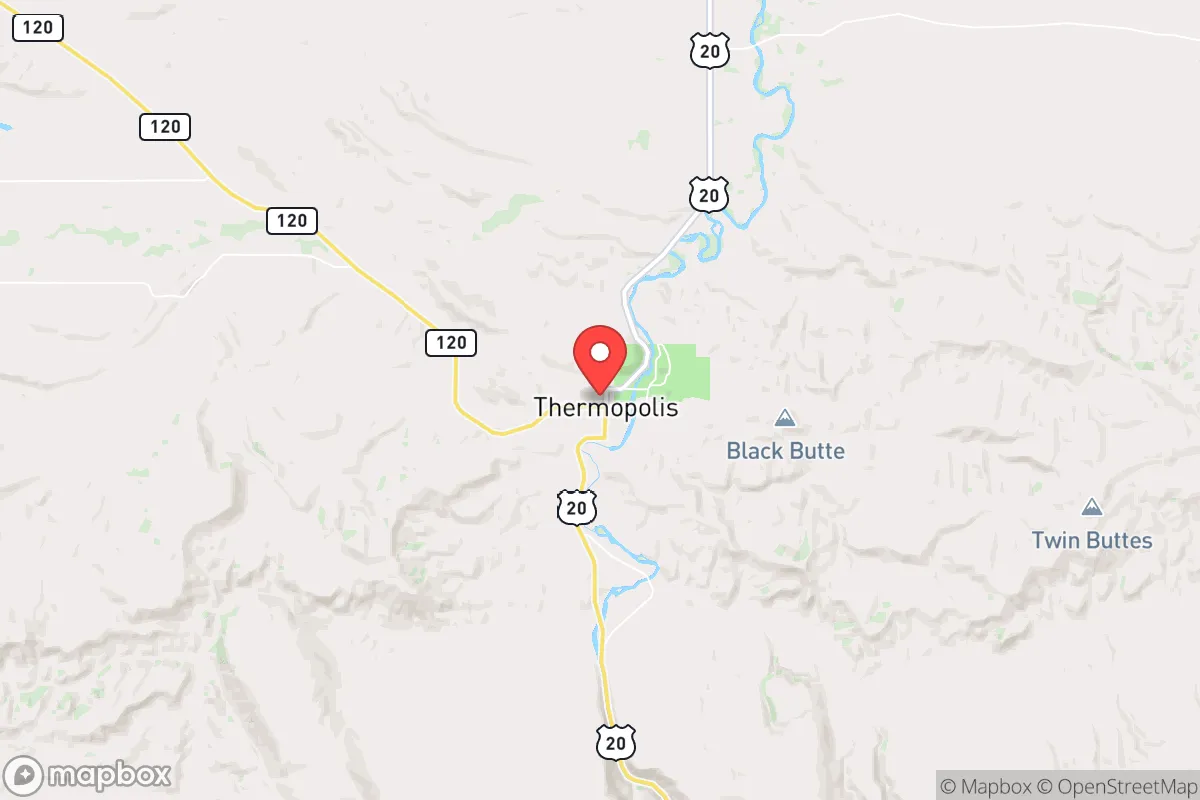
Photo: Wikipedia
Demographics of Thermopolis, WY
Affluence Level in Thermopolis, WY
A middle-class area roughly in line with national averages across income, home values, education, and employment.
People of Thermopolis, WY
The people of Thermopolis, Wyoming, are a predominantly white, long-established community of roughly 2,716 residents, shaped by a century of tourism, energy extraction, and agricultural roots. With a foreign-born population of just 0.6% and a Hispanic share of 5.4%, the city remains one of the least ethnically diverse in the state, reflecting minimal immigration-driven change. The population is older than the national median, with a college attainment rate of 29.7%, and the dominant cultural identity is rooted in ranching, outdoor recreation, and the historic Hot Springs State Park. This is a place where family names trace back generations, and newcomers are often drawn by the promise of small-town safety and low cost of living rather than economic dynamism.
How the city was settled and grew
Thermopolis was formally founded in 1897 after the U.S. government purchased the Big Horn Hot Springs from the Shoshone and Arapaho tribes, creating Hot Springs State Park and establishing the town as a health and tourism destination. The original population was a mix of Anglo-American homesteaders, railroad workers, and entrepreneurs who built the first hotels and bathhouses near the park’s edge in what is now the Historic Downtown District. The Chicago, Burlington & Quincy Railroad arrived in 1905, spurring a second wave of settlement in the North Side neighborhood, where rail workers and their families built modest frame houses. By the 1920s, the discovery of oil in the nearby Big Horn Basin drew a third wave of workers, many of whom settled in the East Thermopolis area, a working-class enclave of small bungalows and trailers that remains the city’s most affordable housing stock. The population peaked at around 3,500 in the 1950s, supported by a mix of tourism, ranching, and the Wyoming State Training School (a facility for the developmentally disabled, later closed), which employed a significant number of local families.
Modern era (post-1965)
After the 1965 Hart-Cellar Act, Thermopolis saw virtually no immigration-driven diversification. The foreign-born share has never exceeded 1%, and the Hispanic population grew only modestly from 3.2% in 2000 to 5.4% today, concentrated in the South Side neighborhood near the industrial park, where seasonal agricultural and service-sector jobs attract a small number of migrant workers. The city’s white population has declined from 96% in 1990 to 90.2% today, driven almost entirely by out-migration of younger adults seeking employment in larger cities like Casper or Billings. The West Side neighborhood, developed in the 1970s and 1980s with larger ranch-style homes, absorbed the majority of the city’s modest in-migration from other parts of Wyoming and the Mountain West, primarily retirees and telecommuters. No significant East/Southeast Asian, Indian, Black, or Arab communities have ever formed; the 0.1% Asian share and 0.0% Black and Indian shares reflect a population that has remained overwhelmingly homogeneous through the modern era.
The future
Thermopolis is projected to continue a slow population decline, with the state’s Economic Analysis Division forecasting a 3-5% drop by 2035 as the aging cohort passes away and younger families leave for regional job centers. The Hispanic share may edge up to 7-8% as a small number of service-sector workers settle in the South Side and East Thermopolis neighborhoods, but the city shows no signs of becoming a multi-ethnic enclave. The white population will remain above 85% for the foreseeable future, and the foreign-born share will likely stay under 1%. The city is homogenizing in the sense that out-migration is removing the most diverse age cohort (young adults), leaving an even more uniformly white and older core. New residents are almost exclusively domestic retirees or remote workers drawn by low housing costs and the hot springs, not by employment growth.
For someone moving in now, Thermopolis offers a stable, culturally homogeneous community with deep local roots and minimal demographic change. The trade-off is clear: you gain safety, affordability, and a tight-knit social fabric, but you accept a shrinking population, limited economic opportunity, and virtually no ethnic or cultural diversity. This is a place for those seeking a quiet, predictable life in a traditional Western setting, not for those looking for a growing or dynamic population center.

* Values derived from national, state, county, city and local statistics and may differ in a specific area. Last updated: 2026-04-21T11:40:36.000Z
Narrative content on this page is AI-generated and may contain mistakes. Verify any details that matter before acting on them.
ReloMaps may earn a commission from affiliate links at no extra cost to you.

