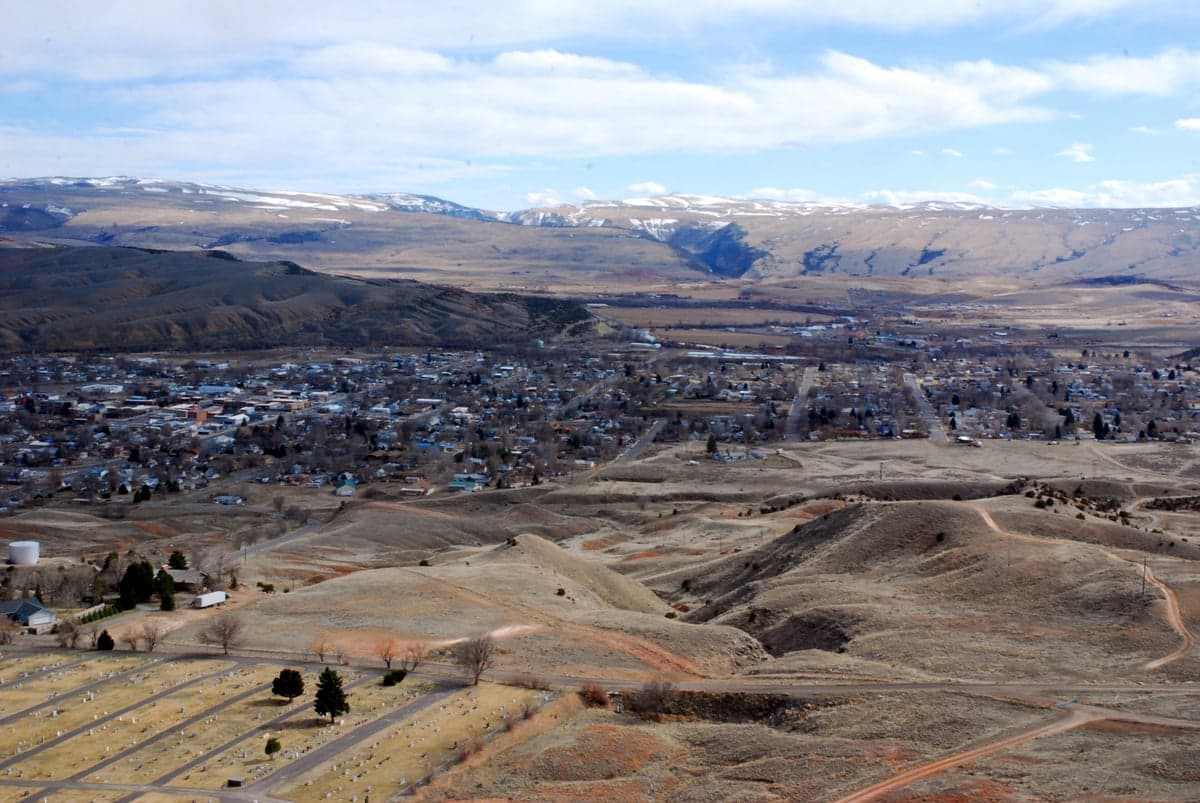
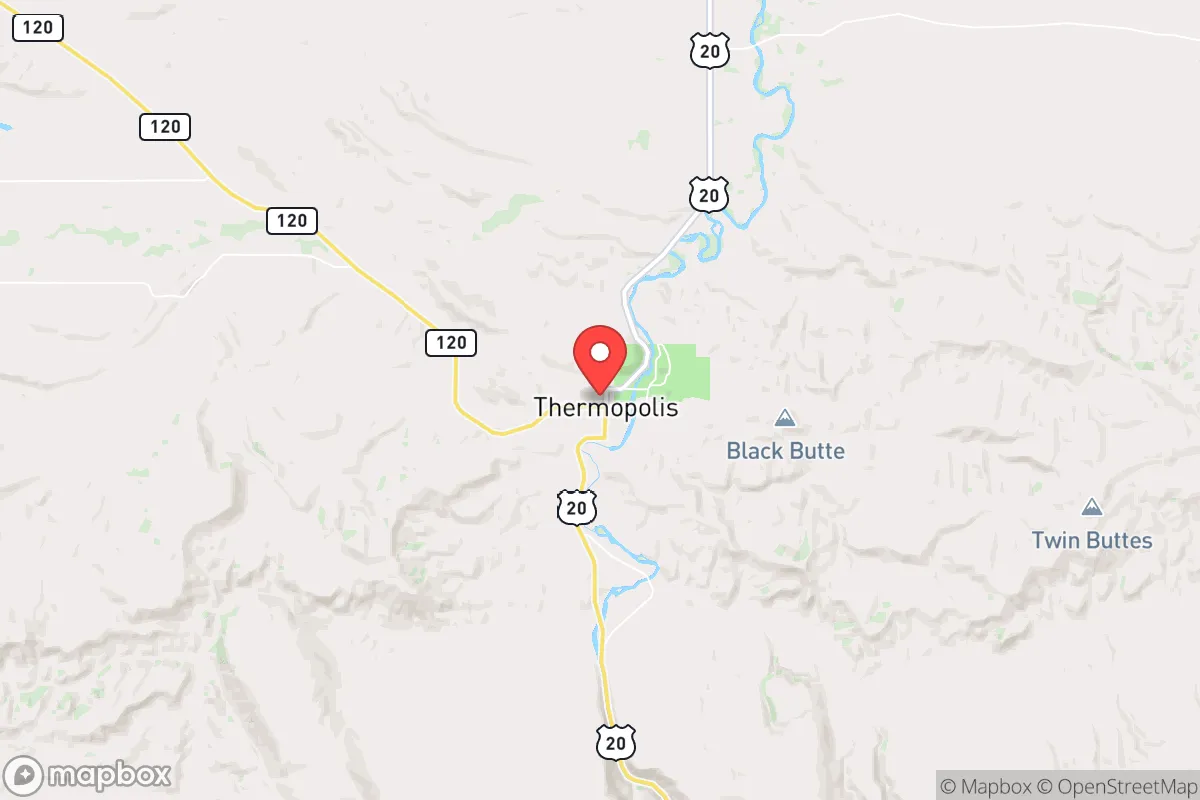
Photo: Wikipedia
Political ClimatePolitical Climate in Thermopolis, WY
District shown is the primary district for this city’s centroid. Cities may span multiple districts.
Inherited from parent state — no local data available.
Local Political AnalysisPolitical Analysis of Thermopolis, WY
Thermopolis is about as rock-ribbed conservative as you’ll find in Wyoming, and that’s saying something for a state that hasn’t voted for a Democrat for president since 1964. The Cook PVI of R+23 tells you the math, but it doesn’t capture the feel. This is a place where the Second Amendment isn’t debated, it’s assumed; where the local economy runs on ranching, tourism, and the hot springs, not government grants. The political lean here isn’t just Republican—it’s a deep, generational skepticism of distant authority, whether that’s Washington D.C. or Cheyenne. If you’re looking for a place that still believes in local control and personal responsibility, this is it. But I’d be lying if I said I hadn’t noticed a few cracks in the foundation over the last decade.
How it compares
Drive an hour east to Worland, and you’ll find a similar conservative vibe, though it’s a bit more tied to the sugar beet and oil industries. Head south to Riverton, and you start to see a different story—more federal land, more reliance on the Wind River Indian Reservation’s economy, and a slightly more moderate tilt in local elections. The real contrast is Cody, about 90 minutes northwest. Cody is reliably red, but it’s got a wealthier, more tourist-driven base that sometimes leans toward the chamber-of-commerce Republicanism that Thermopolis folks find a little too cozy with big government. Here in Thermop, the old-school libertarian streak runs deep. People remember when the state was less about party labels and more about leaving each other alone. The worry now is that even in Wyoming, the progressive creep is real—talk of “equity” initiatives in schools or federal overreach on land use gets a cold reception. The shift isn’t loud, but it’s there, and it’s concerning to anyone who values the way things used to be.
What this means for residents
For daily life, the political climate means you’re mostly left alone. Property taxes are low, regulations are minimal, and the local sheriff isn’t interested in enforcing federal gun laws he disagrees with. The downside? Services are sparse. If you want a big government safety net, you’re in the wrong place. The local hospital and schools run on tight budgets, and there’s a general expectation that you’ll take care of your own problems. That’s fine with most people here—it’s the trade-off for freedom. But the long-term trend is what keeps me up at night. As more people move in from blue states, bringing their voting habits and their demands for “amenities,” the character of the place could shift. The 2024 primary saw a few local races where the more moderate candidate got a surprising share of the vote. It’s not a wave, but it’s a ripple. If you’re thinking of moving here, understand that the political culture is a feature, not a bug. You’ll be expected to respect it.
Culturally, Thermopolis stands apart because of the hot springs—the world’s largest mineral hot spring, actually, and it’s publicly owned. That’s a point of pride: a natural resource managed by the people, for the people, without a federal bureaucracy in the middle. The town also has a strong ranching heritage that shows up in everything from the county fair to the local school board meetings. There’s a quiet but firm resistance to any policy that smacks of top-down control, whether it’s land-use restrictions from the BLM or vaccine mandates from the state health department. The near-term future looks stable, but the long-term? It depends on whether the next generation sticks around and whether the newcomers assimilate. If they do, Thermopolis will stay the kind of place where your neighbor’s business is his own, and the government’s job is to stay out of the way. If they don’t, well, we’ll be having a different conversation in twenty years.

State Political ClimatePolitical Climate in Wyoming
State Political AnalysisPolitical Environment in the State
Wyoming is as solidly Republican as any state in the Union, with a partisan lean that has only deepened over the past two decades. In 2024, Donald Trump carried the state by nearly 43 points, and Republicans hold every statewide office, supermajorities in both legislative chambers, and all three U.S. House seats. The dominant coalition is a blend of rural ranchers, energy-sector workers, and libertarian-leaning conservatives who prize low taxes, minimal regulation, and individual autonomy. Over the last 10-20 years, the state has moved further right, driven by an exodus of moderate Democrats and an influx of conservatives from blue states seeking refuge from progressive policies in places like Colorado and California.
Urban vs. rural divide
The political map of Wyoming is starkly divided between its few small cities and its vast rural expanse. Cheyenne, the capital and largest city, leans Republican but is the state’s most moderate area, with Laramie County occasionally electing a few Democrats to local office. Casper, the second-largest city, is more reliably conservative, anchored by the energy industry. The real engine of the state’s red tilt is the rural and small-town vote. Counties like Sublette, Carbon, and Niobrara routinely deliver 80-90% Republican margins. Teton County, home to Jackson Hole and its wealthy, ski-resort population, is the lone blue outlier — it voted for Joe Biden in 2020 and Kamala Harris in 2024, but its influence is negligible in statewide races. Laramie, home to the University of Wyoming, is a purple-ish pocket, but even Albany County has trended right in recent cycles. The urban-rural divide is less about competing ideologies and more about a rural majority that simply doesn’t tolerate progressive governance.
Policy environment
Wyoming’s policy environment is a conservative dream. There is no state income tax, and the sales tax is a low 4% (with local options pushing it to around 6%). Property taxes are among the lowest in the nation, though a recent 2024 legislative session saw a 50% property tax cut for primary residences, a direct response to rising valuations driven by in-migration. The regulatory posture is aggressively pro-business, especially in energy — oil, gas, and coal remain the backbone, though the state is slowly diversifying into wind and carbon capture. Education policy is a mixed bag: the state funds schools well per pupil, but curriculum battles have intensified. In 2023, the legislature passed a Parents’ Bill of Rights (SF 109), requiring schools to notify parents of any changes to a student’s health or emotional well-being, and banning instruction on gender identity and sexual orientation through third grade. Election laws are tight: voter ID is required, same-day registration is not allowed, and absentee voting requires an excuse. The state also passed a law in 2021 banning private funding of election administration, a direct response to the Zuckerberg-funded 2020 grants that many conservatives saw as corrupting. Healthcare is a sore spot — Wyoming has not expanded Medicaid, and the state has the highest uninsured rate in the nation at around 12%. But for conservatives, that’s a feature, not a bug: it keeps government out of personal medical decisions.
Trajectory & freedom
Wyoming is becoming more free, at least by conservative and libertarian metrics. The 2024 session was a landmark for personal liberty. The state passed a constitutional carry law (SF 147), allowing any adult who can legally possess a firearm to carry concealed without a permit. It also enacted a medical freedom law (HB 100) that prohibits employers and government entities from mandating COVID-19 or any future vaccines as a condition of employment or service. On parental rights, the aforementioned SF 109 was expanded in 2024 to require parental consent for any medical or mental health treatment of minors, effectively banning gender-affirming care for transgender youth. Property rights were strengthened with a new law limiting the use of eminent domain for private economic development. On taxation, the 2024 property tax cut was paired with a cap on annual assessment increases at 5%, preventing the kind of tax creep that has driven people out of states like Texas and Colorado. The only area where freedom has arguably contracted is on abortion: a trigger law went into effect after Dobbs, banning the procedure with narrow exceptions for rape, incest, and life of the mother. But for the conservative audience, that’s a protection of life, not a restriction of liberty.
Civil unrest & political movements
Wyoming is remarkably stable compared to the rest of the country. There have been no major protests or riots in recent years. The most visible political movements are on the right: the Wyoming Freedom Caucus, a hardline conservative faction in the state legislature, has grown in influence, pushing for further tax cuts, school choice, and restrictions on federal land management. In 2023, the group successfully killed a proposed gas tax increase and blocked a bill that would have allowed the state to accept federal funds for broadband expansion, arguing it came with too many strings attached. On the left, the only organized activism is in Teton County, where environmental groups push for renewable energy and land conservation, but they have little sway statewide. Immigration politics are a non-issue — Wyoming has a tiny foreign-born population (around 3%), and there are no sanctuary cities. Election integrity controversies are minimal; the state uses paper ballots and conducts post-election audits, and there has been no significant fraud allegations. The only flashpoint a new resident might notice is the tension between the state and the federal government over land use. The federal government owns about 48% of Wyoming, and there is a long-standing movement for the state to take control of those lands, with the legislature passing a resolution in 2023 demanding the transfer of Bureau of Land Management holdings. It’s more rhetoric than action, but it reflects a deep-seated distrust of federal overreach.
Projection
Over the next 5-10 years, Wyoming will likely become even more conservative, but with a twist. In-migration from blue states — particularly Colorado, California, and Washington — is accelerating, especially to areas like Sheridan and Laramie. These newcomers are often conservative themselves, fleeing progressive policies, but they bring higher housing costs and a demand for services that could strain the state’s low-tax model. The energy transition will be a key battleground: coal is in terminal decline, but the state is betting big on carbon capture and advanced nuclear. If those bets pay off, the economy stays strong; if not, the state could face a fiscal crunch that forces either tax increases or deep spending cuts. Demographically, Wyoming is aging and shrinking — it’s one of the few states with a declining native-born population — but in-migration is offsetting that. The political result will be a state that remains deeply red, but with a more libertarian, less establishment flavor. The Wyoming Freedom Caucus will likely grow stronger, pushing for school vouchers, further tax cuts, and a more aggressive stance on federal land transfer. Someone moving in now should expect to find a state that is fiercely independent, suspicious of government at all levels, and increasingly willing to buck even Republican orthodoxy if it smells like compromise.
For a new resident, the bottom line is this: Wyoming offers a level of personal freedom that is rare in the United States. You will pay no income tax, carry a firearm without a permit, and send your kids to a school that respects your parental authority. But you will also live in a place with limited healthcare access, harsh winters, and a economy that is still tied to boom-and-bust energy cycles. If you value autonomy over convenience, and if you’re willing to trade urban amenities for wide-open spaces and a government that mostly leaves you alone, Wyoming is as good as it gets. Just don’t expect it to stay exactly the same — the people coming in are changing it, but they’re changing it in the same direction you probably want to go.
* Values derived from national, state, county, city and local statistics and may differ in a specific area. Last updated: 2026-04-21T11:40:36.000Z
Narrative content on this page is AI-generated and may contain mistakes. Verify any details that matter before acting on them.
ReloMaps may earn a commission from affiliate links at no extra cost to you.

