
Photo: Wikipedia
Political ClimatePolitical Climate in Troutdale, OR
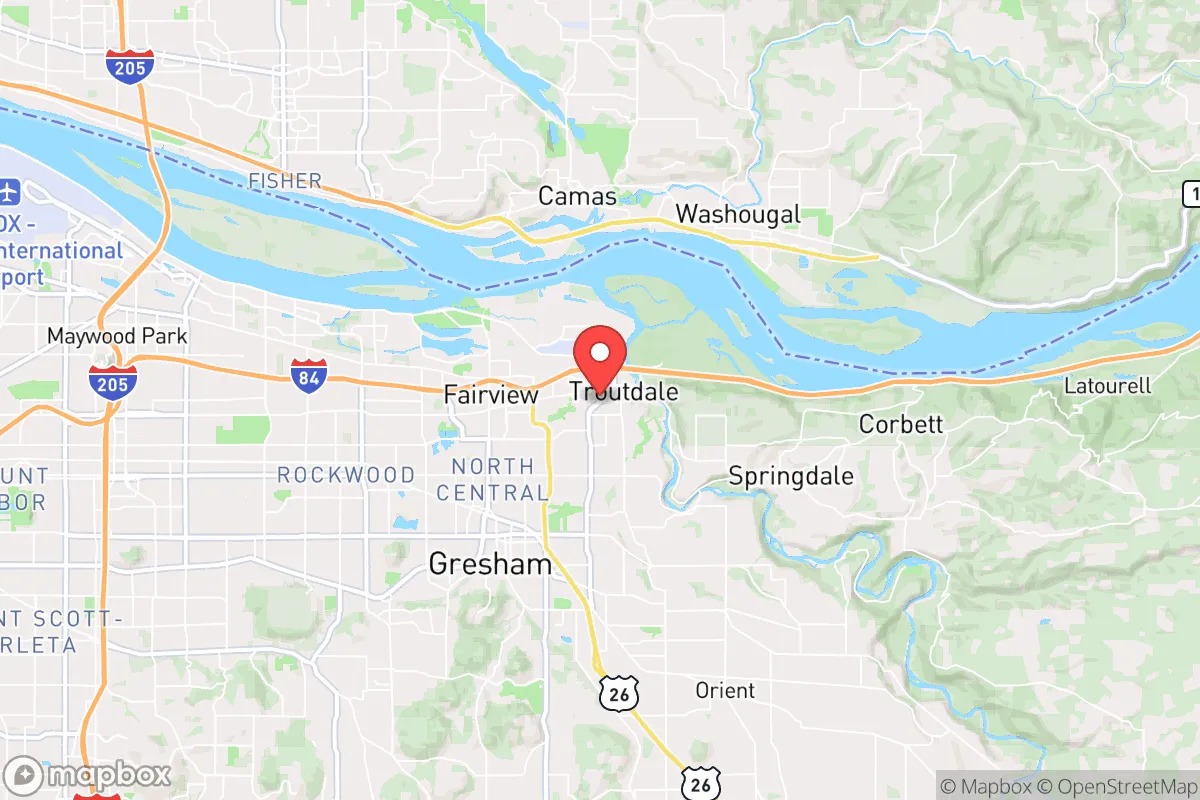
District shown is the primary district for this city’s centroid. Cities may span multiple districts.
Local Political AnalysisPolitical Analysis of Troutdale, OR
Troutdale's political lean is heavily Democratic, with a Cook PVI of D+24 — that's three times more liberal than Oregon as a whole, which sits at D+8. I've lived here for over 20 years, and I've watched this town go from a quiet, middle-of-the-road community to a place where progressive policies are pushed through with little debate. The trajectory is unmistakable: each election cycle, the margins get wider, and the voices of anyone who questions the direction get quieter. It's not just a blue town anymore; it's a one-party stronghold, and that comes with real consequences for personal freedoms and local decision-making.
How it compares
Oregon's D+8 rating already signals a state that leans left, but Troutdale's D+24 puts it in a different league entirely. For context, nearby cities like Gresham (D+16) and Fairview (D+18) are also deep blue, but Troutdale has become an outlier even among them. Drive 15 minutes east to Sandy or Corbett, and you'll find communities that vote more like the state average — still blue, but with a healthy mix of independent and conservative voices. In Troutdale, that mix is almost gone. The city council and school board races are effectively decided in the primary, and policy debates often skip straight to implementation without meaningful opposition. Compared to the state as a whole, Troutdale residents face more aggressive land-use regulations, higher density mandates, and a local government that seems eager to adopt Portland-style homelessness and public safety policies — even when those policies have shown mixed results elsewhere.
What this means for residents
For the average person living here, the political climate translates into a steady erosion of local control. Want to build an accessory dwelling unit on your property? The city's zoning code, shaped by state-level mandates from Salem, makes it harder than it should be. Concerned about rising crime or open drug use in public spaces? The city's response has been to double down on "alternative" approaches rather than traditional enforcement. Many longtime residents I talk to feel like their concerns about government overreach into personal freedoms — from property rights to parental involvement in schools — are simply dismissed as outdated. The push for progressive ideology isn't just a talking point; it shows up in higher taxes, new fees, and a growing sense that the people making decisions don't share the values of the families who've been here for generations.
One cultural distinction that stands out is Troutdale's relationship with its own history. The town was built around the lumber industry and the Sandy River — a working-class, self-reliant place. Today, the city's branding leans heavily into "sustainability" and "equity" initiatives that feel imported from downtown Portland rather than rooted in local identity. The annual festivals and community events still draw crowds, but the political conversation has shifted so far left that even moderate Democrats I know feel uncomfortable speaking up. If the trend continues, Troutdale risks becoming a place where diversity of thought is the one thing that isn't tolerated — and that's a loss for everyone who calls this valley home.

State Political ClimatePolitical Climate in Oregon
State Political AnalysisPolitical Environment in the State
Oregon has been a reliably Democratic state for decades, with a Cook Partisan Voting Index of D+8, but that top-line number hides a deeply fractured political landscape. The state’s electoral trajectory over the past 20 years has been a slow, steady march leftward driven by explosive growth in the Portland metro area, even as vast rural counties have swung hard in the opposite direction. For a conservative considering relocation, the reality is that Oregon is two states under one roof: a progressive, government-heavy western corridor and a libertarian-leaning, resource-dependent east, with a handful of purple suburbs that could tip either way.
Urban vs. rural divide
The political map of Oregon is a textbook case of geographic polarization. The Portland tri-county area (Multnomah, Washington, Clackamas) generates roughly half the state’s votes and is solidly Democratic, with Portland itself pushing far-left policies like decriminalized drug possession and rent control. The Willamette Valley cities of Eugene and Salem are also deep blue, home to the University of Oregon and state government respectively. Meanwhile, the eastern two-thirds of the state—places like Bend, Redmond, Pendleton, and Ontario—vote Republican by wide margins. Central Oregon’s Deschutes County, once a swing area, has trended right as Californians and Portland refugees move in seeking lower taxes and more freedom. The coastal counties are a mixed bag: Lincoln and Tillamook lean left, while Curry and Douglas are reliably red. The real battleground is the Portland suburbs—Beaverton, Hillsboro, Gresham—where moderate voters have been steadily replaced by younger, more progressive transplants.
Policy environment
Oregon’s policy environment is a cautionary tale for conservatives. The state has no sales tax, which sounds good, but it makes up for it with the nation’s fifth-highest personal income tax rate (top bracket 9.9%) and high property taxes in many counties. The regulatory climate is hostile to business: Portland’s strict land-use laws, a statewide ban on new natural gas hookups in some areas, and aggressive environmental mandates drive up costs. Education policy is dominated by teachers’ unions; Oregon ranks near the bottom nationally in graduation rates despite above-average per-pupil spending. Healthcare is heavily regulated, with a state-run insurance exchange and Medicaid expansion that covers nearly one in four residents. Election laws are among the most progressive: automatic voter registration, no-excuse mail-in voting (in place since 2000), and same-day registration. For a conservative, the policy environment feels like a slow squeeze on personal choice and economic freedom.
Trajectory & freedom
Oregon’s trajectory on personal liberty is concerning. The state has expanded government reach in several areas: in 2021, it passed a strict gun control law (Measure 114) that requires permits and bans magazines over ten rounds—though it’s currently tied up in court. Parental rights took a hit with the 2023 law allowing minors to access gender-affirming care without parental consent, a flashpoint for many families. Medical autonomy was further eroded by the state’s assisted suicide law (Death with Dignity Act) and its recent push to allow psilocybin therapy under Measure 109, which many see as government-sanctioned drug use. On the plus side, Oregon has no statewide mask or vaccine mandates currently, and property rights remain relatively strong outside urban growth boundaries. But the overall trend is toward more regulation, not less. The 2020 wildfires led to controversial land-use restrictions that angered rural landowners. For a freedom-minded person, Oregon is a state where you have to fight to keep what’s yours.
Civil unrest & political movements
Oregon has a long history of political activism, and recent years have been explosive. Portland became the epicenter of the 2020 George Floyd protests, with months of nightly demonstrations, property destruction, and a federal intervention that made national headlines. The city’s “defund the police” movement led to a 10% budget cut to the police bureau, though crime spikes later prompted some restoration. On the right, rural counties have pushed back hard: in 2020, several eastern Oregon counties voted to join the “Greater Idaho” movement, seeking to secede and merge with the more conservative state. The movement has gained traction, with some county commissions formally supporting it. Immigration politics are tense: Portland is a sanctuary city, and the state has a “sanctuary” law (ORS 181A.820) that limits local cooperation with federal immigration enforcement. Election integrity remains a hot topic—Oregon’s all-mail system has been criticized by conservatives for potential fraud, though no widespread issues have been proven. A new resident will notice the stark cultural divide: drive 30 minutes outside Portland and you’ll see Trump flags; inside the city, you’ll see pride flags and “Hate Has No Home Here” signs.
Projection
Looking five to ten years out, Oregon is likely to become even more polarized. In-migration from California and other blue states continues to fuel growth in the Portland metro and Bend, pushing those areas further left. Meanwhile, rural counties are aging and losing population, but their political influence is shrinking as the state’s legislative districts are redrawn to favor urban areas. The Greater Idaho movement may gain symbolic victories but is unlikely to succeed without a constitutional amendment. The biggest wild card is housing: Oregon’s severe shortage and high costs are driving some young families to cheaper, redder states like Idaho and Texas. If that trend accelerates, the state could see a net loss of conservative-leaning residents, further entrenching progressive control. For someone moving in now, expect a decade of continued cultural conflict, with state government increasingly out of step with rural values.
Bottom line for a new resident: Oregon offers stunning natural beauty and a laid-back lifestyle, but the political climate is increasingly hostile to conservative values. If you’re a single professional or parent who values low taxes, school choice, gun rights, and limited government, you’ll find yourself fighting an uphill battle in the state legislature and local school boards. The best bets for a conservative-friendly community are in the suburbs of Bend (Redmond, Sisters), the Rogue Valley (Medford, Grants Pass), or eastern Oregon (Pendleton, La Grande). But even there, state-level policies will affect your daily life. Come for the mountains and coast, but be prepared to engage politically to protect your freedoms.
* Values derived from national, state, county, city and local statistics and may differ in a specific area. Last updated: 2026-05-18T16:03:22.000Z
Narrative content on this page is AI-generated and may contain mistakes. Verify any details that matter before acting on them.
ReloMaps may earn a commission from affiliate links at no extra cost to you.

