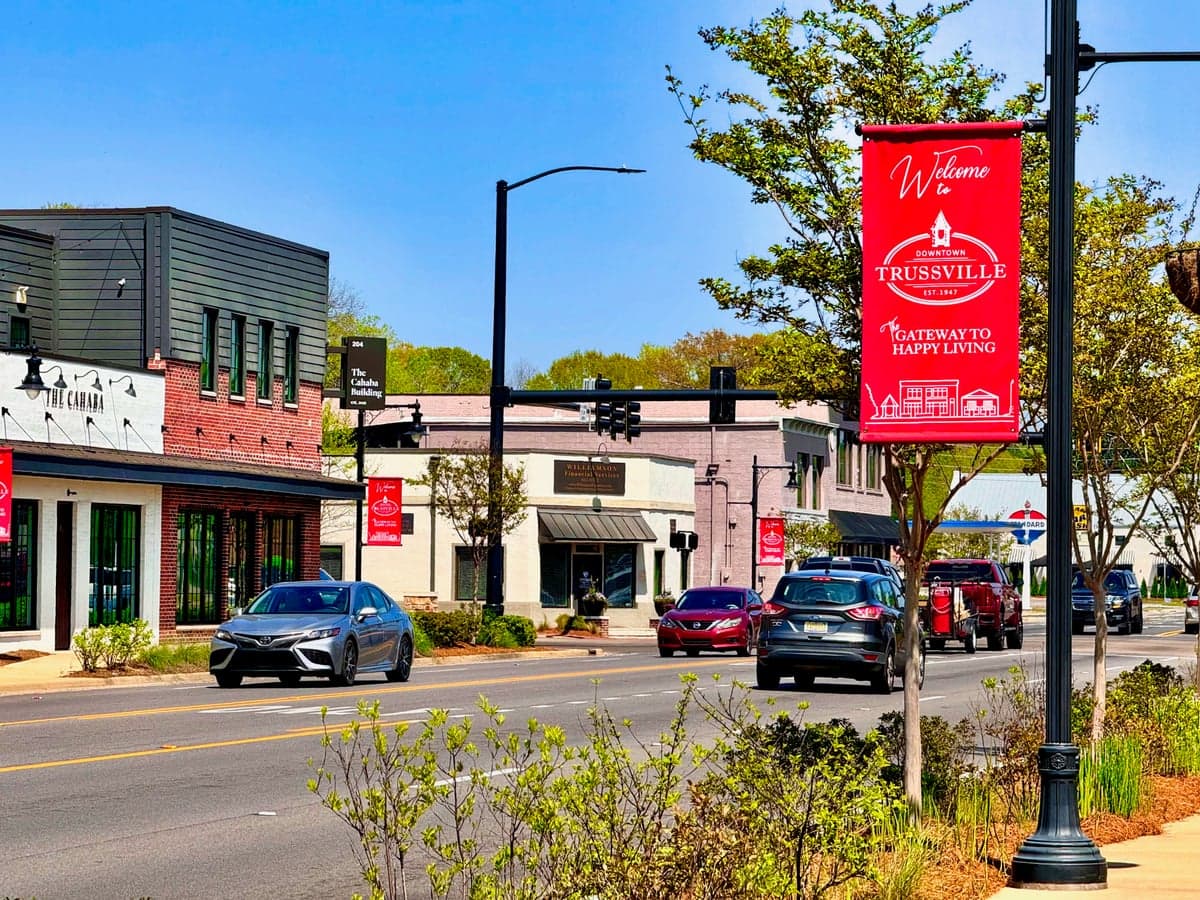
Photo: Wikipedia
Personal Sovereignty in Trussville, AL
Viable for self-reliance. Generally workable, though some barriers may limit total independence.
What does Personal Sovereignty tell us?
Personal Sovereignty measures your capacity for self-reliance and independence with minimal government friction. Higher scores mean fewer barriers between you and the way you want to live... but it assumes you have the space you need and good neighbors.
What does this tell us?
Personal Sovereignty measures your capacity for self-reliance and independence with minimal government friction. Higher scores mean fewer barriers between you and the way you want to live... but it assumes you have the space you need and good neighbors.
State Policy
Energy independence: Importer (45% of energy produced in-state)
Personal Liberty
Homesteading

Personal Liberty Analysis
Trussville, Alabama, offers a notably high degree of personal sovereignty compared to many suburban enclaves, largely because it sits within a state that has aggressively pushed back against federal overreach and maintains a strong constitutional framework for individual rights. For those with a survivalist or prepper mindset, the key takeaway is that Alabama’s legal and cultural environment actively supports self-reliance, from low taxes and minimal business regulation to some of the strongest gun laws in the nation. While Trussville itself is a growing suburb of Birmingham with modern amenities, its local governance and state-level protections create a buffer against the kind of government overreach that increasingly chokes personal freedoms in more progressive regions. This analysis examines the specific pillars of autonomy—tax burden, self-defense rights, homesteading feasibility, and personal liberties—that make Trussville a strategic relocation target for those prioritizing individual sovereignty.
Tax burden and regulatory posture: How Alabama protects your wallet and choices
Alabama’s tax structure is deliberately designed to minimize the state’s footprint on your income and property, which directly supports personal financial sovereignty. The state levies a flat income tax of 5%, but crucially, there is no state-level property tax—only local and county rates apply, and in Trussville, the combined effective property tax rate hovers around 0.4% of assessed home value, one of the lowest in the nation. This means a $300,000 home would incur roughly $1,200 annually in property taxes, leaving more capital for self-sufficient investments like land improvements, solar panels, or emergency supplies. Sales tax in Trussville is 10%, which is high, but this is offset by the absence of state income tax on Social Security benefits and a full deduction for federal income taxes paid, effectively lowering your overall tax burden. From a regulatory standpoint, Alabama is a right-to-work state with minimal business licensing requirements, and Trussville’s local government is known for a pro-development, low-interference approach—permits for home additions or workshops are straightforward, and there are no onerous zoning overlays that would restrict a homeowner from building a greenhouse, installing a rainwater catchment system, or keeping livestock on larger lots. This regulatory posture is a deliberate contrast to states like California or New York, where environmental and land-use regulations can effectively ban self-reliant practices.
Self-defense and gun law specifics: Stand your ground and constitutional carry
For anyone concerned with the right to defend themselves and their family, Trussville sits in a legal environment that is among the most permissive in the United States. Alabama is a constitutional carry state, meaning no permit is required to carry a concealed firearm for anyone legally allowed to possess one—this went into effect in 2022 and has not been rolled back. The state also has a robust Stand Your Ground law, codified in Alabama Code § 13A-3-23, which removes any duty to retreat before using deadly force if you are in a place you have a lawful right to be and reasonably believe force is necessary to prevent death or great bodily harm. This applies to your home, vehicle, and any public space. Trussville itself has a low violent crime rate—roughly 1.5 incidents per 1,000 residents in 2024—but the legal framework ensures that if a threat does arise, you are not hamstrung by bureaucratic hurdles. Additionally, Alabama does not have a red flag law, nor does it require firearm registration or impose magazine capacity restrictions. For preppers, this means you can stockpile ammunition and maintain a full arsenal without fear of sudden legislative confiscation. The local sheriff’s office in Jefferson County (which covers Trussville) is known for being pro-Second Amendment and issues permits for those who still want reciprocity with other states, but the constitutional carry provision makes it unnecessary for daily life.
Self-reliance and homesteading viability: Lot sizes, zoning, and off-grid feasibility
Trussville offers a realistic path to semi-self-sufficiency, particularly for those willing to look beyond the typical subdivision. While many newer developments have HOA covenants that restrict livestock, solar panels, or clotheslines, there are still neighborhoods and unincorporated pockets within the Trussville zip code where lot sizes range from half an acre to several acres. The city’s zoning code allows for “agricultural” uses on parcels zoned A-1, which includes keeping chickens, goats, and even a single horse on lots as small as one acre, provided you meet setback requirements. Off-grid feasibility is moderate: Alabama has no state-level ban on rainwater collection, and while Trussville is connected to municipal water and sewer, you can legally install a well and septic system on larger lots with a permit. Solar panels are permitted without excessive red tape, and net metering is available through Alabama Power, though the rates are not as favorable as in some states. The climate—mild winters and long growing seasons—supports year-round vegetable gardening, and the soil in the Cahaba River valley is fertile. However, note that Trussville is in a tornado-prone area, so any homesteading plan must include a storm shelter or reinforced safe room. For those serious about self-reliance, the nearby rural areas of St. Clair County (just east of Trussville) offer larger parcels at lower prices, with even less zoning interference, while still being within a 20-minute drive of Trussville’s grocery stores and medical facilities.
Personal liberties: Parental rights, medical autonomy, speech, and property
Alabama has positioned itself as a stronghold for parental rights and medical autonomy, which directly impacts personal sovereignty. The state passed the Alabama Parental Rights Protection Act, which affirms that parents have the fundamental right to direct the upbringing, education, and healthcare of their children, including the right to opt out of any school curriculum or medical treatment they find objectionable. In Trussville City Schools, this translates to transparent policies on parental notification for any health services and a curriculum that emphasizes traditional values—there is no critical race theory or gender ideology instruction in the classroom. On medical autonomy, Alabama has some of the strictest laws against vaccine mandates in the country; a 2023 law prohibits employers from requiring COVID-19 vaccination as a condition of employment, and schools cannot mandate any vaccine not already required by state law for attendance. Speech protections are robust under the Alabama Constitution, which explicitly protects the right to peaceably assemble and petition the government, and there are no local ordinances in Trussville that restrict political signage or public expression. Property rights are further secured by Alabama’s strong eminent domain protections—the state constitution requires that any taking be for a truly public use (not private economic development) and that just compensation includes relocation costs. This legal framework means that a homeowner in Trussville can put up a political sign, refuse a medical procedure for their child, or build a fence without fear of government overreach.
In the broader context of personal sovereignty across the United States, Trussville ranks highly for those who prioritize autonomy over convenience. It lacks the extreme libertarian ethos of a place like rural Idaho or New Hampshire, but it compensates with a functional infrastructure, low crime, and a community that largely shares conservative values. The trade-off is that you are still within the orbit of a major city (Birmingham), which brings some degree of urban influence and occasional state-level political battles, but the local culture and state laws provide a strong buffer. For a single individual or a family looking to maximize self-reliance while maintaining access to jobs and healthcare, Trussville offers a rare combination: the legal tools to defend your life, keep your money, and raise your children according to your own values, all within a community that won’t penalize you for doing so. It is not a prepper’s paradise in the wilderness, but it is a strategically sound base of operations in a state that has consistently chosen freedom over control.

* Values derived from national, state, county, city and local statistics and may differ in a specific area. Last updated: 2026-04-19T11:55:20.000Z
Narrative content on this page is AI-generated and may contain mistakes. Verify any details that matter before acting on them.
ReloMaps may earn a commission from affiliate links at no extra cost to you.

