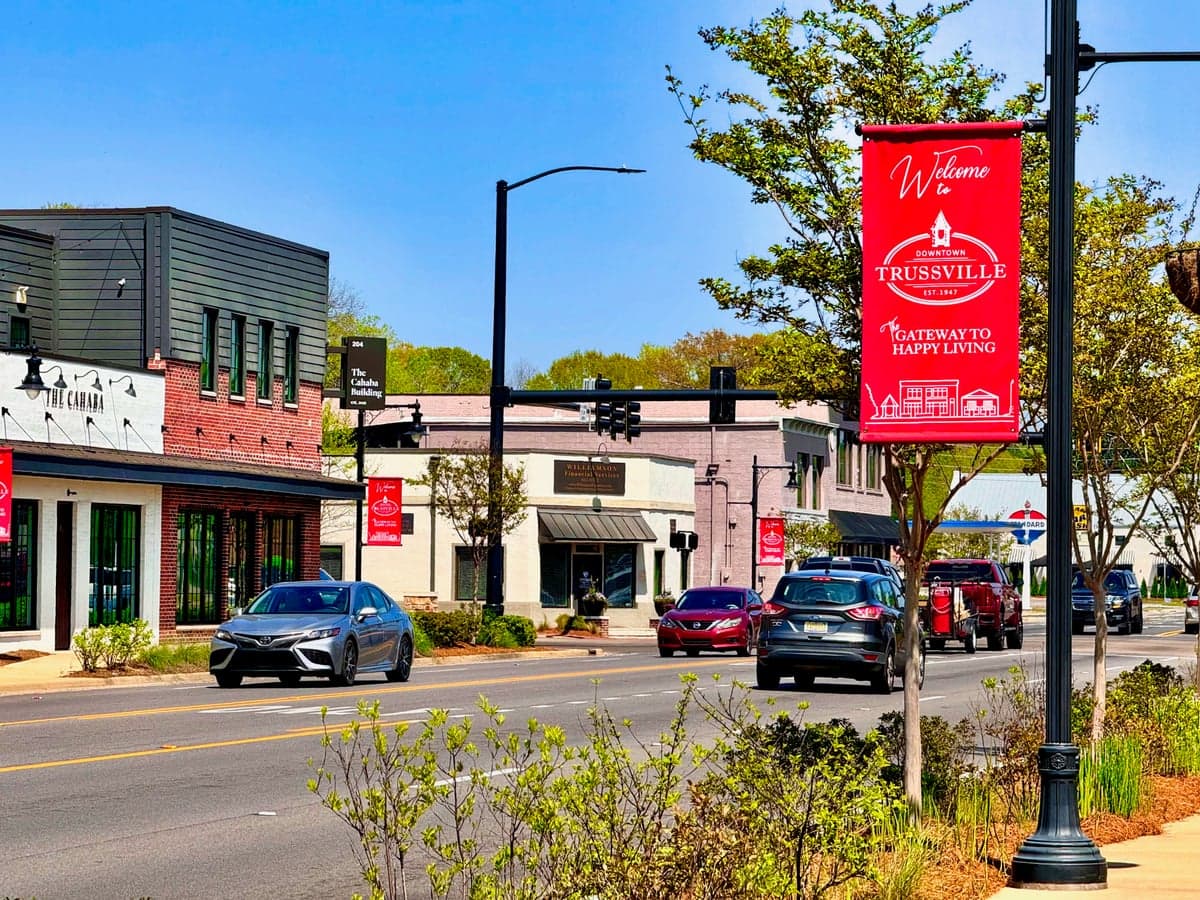
Photo: Wikipedia
Strategic Assessment of Trussville, AL
Workable tactical position. Some exposure to population density or targets, but generally defensible in a crisis.
What does the Strategic Assessment tell us?
Our Strategic Assessment grades tactical survivability of an area. Major population centers, military targets, fallout zones, natural disasters, and border exposure all drive risk — lower exposure means a more defensible position in a crisis.
This is heavily inspired by Joel Skousen's Strategic Relocation book. Highly recommended you checkout the book ($)What does this tell us?
Our Strategic Assessment grades tactical survivability of an area. Major population centers, military targets, fallout zones, natural disasters, and border exposure all drive risk — lower exposure means a more defensible position in a crisis.
This is heavily inspired by Joel Skousen's Strategic Relocation book. Highly recommended you checkout the book ($)Strategic Pillars

Key Distances
Regional Safe Places
Below is our recommended "safe zones" in Alabama and the surrounding area based on our strategic heuristics. For most people, it's unrealistic to live in a “safe zone” full-time due to work, family or other personal reasons. They tend to be more rural. However, many of these areas are perfect for second homes and retreat properties that double as a vacation home or even a short-term rental.
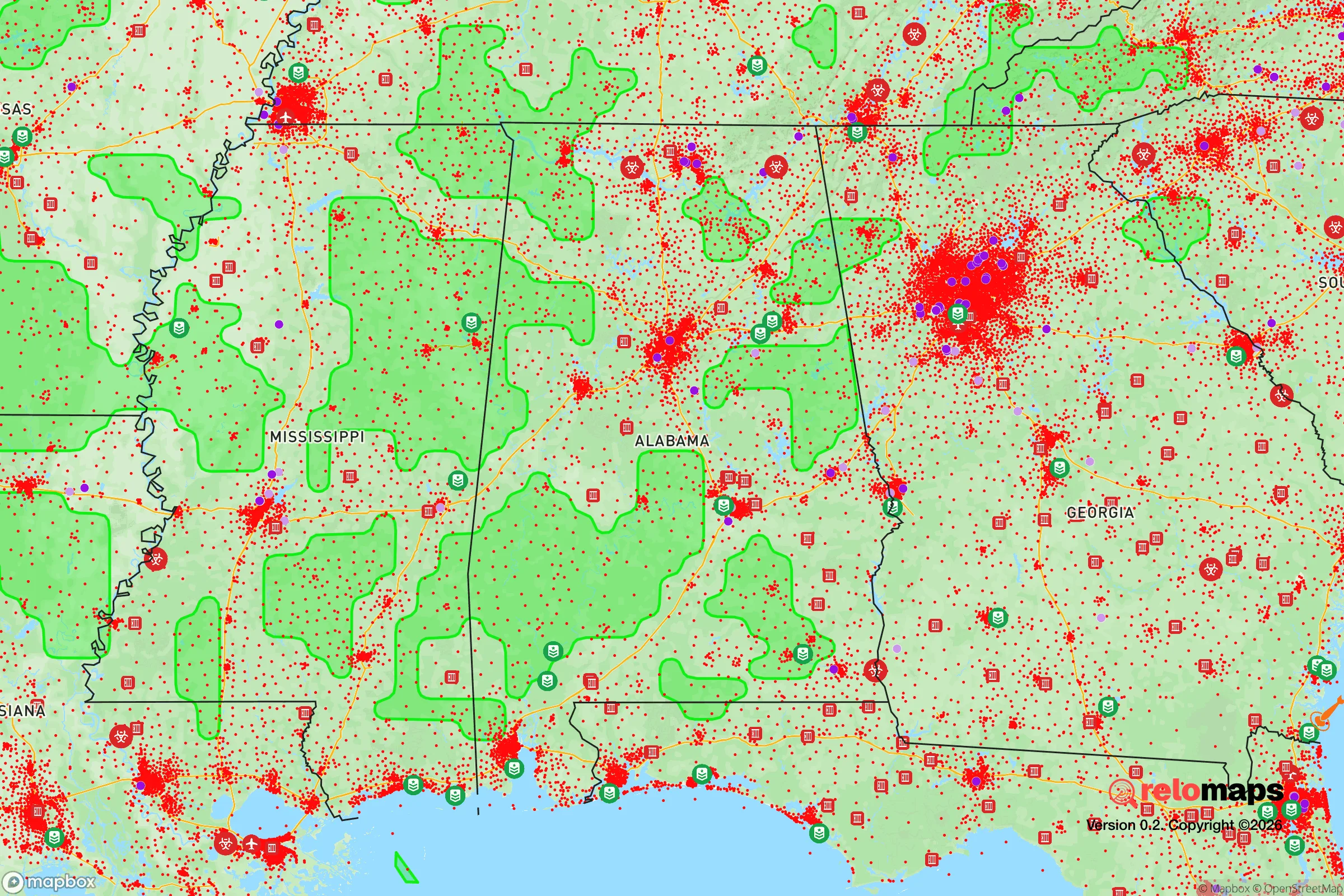
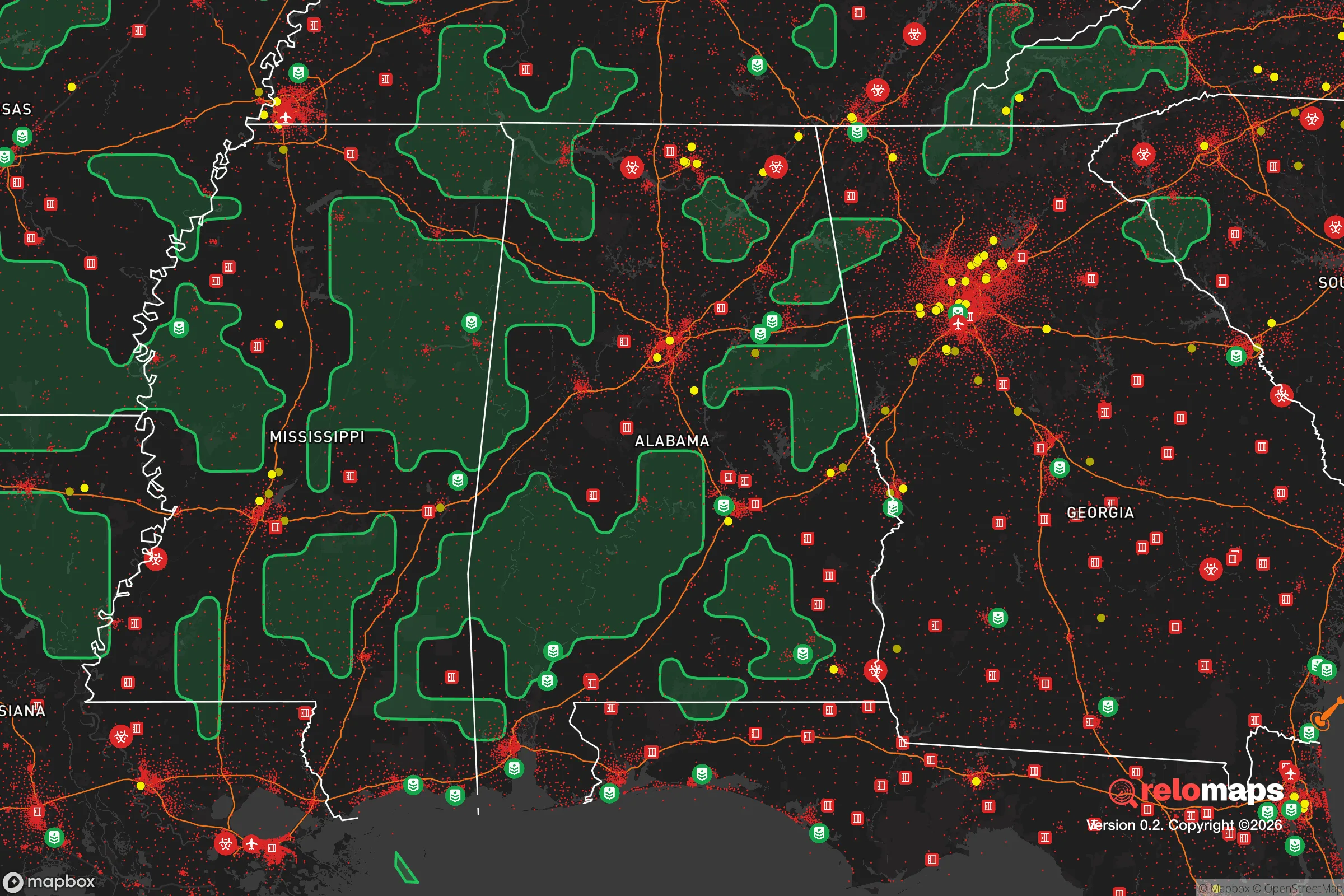


Important Note: For informational purposes only. This does not mean nothing bad ever happens in the green zones. Please use common sense. This is based on public data and modeled with AI. We tried to take a conservative approach but mistakes happen. We update this regularly as new information becomes available.
Solar Generator Recommendations
Backup power matters more here than in safer locations. We've picked three solar generators across budgets and capacity tiers — start with the budget unit if you only need a few essentials, or step up if you want to run a fridge and HVAC for days at a time.

Jackery Portable Power Station Explorer 300
Budget OptionPower on the Go: Weighing only 11 lbs, it's convenient to set up and store with book-sized foldable solar panels

BLUETTI Portable Power Station AC180
Designed for both indoor and outdoor scenarios, AC180 is highly capable as it has a robost capacity and continuous output power.

EF ECOFLOW DELTA Pro Ultra Power Station
Upgraded PickEcoFlow DELTA Pro Ultra is a whole-home energy system designed to grow with your family. Integrated with the Smart Home Panel 2, it scales to meet your evolving energy needs — keeping your home powered, intelligent, and secure through every stage of life.
We earn a commission, at no additional cost to you.
Strategic Assessment Analysis
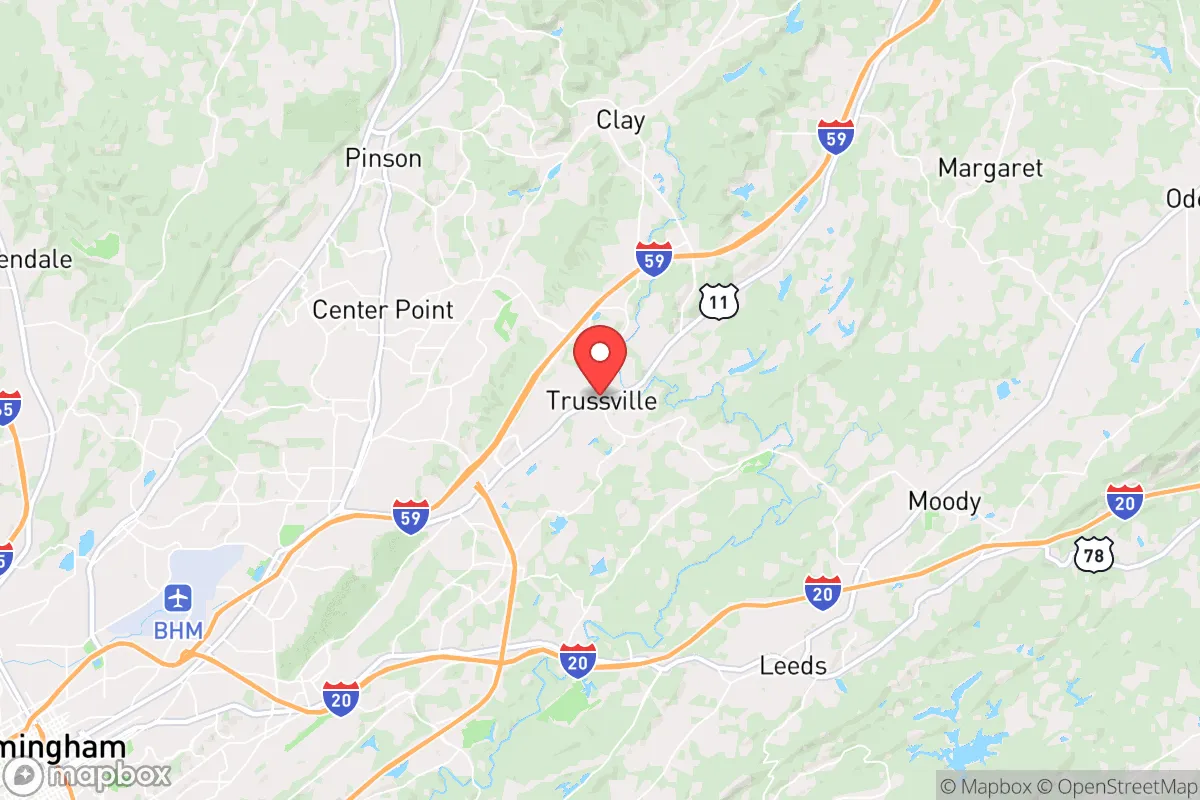
Trussville, Alabama, sits in a precarious but potentially advantageous position for those prioritizing resilience and preparedness. Located just northeast of Birmingham along Interstate 59, it offers a blend of suburban stability and access to rural escape routes, but its proximity to a major metropolitan hub introduces significant vulnerabilities. For a relocator focused on weathering civic unrest, mass casualty events, or large-scale disasters, Trussville’s strategic value hinges on how well you can leverage its strengths while mitigating its exposure to the fallout of a major city.
Geographic position and natural advantages for long-term survival
Trussville’s location in the foothills of the Appalachian Mountains provides a natural buffer against some threats. The area sits on the Cahaba River, offering a reliable freshwater source, and is surrounded by the Talladega National Forest to the east, which serves as both a resource zone and a potential retreat. The terrain is hilly and wooded, which complicates large-scale movement—a defensive plus if civil order breaks down. The climate is temperate, with four distinct seasons, allowing for year-round agriculture and foraging, though summers are humid and winters mild. The region’s geology is stable, with low seismic risk, and it’s far enough from the Gulf Coast to avoid the worst of hurricane storm surges, though inland flooding from heavy rain is a real concern. For a prepper, the key natural advantage is the ability to move east into less populated, more defensible terrain within an hour’s drive, while still having access to the resources of Birmingham when things are stable.
Risks, exposures, and proximity to fallout-relevant landmarks
The biggest liability for Trussville is its proximity to Birmingham—roughly 12 miles southwest. In a scenario involving civil unrest, mass casualty events, or a major disaster, Birmingham becomes a source of refugees, looting, and potential violence. The city’s industrial and transportation infrastructure, including the Birmingham-Shuttlesworth International Airport and major rail yards, are high-value targets for disruption. Trussville sits directly on I-59, a major evacuation route from Birmingham to the northeast, which means it would be a choke point for traffic and a likely corridor for fleeing populations. Additionally, the area is within 50 miles of the Browns Ferry Nuclear Plant in Limestone County, a potential fallout risk in a catastrophic event. The chemical plants and refineries in the Birmingham metro area also pose a hazard for toxic releases. For a survivalist, these exposures mean that Trussville is not a bug-out location—it’s a staging area. You need a plan to either harden your position here or have a secondary retreat further east, like in the Coosa Valley or the Appalachian foothills, within a two-hour drive.
Practical resilience for a relocator: food, water, energy, and defensibility
Trussville’s suburban character offers mixed resilience. Water is a strong point: the Cahaba River and local groundwater are accessible, but you’ll need filtration and a well if you’re on city water, which is vulnerable to contamination and service disruption. The area has good soil for gardening, with many homes on half-acre to acre lots, allowing for substantial food production. Local farmers’ markets and the proximity to rural Jefferson and St. Clair counties mean you can source livestock, seeds, and tools without relying on big-box stores. Energy is a weak spot—the grid is typical of the Southeast, prone to outages from storms and ice, and reliant on coal and natural gas. Solar is viable, but you’ll need battery storage for the cloudy days. Defensibility is moderate: Trussville is a bedroom community with cul-de-sacs and subdivisions, which can be secured in small groups but are not easily fortified against a determined mob. The best approach is to choose a property on the eastern edge of town, near the forest, with good sightlines and a single access road. Avoid homes near I-59 or the main commercial corridors. For community resilience, Trussville has a strong church network and a conservative-leaning population, which can foster mutual aid, but it’s not a tight-knit prepper community—you’ll need to build your own network.
The overall strategic picture for a conservative relocator
Trussville offers a decent baseline for a relocator who wants suburban comfort with a realistic escape plan. It’s not a fortress, and it’s not a remote homestead. The area’s political leanings are reliably conservative—Jefferson County as a whole is purple, but Trussville itself votes solidly red, which aligns with a culture of self-reliance and Second Amendment rights. The local economy is stable, with healthcare and logistics jobs, and the cost of living is below the national average, freeing up capital for preps. The real strategic value is in the balance between access and isolation: you can live a normal life, work in Birmingham if needed, and still have a viable retreat within an hour. The downsides are real—proximity to a major city, grid dependency, and a lack of natural barriers—but for someone willing to invest in off-grid capabilities and a secondary location, Trussville is a solid choice. The bottom line: if you’re looking for a place to ride out the storm without going full hermit, Trussville works—but only if you treat it as a base, not a bunker. Have your bug-out bag ready, know your routes east, and build relationships with neighbors who share your mindset. That’s the difference between surviving and thriving here.

* Values derived from national, state, county, city and local statistics and may differ in a specific area. Last updated: 2026-04-19T11:55:20.000Z
Narrative content on this page is AI-generated and may contain mistakes. Verify any details that matter before acting on them.
ReloMaps may earn a commission from affiliate links at no extra cost to you.

