Photo: Wikipedia
Demographics of Tullahoma, TN
Affluence Level in Tullahoma, TN
A middle-class area roughly in line with national averages across income, home values, education, and employment.
People of Tullahoma, TN
The people of Tullahoma, Tennessee today number 20,672, forming a predominantly white (84.1%) community with a very small foreign-born population (0.5%). The city is characterized by a strong sense of local identity rooted in its aerospace and manufacturing history, with a college-educated rate of 27.3% that aligns with its role as a regional employment hub. Distinctive markers include a notably low Hispanic share (5.6%) and Black share (6.3%) compared to Tennessee as a whole, and an East/Southeast Asian population (1.2%) that is present but small. The city’s population is stable and aging, with limited recent in-migration from outside the region.
How the city was settled and grew
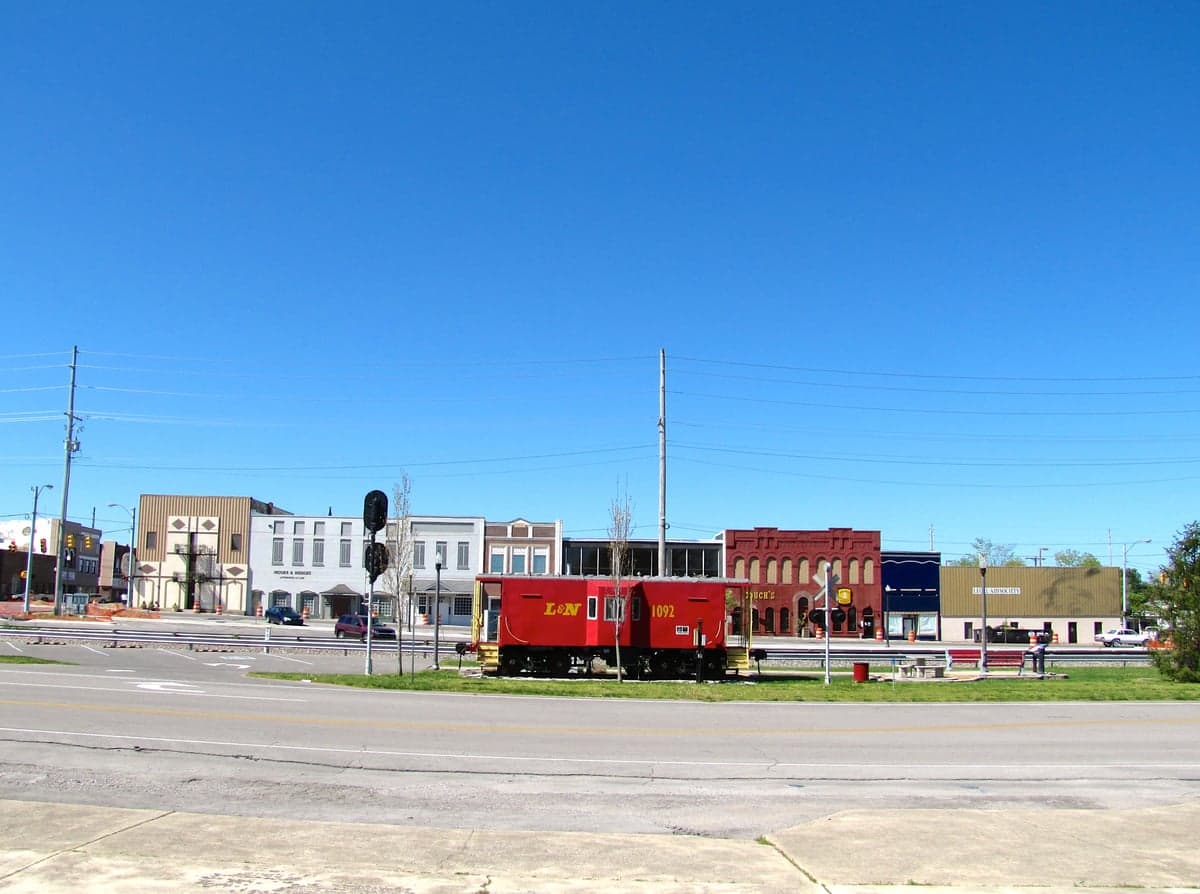
Tullahoma was founded in 1852 as a railroad town on the Nashville and Chattanooga Railroad, drawing its earliest population from surrounding rural areas of Middle Tennessee. The original settlers were predominantly of English and Scots-Irish descent, subsistence farmers and small landowners who moved to the new rail stop for access to markets. The first wave of growth came during the Civil War, when the city served as a Union supply depot, but the defining population surge began in the 1940s with the establishment of the Arnold Engineering Development Center (AEDC) by the U.S. Army Air Forces. This federal investment brought a wave of engineers, technicians, and military personnel from across the country, many of whom settled in the North Tullahoma neighborhood near the base. A second wave followed in the 1950s and 1960s as AEDC expanded, drawing skilled workers and their families into the West Tullahoma area, where larger single-family homes were built. The historic Downtown Tullahoma district, centered around the railroad depot, remained the commercial and social heart for the original railroad-era families, while the newer subdivisions reflected the post-war professional class.
Modern era (post-1965)
After the 1965 Hart-Cellar Act, Tullahoma saw virtually no increase in foreign-born immigration, a pattern that continues today with only 0.5% foreign-born. Domestic in-migration has been the primary driver of demographic change, but it has been modest and largely internal to Tennessee and the surrounding Southeast. The Black population, at 6.3%, is concentrated in the East Tullahoma neighborhood, historically the area where African American families settled after the Civil War and through the Jim Crow era. This community has remained stable but has not grown significantly, reflecting limited new Black in-migration. The Hispanic population (5.6%) is the fastest-growing group, though still small, and is dispersed primarily in the South Tullahoma area, where lower-cost housing and employment in manufacturing and service jobs have attracted families from Mexico and Central America. The East/Southeast Asian population (1.2%) is largely composed of professionals and their families associated with AEDC and the University of Tennessee Space Institute, living in the West Tullahoma and North Tullahoma subdivisions. The Indian subcontinent population is effectively zero (0.0%), meaning no significant community from India, Pakistan, Bangladesh, or Sri Lanka exists in the city.
The future
The population of Tullahoma is likely to remain predominantly white and native-born for the foreseeable future. The city’s low foreign-born share and lack of a major university or refugee resettlement program mean that immigrant-driven growth will remain minimal. The Hispanic population may continue to grow slowly as families follow employment in manufacturing and agriculture, but it is unlikely to reach double digits in the next decade. The Black population is plateauing, with no major drivers of in-migration. The East/Southeast Asian population will likely remain small and tied to the aerospace sector. The city is not homogenizing into a single identity but is instead tribalizing into distinct neighborhoods: North Tullahoma and West Tullahoma remain the professional, college-educated enclaves; East Tullahoma is the historic Black community; South Tullahoma is the emerging Hispanic corridor; and Downtown Tullahoma is seeing a slow revitalization as a mixed-use area for all groups. The overall population is aging, with a median age above the national average, and the city may see a slight decline in total numbers over the next 20 years unless new industry or retirement migration offsets the trend.
For someone moving in now, Tullahoma offers a stable, low-diversity community with a strong sense of place and clear neighborhood identities. The city is becoming more defined by its internal enclaves than by new arrivals, and the lack of significant demographic change means that newcomers will find a population that is largely the same as it was a generation ago. This is a place for those seeking predictability, a slower pace, and a community where the past still shapes the present.

* Values derived from national, state, county, city and local statistics and may differ in a specific area. Last updated: 2026-05-01T11:46:04.000Z
Narrative content on this page is AI-generated and may contain mistakes. Verify any details that matter before acting on them.
ReloMaps may earn a commission from affiliate links at no extra cost to you.

