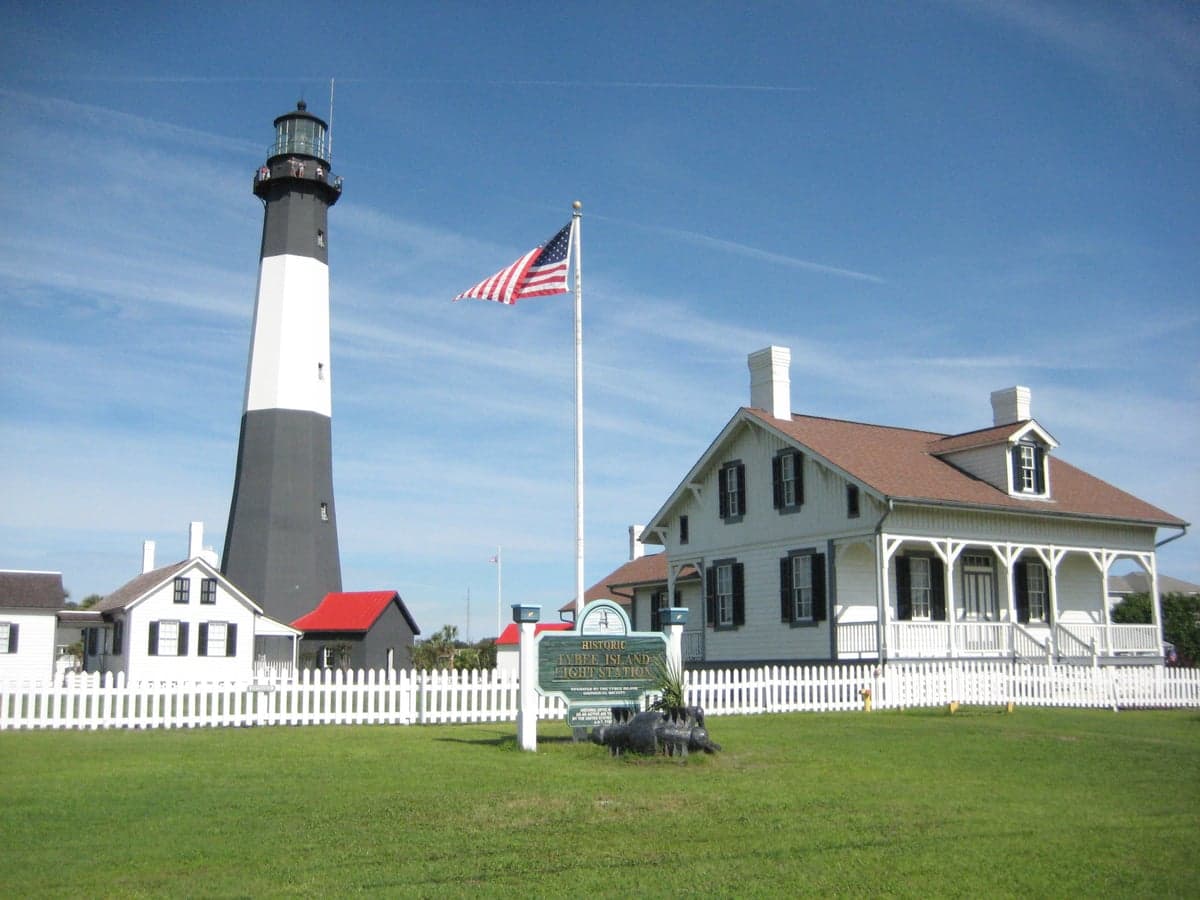
Photo: Wikipedia
Demographics of Tybee Island, GA
Affluence Level in Tybee Island, GA
An upper-middle-class area. Household wealth, education levels, and homeownership run ahead of national benchmarks.
People of Tybee Island, GA
Tybee Island, Georgia, is a small, tightly-knit coastal community of 3,121 residents that is overwhelmingly white (94.9%) and highly educated (49.7% hold a college degree). The island’s population is notably homogeneous, with a foreign-born share of just 1.7% and no recorded Hispanic or East/Southeast Asian residents. Its character is defined by a mix of longtime local families, seasonal second-home owners, and a growing number of remote workers drawn to its beachside lifestyle, creating a distinct identity that balances small-town Southern roots with a laid-back, tourist-oriented economy.
How the city was settled and grew
Tybee Island’s human history began with Native American inhabitants, but its permanent European settlement took shape in the early 18th century as a military outpost. The island’s strategic location at the mouth of the Savannah River led to the construction of Fort Screven in the 1890s, which became the primary driver of population growth. The fort brought military personnel, engineers, and their families to the island, many of whom settled in what is now the Fort Screven Historic District, a neighborhood of early 20th-century cottages and officer quarters that still anchors the island’s northern end. After the fort’s decommissioning in 1947, the island transitioned to a tourism and residential economy. The Mid Island area, centered around Butler Avenue, developed as the commercial and residential core, attracting middle-class families and seasonal visitors. The South End, near the lighthouse and beach, became a hub for vacation rentals and second homes, drawing wealthier seasonal residents from Savannah and beyond. By the mid-20th century, Tybee’s population remained small and overwhelmingly white, shaped by its military and tourism roots rather than industrial or agricultural migration.
Modern era (post-1965)
After the 1965 Hart-Cellar Act, Tybee Island saw virtually no increase in foreign-born or non-white populations, a pattern that continues today. The island’s modern demographic story is one of domestic in-migration, primarily from within Georgia and the Southeast. The Back River area, a quieter residential stretch along the island’s western side, attracted retirees and families seeking lower-density living, while the North Beach neighborhood, near the old fort, became a mix of year-round locals and short-term rental properties. The island’s Black population, at 2.5%, is largely composed of families with deep roots in the area, many of whom trace their lineage to the Gullah Geechee communities of the nearby Lowcountry. However, Tybee never experienced the suburban boom that diversified other coastal Georgia towns; its limited land area, strict zoning, and high property values have kept it exclusive and demographically stable. The college-educated share (49.7%) reflects an influx of professionals and remote workers since the 2010s, many of whom purchased homes in the Chatham Crescent area (a small enclave on the island’s eastern edge) or renovated historic cottages in the Fort Screven district.
The future
Tybee Island’s population is likely to remain small and homogeneous over the next 10–20 years. The island has no room for large-scale development, and its zoning laws favor single-family homes and low-density construction. The foreign-born share (1.7%) is unlikely to rise significantly, as there are no major immigrant-employing industries or affordable housing stock to attract new arrivals. The Hispanic and East/Southeast Asian populations are recorded at 0.0%, and there is no indication of future growth in these groups. Instead, the island is homogenizing further: younger families and remote workers are replacing older retirees, but the racial and ethnic composition remains static. The Mid Island area may see modest infill development, but the South End and Fort Screven neighborhoods will likely remain dominated by vacation rentals and second homes, limiting year-round population growth. The island’s high property values and lack of rental diversity mean that new residents will continue to be predominantly white, college-educated, and relatively affluent.
For someone moving to Tybee Island now, the community offers a stable, insular, and predominantly white environment with a strong sense of local identity. The population is not diversifying, and the island’s future is one of slow, controlled growth that preserves its existing character. New residents should expect a place where long-time locals and seasonal visitors coexist, where the economy revolves around tourism and remote work, and where demographic change is minimal. This is a community that values its history and its quiet, beachside lifestyle—ideal for those seeking predictability and a tight-knit social fabric, but not for those looking for ethnic or cultural diversity.

* Values derived from national, state, county, city and local statistics and may differ in a specific area. Last updated: 2026-04-23T05:28:25.000Z
Narrative content on this page is AI-generated and may contain mistakes. Verify any details that matter before acting on them.
ReloMaps may earn a commission from affiliate links at no extra cost to you.

