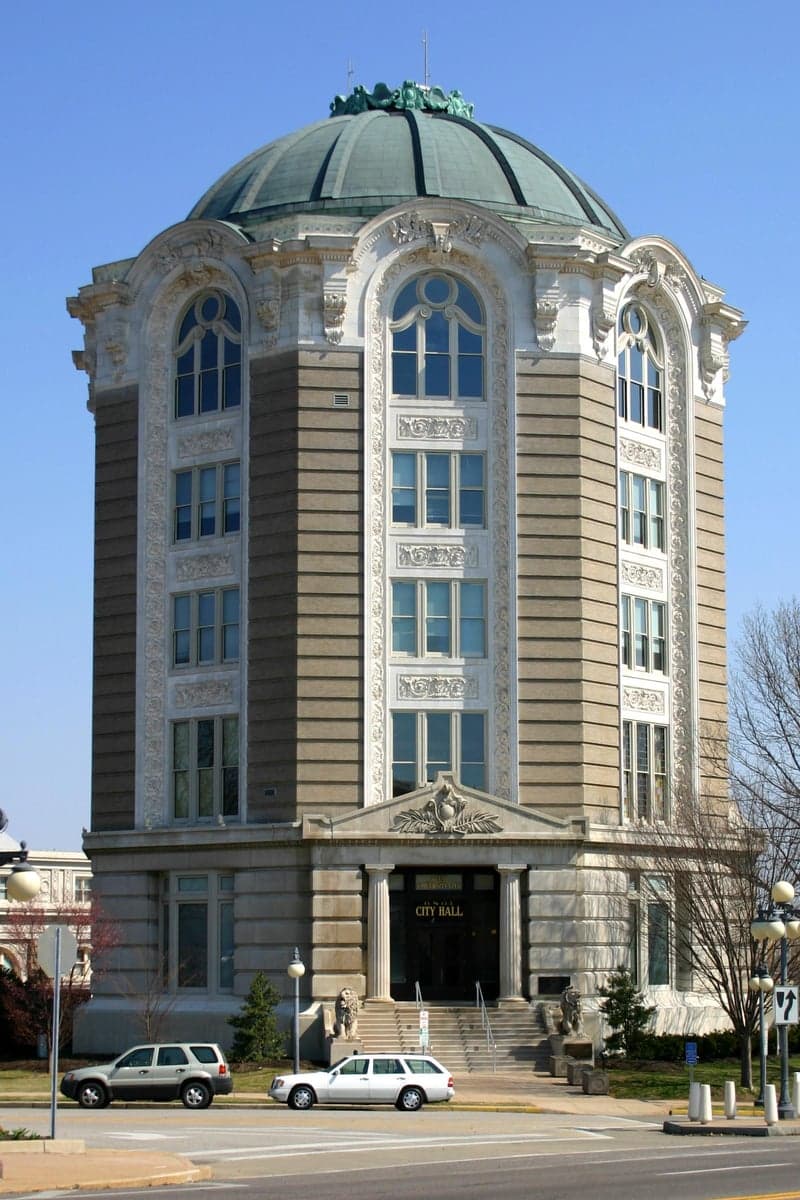
Photo: Wikipedia
Demographics of University City, MO
Affluence Level in University City, MO
An upper-middle-class area. Household wealth, education levels, and homeownership run ahead of national benchmarks.
People of University City, MO
University City, Missouri, is a dense, historic inner-ring suburb of St. Louis with a population of 34,655 that is notably diverse and highly educated. Its residents are a mix of long-standing Jewish and Black families, a growing East and Southeast Asian community, and a significant white professional class drawn by its walkable neighborhoods and top-tier schools. With 64.2% of adults holding a college degree, the city is defined by its intellectual and cultural character, anchored by Washington University in St. Louis just across the city line.
How the city was settled and grew
University City was not a 19th-century farming village but a planned early-20th-century suburb, incorporated in 1906. The city was the brainchild of developer Edward Gardner Lewis, who envisioned a model community centered around a "people's university" (hence the name). The original population was overwhelmingly white, native-born, and middle-to-upper class, drawn by the promise of modern infrastructure, electric streetcars, and large lots. The first major wave of settlement concentrated in the Delmar Loop area and the Parkview neighborhood, where grand Arts and Crafts homes were built for St. Louis businessmen and professionals. A second, crucial wave arrived in the 1920s and 1930s: Jewish families fleeing discrimination and restrictive covenants in the city of St. Louis. They settled heavily in the Westgate and Heman Park neighborhoods, establishing synagogues, delis, and a vibrant civic life that made University City a regional hub of Jewish culture for decades.
Modern era (post-1965)
The post-1965 era brought profound demographic change. The Immigration and Nationality Act of 1965 opened the door to new arrivals, while the 1968 Fair Housing Act allowed Black families to move into previously restricted neighborhoods. White flight from St. Louis city accelerated in the 1970s and 1980s, and University City experienced a rapid racial transition. The Jackson Park and Heman Park neighborhoods became predominantly Black as middle-class African American families moved in, while many white families moved farther west to Creve Coeur and Chesterfield. By the 1990s, the city was roughly 50% Black and 45% white. Today, the white population has rebounded slightly to 54.7%, driven by young professionals and academics renovating historic homes in Parkview and the Delmar Loop. The Black population stands at 30.4%, concentrated in the central and eastern neighborhoods. The East and Southeast Asian community (5.8%) is a newer, smaller wave, largely composed of Chinese and Korean families drawn to the University City School District's strong reputation; they are most visible in the Delmar Loop and near the Washington University campus border. The Indian-subcontinent population (0.8%) and Hispanic population (3.4%) remain modest but stable.
The future
The population is trending toward a bifurcated future. The western neighborhoods (Parkview, Westgate) are becoming whiter and wealthier, as historic home prices push out all but the affluent. The eastern and central areas (Jackson Park, Heman Park) remain predominantly Black and more economically diverse, though gentrification pressure is creeping eastward along the Delmar Loop. The East and Southeast Asian community is growing slowly but steadily, likely plateauing as housing costs rise. The foreign-born share (7.0%) is below the national average, and there is no large immigrant enclave forming. The city is not homogenizing into a single identity; rather, it is tribalizing into distinct, economically stratified enclaves. The next 10-20 years will likely see continued in-fill development along the Loop, a gradual increase in the white professional share, and a slow decline in the Black population as families are priced out or move to more affordable suburbs like Ferguson or Florissant.
For someone moving in now, University City offers a dense, walkable, intellectually vibrant environment with excellent schools and a genuinely diverse population—but it is a place of sharp contrasts. The city is becoming more affluent and white in its western half while remaining more diverse and economically strained in its eastern half. New residents should expect a community that values its progressive identity but is grappling with the real estate pressures that threaten to narrow its historic diversity.

* Values derived from national, state, county, city and local statistics and may differ in a specific area. Last updated: 2026-05-29T16:46:43.000Z
Narrative content on this page is AI-generated and may contain mistakes. Verify any details that matter before acting on them.
ReloMaps may earn a commission from affiliate links at no extra cost to you.

