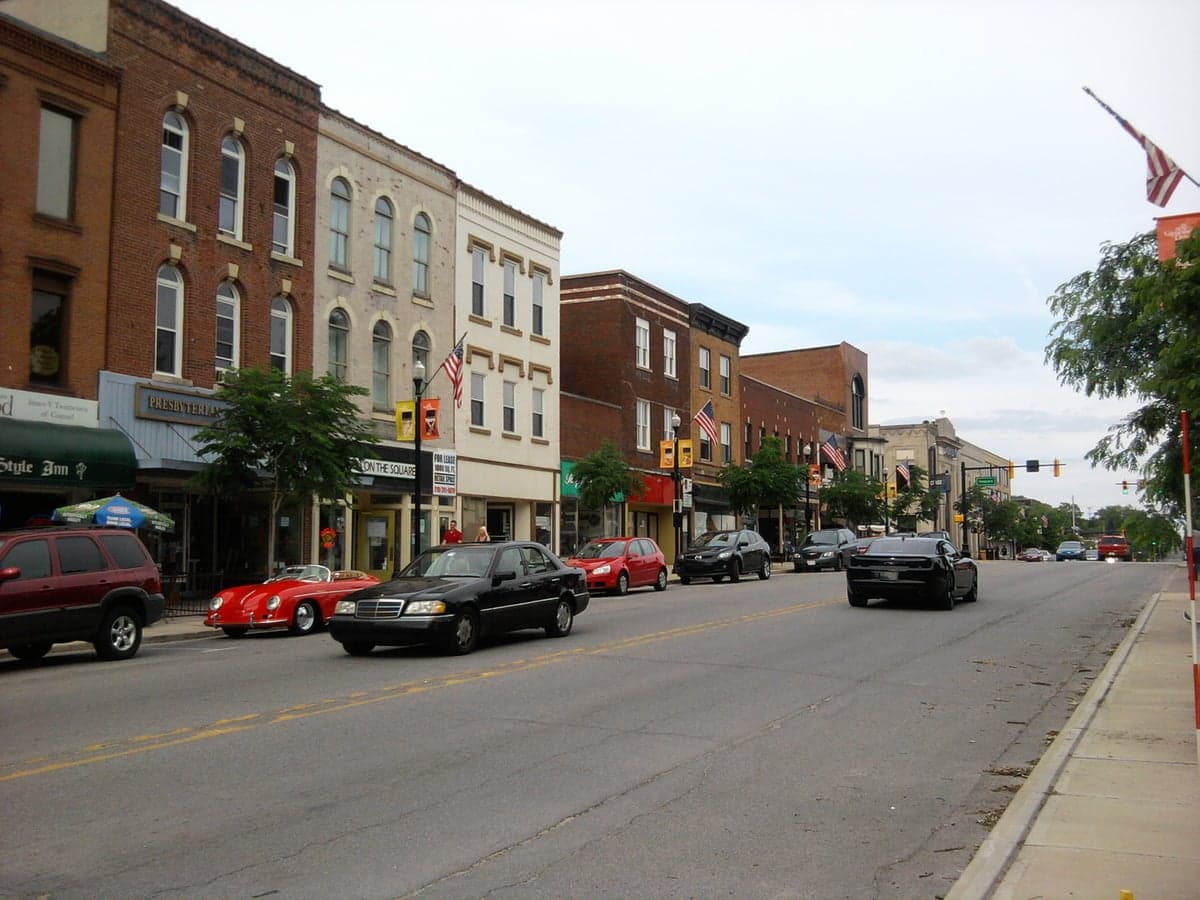
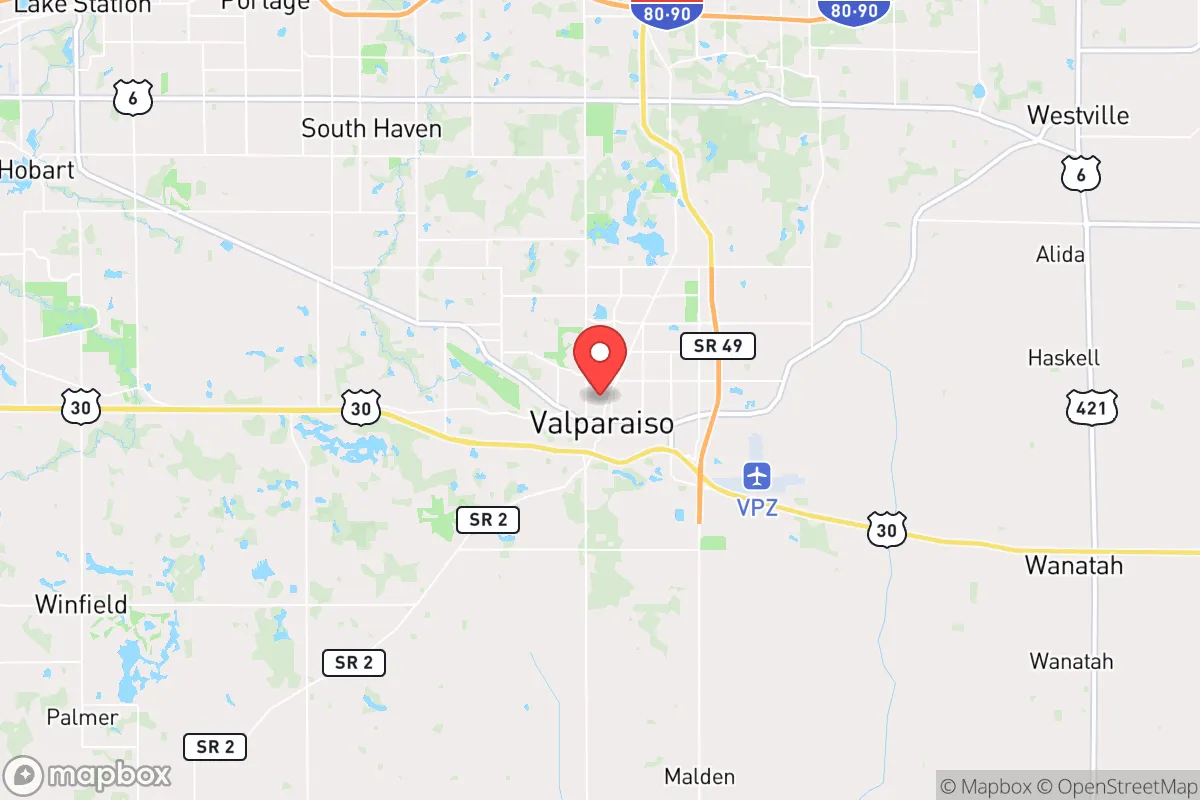
Photo: Wikipedia
Demographics of Valparaiso, IN
Affluence Level in Valparaiso, IN
A middle-class area roughly in line with national averages across income, home values, education, and employment.
People of Valparaiso, IN
Valparaiso, Indiana, is a city of roughly 34,400 residents that remains predominantly white (80.4%) and well-educated (40.6% hold a bachelor’s degree or higher), with a small but growing Hispanic population (9.0%) and modest East/Southeast Asian (2.1%) and Indian-subcontinent (1.1%) communities. The city’s character is shaped by its role as the seat of Porter County, a historic railroad and manufacturing hub that has transitioned into a commuter and college town anchored by Valparaiso University. Residents describe it as a family-oriented, politically moderate-to-conservative community where local government and school board races often draw more attention than national politics, and where the population is slowly diversifying without dramatic demographic upheaval.
How the city was settled and grew
Valparaiso’s founding population arrived in the 1830s and 1840s, drawn by the federal land office established in 1836 and the promise of fertile farmland in the Calumet region. The city was platted in 1836 and named after the Chilean port, a reflection of the era’s romantic nationalism. The first major wave of settlers were Yankees from New England and upstate New York, who built the early downtown around what is now the Courthouse Square Historic District. A second wave, beginning in the 1850s, brought German and Irish immigrants who worked on the railroad lines and in the region’s emerging lumber and milling industries. These groups settled in the North Side neighborhood, where modest worker cottages and St. Paul’s Catholic Church (founded 1853) still mark their presence. By the 1870s, Swedish immigrants arrived to farm the sandy loam soils south of the city, establishing a rural enclave that later became the Southlawn area. The founding of Valparaiso University (then Northern Indiana Normal School) in 1873 attracted a small but steady stream of faculty and students, creating a distinct college-town demographic in the University Park district. Through the early 20th century, the city’s population grew slowly, reaching about 8,000 by 1930, with the industrial base shifting from agriculture to steel and manufacturing as the Gary-Chicago corridor expanded.
Modern era (post-1965)
The post-1965 period brought two significant demographic shifts. First, the expansion of Valparaiso University under the Lutheran Church–Missouri Synod drew a small but visible East/Southeast Asian population, primarily faculty and graduate students in engineering and the sciences. These families settled in the Forest Park neighborhood, near the university’s south edge, where newer subdivisions offered larger lots and good schools. Second, the completion of the Indiana Toll Road (I-80/90) in the 1950s and the subsequent suburbanization of the Chicago metro area turned Valparaiso into a bedroom community for commuters working in Lake County and even Chicago. This domestic in-migration, mostly white and middle-class, filled subdivisions like Briar Ridge and Creekside on the city’s west and north sides. The Hispanic population, which stood at just 1.5% in 1990, grew to 9.0% by 2020, driven by Mexican and Central American families moving into service and construction jobs. These newer arrivals have concentrated in the Eastside neighborhood, near the industrial corridor along U.S. 30, where rental housing and older single-family homes are more affordable. The Indian-subcontinent community, though small at 1.1%, has grown since the 1990s, with professionals in healthcare and information technology settling in the Silhavy area near the hospital and the university. The Black population has remained stable at around 3.3%, with no single neighborhood majority, reflecting a pattern of scattered integration rather than concentrated settlement.
The future
Valparaiso’s population is likely to continue its slow diversification, driven by two forces: the expansion of the healthcare and education sectors (the city’s largest employers) and the ongoing spillover of Chicago-area residents seeking lower taxes and better schools. The Hispanic share is projected to reach 12-14% by 2040, based on current birth rates and continued in-migration, with the Eastside neighborhood becoming a more distinct ethnic enclave. The East/Southeast Asian and Indian-subcontinent populations are expected to grow modestly, primarily through professional recruitment to the university and the Porter Regional Hospital system, but will likely remain below 5% combined. The white population, while still the majority, is aging: the median age in Valparaiso is 34.5, but the over-65 cohort is growing faster than the under-18 cohort, a trend that may slow future growth unless younger families are attracted by new housing developments. The city is not tribalizing into sharply divided enclaves; rather, it is experiencing a gentle, market-driven diversification where most neighborhoods remain predominantly white but with visible minority pockets. The biggest wildcard is housing affordability: Valparaiso’s median home value of $280,000 (2025 estimate) is high for Northwest Indiana, which may limit in-migration from lower-income groups and reinforce its character as a solidly middle-class, college-educated community.
For someone moving in now, Valparaiso offers a stable, family-oriented environment with good schools and a conservative-leaning civic culture, but with enough diversity—especially in the Eastside and University Park areas—to avoid the insularity of a purely homogeneous suburb. The city is becoming slightly more diverse, slightly more expensive, and slightly more connected to Chicago, but it remains fundamentally a place where the old Yankee and German roots still shape the social and political landscape.

* Values derived from national, state, county, city and local statistics and may differ in a specific area. Last updated: 2026-04-19T19:56:08.000Z
Narrative content on this page is AI-generated and may contain mistakes. Verify any details that matter before acting on them.
ReloMaps may earn a commission from affiliate links at no extra cost to you.

