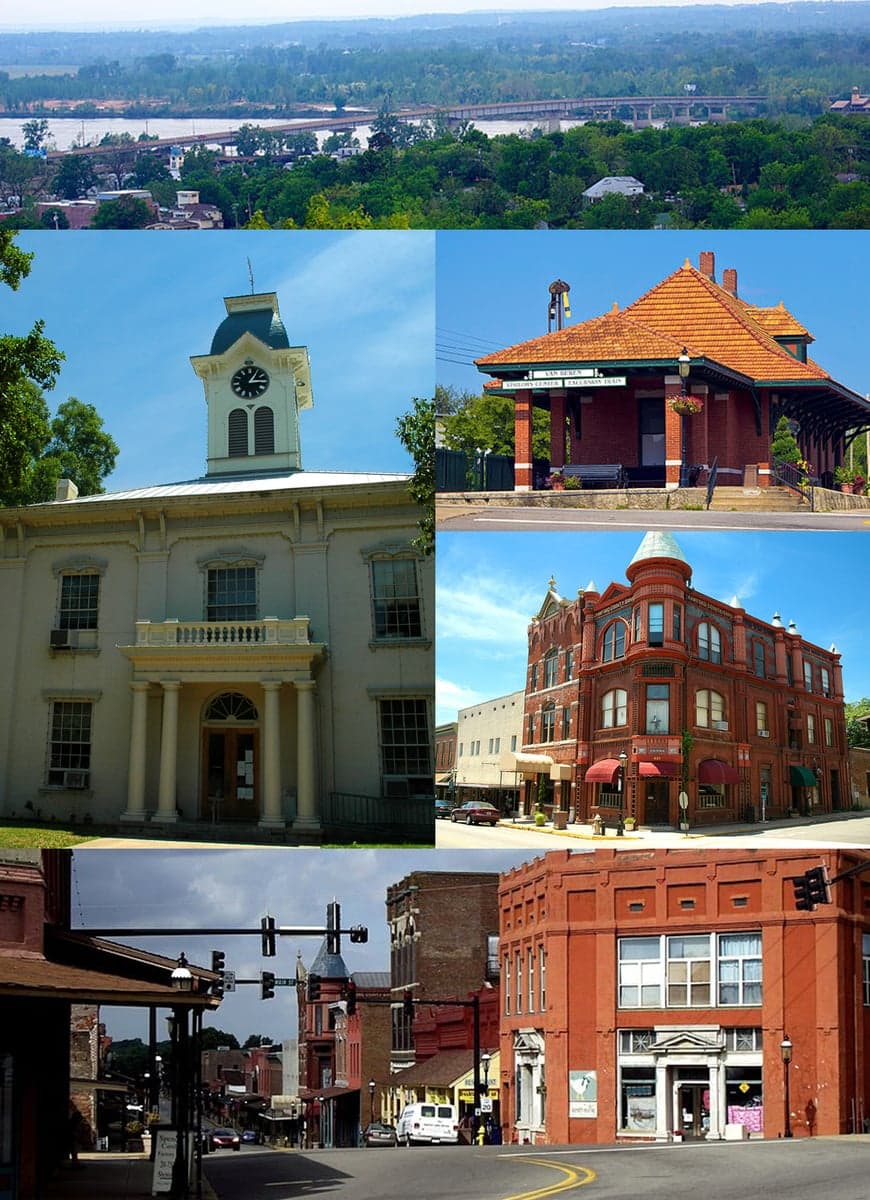
 Popular

Photo: Wikipedia
Demographics of Van Buren, AR
Affluence Level in Van Buren, AR
A middle-class area roughly in line with national averages across income, home values, education, and employment.
People of Van Buren, AR
Van Buren, Arkansas, today is a predominantly white, working-class city of 23,545 residents, with a growing Hispanic minority and a small but established East/Southeast Asian community. The city’s identity is rooted in its historic river-port and railroad past, with a noticeably lower college attainment rate (19.8%) than the national average, reflecting a blue-collar and service-oriented economy. Its population is denser and older than neighboring Fort Smith, with a distinct small-town character that values local history and community ties.
How the city was settled and grew
Van Buren’s original population was drawn by its strategic location on the Arkansas River and the arrival of the railroad in the 1840s. The city was founded in 1831 as a river port for cotton and timber, and its first major wave of settlers were Anglo-American farmers and merchants from the Upper South, primarily Tennessee and Kentucky. These early families built homes in the Historic Main Street District, where Greek Revival and Victorian houses still stand, and established the city’s commercial core along the riverfront. A second wave came after the Civil War, when the railroad expanded and brought Irish and German laborers to work on the tracks and in the new lumber mills. These immigrants settled in the Dora and Lee Creek neighborhoods, which remain working-class areas with older housing stock. By 1900, Van Buren was a thriving railroad town with a population of about 3,000, almost entirely white and native-born, with a small Black community that lived near the river in what was then called the “Bottom” area (now part of the industrial district). The city’s growth slowed after World War II, as manufacturing jobs shifted to nearby Fort Smith, and Van Buren became a quieter bedroom community.
Modern era (post-1965)
The post-1965 era brought two significant demographic shifts. The first was the arrival of Hispanic workers, primarily from Mexico and Central America, who came to work in poultry processing plants and construction. By 2020, the Hispanic share of the population had reached 15.6%, with most families settling in the South 28th Street corridor and the Pleasant View neighborhood, where newer, affordable housing subdivisions were built. The second shift was the growth of an East/Southeast Asian community, now at 2.1% of the population, largely Vietnamese and Filipino families who moved to the area for jobs at the nearby Fort Smith Tyson Foods plant and the regional medical center. These families concentrated in the Park Hill area, near the high school, where mid-century ranch homes are common. The Black population, historically small, declined further to just 1.5%, as many families left for larger cities in the 1970s and 1980s. The Indian-subcontinent population remains negligible at 0.1%. Domestic in-migration during this period came primarily from other parts of Arkansas and Oklahoma, drawn by lower housing costs and a slower pace of life. These new residents tended to settle in the Renaissance subdivision and other newer developments on the city’s western edge, reinforcing the city’s overall white majority.
The future
Van Buren’s population is projected to grow slowly, reaching roughly 26,000 by 2035, driven primarily by Hispanic natural increase and continued in-migration from within the region. The city is not homogenizing; rather, it is becoming more ethnically segmented. The Hispanic community is growing and consolidating in the South 28th Street and Pleasant View areas, while the white population remains dominant in the older historic districts and newer western subdivisions. The East/Southeast Asian community is small and stable, with little new immigration expected. The foreign-born share (3.5%) is low but rising, almost entirely from Latin America. The city’s low college attainment rate suggests that future growth will likely be in service and light manufacturing jobs, not in high-tech or professional sectors. For a newcomer, this means Van Buren will remain a predominantly white, conservative, working-class city with a growing Hispanic minority that is increasingly visible in local schools and small businesses.
For someone moving in now, Van Buren is becoming a more diverse but still strongly traditional community, where the historic Anglo-American character is slowly blending with a Hispanic influence, while other ethnic groups remain small and peripheral. The city offers affordable housing and a tight-knit feel, but the economic and educational opportunities are limited compared to larger metro areas.

* Values derived from national, state, county, city and local statistics and may differ in a specific area. Last updated: 2026-04-23T03:01:48.000Z
Narrative content on this page is AI-generated and may contain mistakes. Verify any details that matter before acting on them.
ReloMaps may earn a commission from affiliate links at no extra cost to you.

