Photo: Wikipedia
Demographics of Ventura, CA
Affluence Level in Ventura, CA
An upper-middle-class area. Household wealth, education levels, and homeownership run ahead of national benchmarks.
People of Ventura, CA
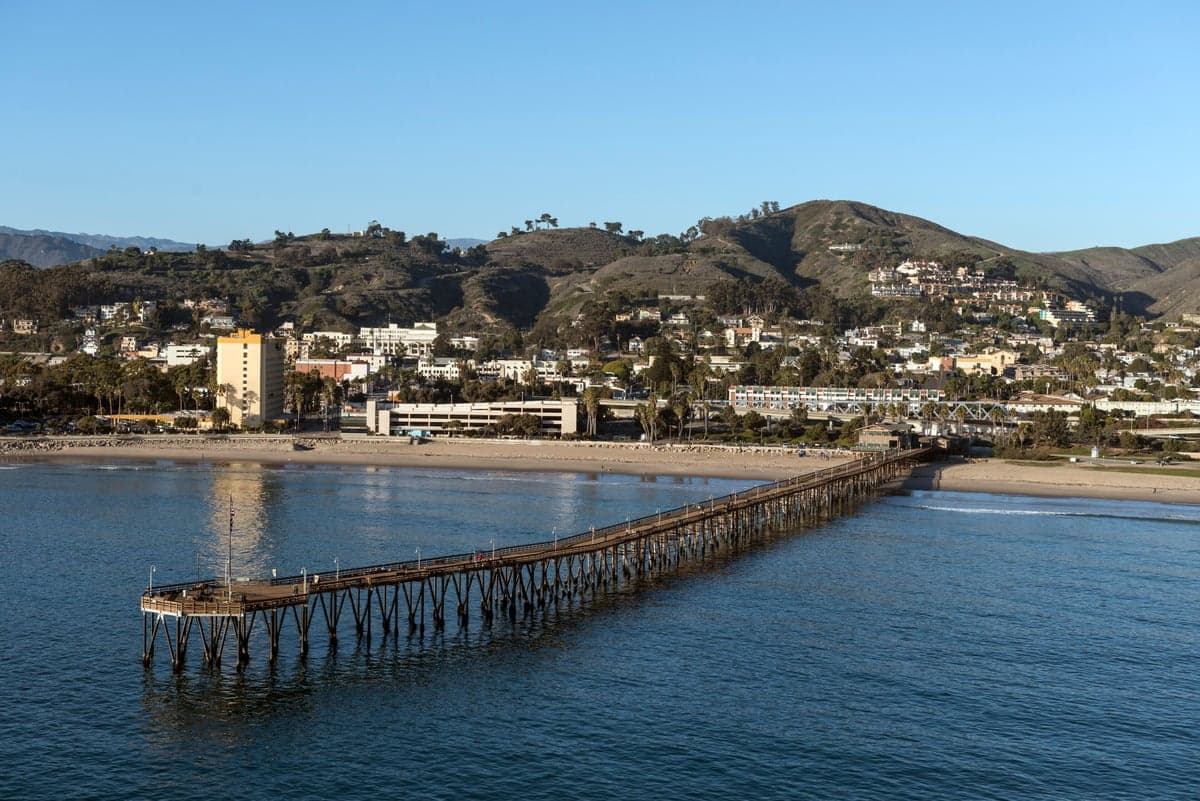
The people of Ventura, California, today number roughly 109,900, forming a city that is majority-white (53.3%) with a substantial Hispanic minority (35.7%) and small but growing East/Southeast Asian (3.2%) and Indian (1.0%) communities. The city’s character is defined by its historic downtown, a working waterfront, and a notably low foreign-born share of just 5.6% — far below the California average — reflecting a population that is largely native-born and multigenerational. Ventura feels less like a coastal melting pot and more like a stable, middle-class American city with a strong sense of local identity, where the dominant cultural tension is between its Anglo and Mexican-American heritage rather than between newer immigrant groups.
How the city was settled and grew
Ventura’s human history begins with the Chumash people, who lived along this stretch of coast for thousands of years before Spanish colonization. The city’s European founding came in 1782 with the establishment of Mission San Buenaventura, which drew Spanish soldiers and settlers to what is now the Mission Historic District. After Mexican independence, large land grants like Rancho San Miguelito and Rancho Cañada Larga created a ranching economy, but the population remained sparse — a mix of Californio families and mission-adjacent Indigenous laborers. The real demographic shift began after the U.S. annexation in 1848 and the arrival of the Southern Pacific Railroad in 1887. That rail link turned Ventura from a sleepy ranching outpost into a shipping hub for citrus, walnuts, and oil. Anglo-American migrants from the Midwest and East Coast poured in, settling the Midtown and Westside neighborhoods with tidy bungalows and forming the city’s white, Protestant, small-town character. By 1900, the population had reached about 2,500, and the city’s Anglo majority was firmly established. Mexican-American workers, drawn by agricultural and railroad jobs, settled in the Eastside and Westside barrios, creating a parallel community that would grow steadily through the 20th century.
Modern era (post-1965)
The 1965 Immigration and Nationality Act had a muted effect on Ventura compared to Los Angeles or San Jose. The city’s foreign-born share remains low at 5.6%, and the Hispanic population grew primarily through natural increase and domestic migration from other California cities rather than direct immigration. The 1970s and 1980s saw suburban expansion into the College Area and Foothill neighborhoods, attracting white-collar families from the San Fernando Valley and Oxnard who sought lower housing costs and better schools. The Hispanic share rose from roughly 15% in 1970 to 35.7% today, with the Eastside remaining the historic heart of the Mexican-American community, while newer Hispanic residents moved into the Westside and parts of Midtown. The Asian population — primarily Filipino and Vietnamese — grew modestly from near-zero to 3.2%, concentrated in the College Area near Ventura College and in newer subdivisions near the 101 freeway. The Indian community, at 1.0%, is small but visible in the medical and tech sectors, with no single ethnic enclave. The Black population has remained flat at 1.3%, a figure that has not changed significantly since the 1970s. The white share has declined from over 80% in 1970 to 53.3% today, driven by aging demographics and out-migration of younger families to cheaper inland areas.
The future
Ventura’s population is trending older and more Hispanic, with the white share projected to fall below 50% within the next decade. The Hispanic population is not tribalizing into isolated enclaves but is instead dispersing across the city, particularly into the Westside and Midtown, as the historic Eastside becomes more mixed. The East/Southeast Asian and Indian communities are growing slowly through professional in-migration, but neither is likely to reach double-digit shares by 2040. The foreign-born share is expected to remain low, as Ventura lacks the entry-level job base and dense ethnic networks that drive immigration in larger cities. The biggest demographic story is the continued aging of the white population and the gradual replacement of older Anglo homeowners with younger Hispanic families, a process that is already visible in the city’s elementary school enrollment, which is now majority Hispanic. This is not a story of rapid change or ethnic conflict, but of slow, generational turnover.
For someone moving to Ventura now, the city offers a stable, low-drama demographic environment. It is not a place of high immigration or rapid diversification, but of gradual Hispanicization within a still-white-majority framework. The neighborhoods remain relatively integrated, with no single group dominating any area to the exclusion of others. The city’s character — coastal, historic, family-oriented — is likely to persist, even as its ethnic composition shifts. For conservative-leaning families, Ventura represents a California city that has avoided the sharp ethnic polarization and high immigration rates of larger metros, while still offering a genuine multicultural texture through its Mexican-American heritage.

* Values derived from national, state, county, city and local statistics and may differ in a specific area. Last updated: 2026-04-22T01:17:10.000Z
Narrative content on this page is AI-generated and may contain mistakes. Verify any details that matter before acting on them.
ReloMaps may earn a commission from affiliate links at no extra cost to you.

