Photo: Wikipedia
Political ClimatePolitical Climate in Ventura, CA
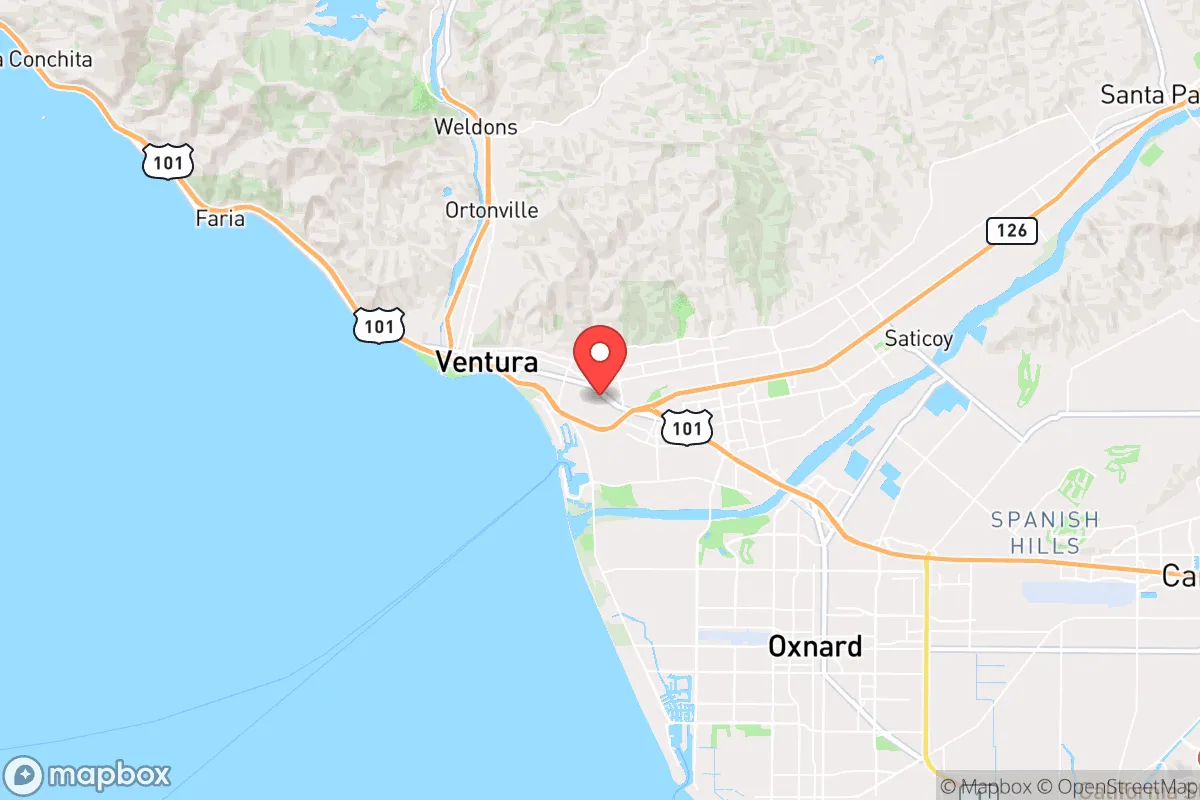
District shown is the primary district for this city’s centroid. Cities may span multiple districts.
Local Political AnalysisPolitical Analysis of Ventura, CA
Ventura, California, leans heavily Democratic, with a Cook PVI of D+13, meaning the city votes about 13 points more Democratic than the national average. This wasn't always the case—I remember when this town was a lot more purple, with a healthy mix of working-class families, farmers, and small business owners who kept things balanced. Over the last decade or so, the shift has been pretty dramatic, driven by an influx of folks from Los Angeles and the Bay Area who bring their big-city politics with them. The trajectory feels like it's heading further left, and honestly, that's got a lot of longtime residents worried about what's next for our local freedoms.
How it compares
If you drive just a few miles inland, you'll hit places like Santa Paula or Fillmore, where the political vibe is noticeably more conservative—those areas still have a strong agricultural base and a lot of folks who value personal responsibility over government programs. Oxnard, right next door, is also Democratic but has a more moderate, working-class flavor compared to Ventura's coastal progressive tilt. The contrast is stark: in Ventura, you'll see more "Black Lives Matter" signs and climate activism, while out in the orchards, it's "Don't Tread on Me" and concerns about water rights. Even within Ventura County, the Board of Supervisors has a conservative majority, which creates a constant tug-of-war between city and county policies—especially on land use and public health mandates.
What this means for residents
For those of us who value personal freedoms, the local political climate can feel suffocating at times. The city council has pushed through things like strict rent control, plastic bag bans, and even considered a soda tax—all well-intentioned, sure, but they add up to a lot of government telling you how to live your life. Property taxes are already high thanks to Prop 13 loopholes being chipped away, and there's constant chatter about new bond measures for affordable housing and transit projects that never seem to deliver results. The school board has also leaned into progressive curriculum changes, which has some parents worried about losing control over what their kids are taught. If you're a small business owner, the permitting process can be a nightmare, with environmental reviews and labor regulations that make it hard to just open a shop without jumping through hoops.
Cultural and policy distinctions
One thing that stands out about Ventura is its "surf town" identity—there's a strong libertarian streak beneath the surface, especially among the older crowd who remember when the city was more about beach access and fishing than political activism. You'll still find plenty of folks who fly the Gadsden flag on their pickup trucks, but they're increasingly outnumbered by newcomers who want to ban gas-powered leaf blowers and restrict short-term rentals. The city's ban on new oil drilling and its push for "sanctuary city" status are big red flags for anyone who thinks local government should stay out of energy policy and immigration enforcement. Looking ahead, I'd expect more fights over housing density, water usage, and police funding—the progressive wing is gaining momentum, and it feels like the old Ventura is slowly being regulated out of existence. If you're considering a move here, just know that the political climate is friendly if you lean left, but if you value limited government and personal choice, you'll need to get involved in local elections to have any say in how things shake out.

State Political ClimatePolitical Climate in California
State Political AnalysisPolitical Environment in the State
California is a one-party Democratic superstate where Republicans have been reduced to a permanent minority, holding zero statewide offices and just 11 of 52 congressional seats as of 2025. The state’s overall partisan lean is roughly D+25 in presidential elections, but that number masks a dramatic 20-year trajectory: in 2004, George W. Bush lost California by just 10 points; by 2024, the Democratic margin had ballooned to nearly 30 points. The dominant coalition is a fusion of coastal progressives, Silicon Valley tech donors, and public-sector unions, with Latino voters—once a swing bloc—now breaking for Democrats by a 2-to-1 margin. For a conservative considering relocation, the bottom line is that California’s political culture is hostile to traditional values, and the state’s policy apparatus is designed to squeeze out anyone who doesn’t align with its progressive orthodoxy.
Urban vs. rural divide
The political map of California is a tale of two nations. The entire coast from San Diego up through Los Angeles, the Bay Area, and into the North Coast is solidly Democratic, with San Francisco and Oakland routinely delivering 85-90% of the vote to Democrats. The Central Valley—places like Bakersfield, Fresno, and Modesto—is more competitive but trending blue as Latino populations grow and union organizing intensifies. The real Republican strongholds are the inland rural counties: the Sierra Nevada foothills (Placer, El Dorado, Tuolumne), the far north (Shasta, Siskiyou, Modoc), and the desert interior (Kern, Riverside, San Bernardino). But these areas are losing population and political clout. A telling example: Orange County, once the heart of Reagan Republicanism, flipped to Biden in 2020 and has not looked back—its suburban voters, especially Asian-Americans and college-educated whites, have abandoned the GOP over Trump-era culture wars. The Inland Empire (Riverside and San Bernardino counties) remains a purple battleground, but even there, Democratic registration is climbing faster than Republican. The urban-rural split is so stark that a conservative living in Bakersfield might feel like they’re in a different country from someone in San Francisco, but the state’s legislative maps ensure that the cities call the shots.
Policy environment
California’s policy environment is a laboratory for progressive governance, and it shows in every lever of state power. The state has the highest personal income tax rate in the nation (13.3% for top earners), a corporate tax rate of 8.84%, and a sales tax that can exceed 10% in some cities. Property taxes are capped by Proposition 13, but the state has found workarounds through parcel taxes and Mello-Roos districts. On regulation, California sets its own emissions standards, mandates electric vehicle sales by 2035, and has some of the strictest labor laws in the country, including a $16 minimum wage and mandatory paid sick leave. Education policy is dominated by the California Teachers Association, which has blocked school choice and charter expansion for decades; the state’s public schools rank near the bottom nationally in reading and math proficiency despite per-pupil spending above the national average. Healthcare is heavily regulated, with a state-run exchange (Covered California) and a push toward single-payer that has stalled but not died. Election laws are among the most liberal: universal mail-in voting, same-day registration, and no voter ID requirement. For a conservative, the cumulative effect is a state that taxes heavily, regulates intrusively, and prioritizes government unions over parental rights and individual freedom.
Trajectory & freedom
California is becoming less free by any objective measure, and the trend is accelerating. On gun rights, the state has passed some of the nation’s strictest laws: a ban on “assault weapons,” a 10-day waiting period, a requirement for microstamping on new handguns, and a 2023 law (SB 2) that effectively bans concealed carry in most public places by creating “sensitive places” so broad they cover nearly everywhere. On parental rights, the state passed AB 1955 in 2024, which prohibits school districts from requiring parental notification when a child changes their gender identity—a direct assault on family authority. On speech, California’s AB 587 (2023) forces social media companies to disclose their content moderation policies, but the practical effect has been to pressure platforms to censor conservative viewpoints. Medical autonomy took a hit with the state’s COVID-19 vaccine mandates for schoolchildren and healthcare workers, which remain in place despite the end of the emergency. Property rights are under constant threat from rent control expansions (AB 1482 caps annual rent increases at 5% plus inflation) and a 2024 ballot measure that allows local governments to impose rent control on single-family homes. The only bright spot for liberty-minded residents is that California’s economy is so large that some freedom persists in practice—but the legal trajectory is unmistakably toward more government control over daily life.
Civil unrest & political movements
California has been a flashpoint for civil unrest and political movements for decades, and the tensions are not cooling. The 2020 George Floyd protests in Los Angeles and San Francisco caused billions in property damage and led to a wave of progressive district attorneys—like George Gascón in LA and Chesa Boudin in San Francisco (since recalled)—who declined to prosecute many property crimes, fueling a perception of lawlessness that persists today. Immigration politics are a constant battleground: California is a “sanctuary state” under SB 54, which limits local law enforcement cooperation with federal immigration authorities, and the state has spent billions on legal aid for undocumented immigrants. The secession movement (CalExit) flares up periodically but has no real political traction; more notable is the “State of Jefferson” movement in the far north, where counties like Siskiyou and Modoc have voted to explore secession from California, citing rural neglect and progressive overreach. Election integrity is a live issue: the state’s universal mail-in voting system, implemented permanently after 2020, has led to concerns about ballot harvesting and signature verification, though no major fraud has been proven. A new resident would notice the visible homelessness crisis in every major city—a direct result of progressive policies that decriminalized public camping and drug use—and the constant presence of political graffiti, from “Defund the Police” tags in Oakland to pro-Trump flags flying from pickup trucks in the Central Valley. The culture war is not abstract here; it’s on every street corner.
Projection
Over the next 5-10 years, California will likely become even more progressive, driven by three demographic realities. First, the state’s population is aging and declining—California lost a congressional seat after the 2020 census for the first time in its history—and the people leaving are disproportionately conservative-leaning, middle-class families heading to Texas, Arizona, and Idaho. Second, the people arriving are overwhelmingly foreign-born immigrants, many from countries with left-of-center political traditions, and they tend to vote Democratic once naturalized. Third, the state’s media and education systems are uniformly progressive, meaning the next generation of voters will be even more left-wing than the current one. The practical result: expect higher taxes, more regulation, and a continued erosion of personal freedoms. The only countervailing force is a growing backlash among Asian-American and Latino voters in places like Orange County and the Inland Empire, who have shown signs of shifting right on education and crime issues—but this is a slow trickle, not a flood. For someone moving in now, the California of 2035 will look much like the California of 2025, only more so: more expensive, more regulated, and less tolerant of dissent.
For a conservative considering relocation, California offers a few genuine advantages—world-class natural beauty, a massive economy with high-paying jobs, and a climate that’s hard to beat—but the political and cultural costs are steep. You will pay more in taxes, have less control over your children’s education, face restrictions on your Second Amendment rights, and live in a state where your values are increasingly treated as out of step with the mainstream. If you’re a single professional in tech or entertainment, you might find the trade-offs acceptable. If you’re a parent who wants school choice, a homeowner who wants property rights, or a gun owner who wants to carry, you will be fighting an uphill battle every day. The inside scoop from someone who’s been here: California is a beautiful place to visit, but it’s a hard place to live if you value freedom.
* Values derived from national, state, county, city and local statistics and may differ in a specific area. Last updated: 2026-04-22T01:17:10.000Z
Narrative content on this page is AI-generated and may contain mistakes. Verify any details that matter before acting on them.
ReloMaps may earn a commission from affiliate links at no extra cost to you.

