Photo: Wikipedia
Demographics of Vermillion, SD
Affluence Level in Vermillion, SD
A below-average socioeconomic profile. Incomes, home values, and educational attainment trail the U.S., with higher poverty and unemployment.
People of Vermillion, SD
Vermillion, South Dakota, is a small, tight-knit university town of 11,800 residents, shaped by its role as the home of the University of South Dakota (USD). The population is predominantly white (85.0%) and highly educated, with over half (50.6%) holding a college degree, a figure that reflects the university's gravitational pull on faculty, staff, and students. The city’s character is defined by a blend of long-standing local families, a transient student population, and a modest but growing diversity driven by academic and professional recruitment.
How the city was settled and grew
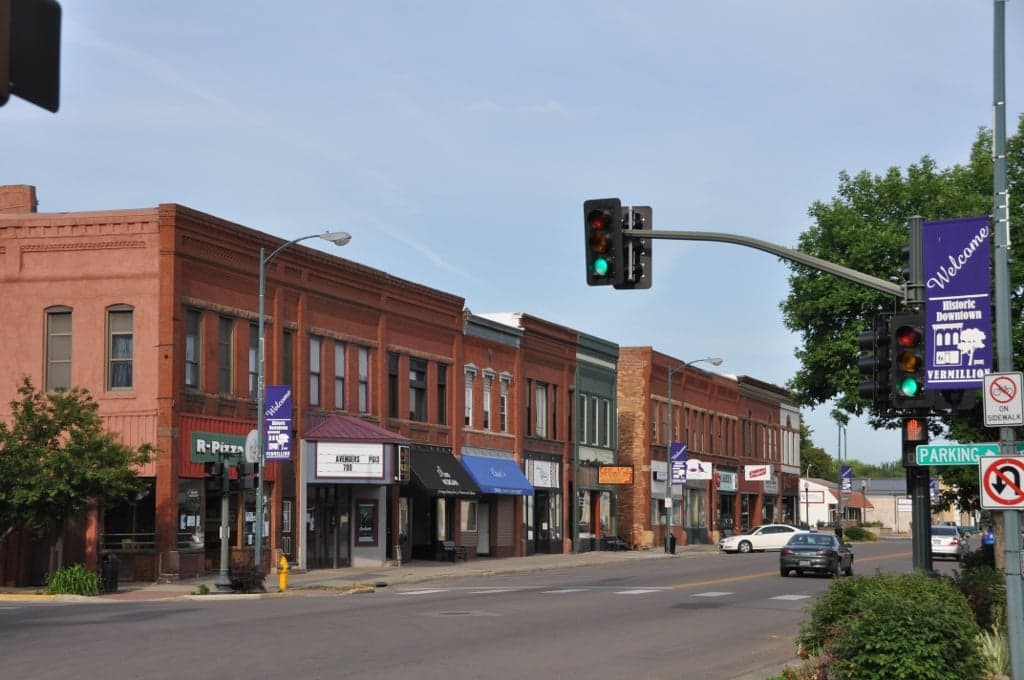
Vermillion’s original population was drawn by the promise of fertile Missouri River bottomland and the 1862 Homestead Act, which offered 160 acres to settlers willing to farm the Dakota Territory. The first wave of European-American settlers, primarily of German, Norwegian, and Irish stock, arrived in the 1860s and 1870s, establishing farms and a small river-port economy. The founding of the University of South Dakota in 1862—initially a territorial normal school—created a second, more educated population stream: professors, administrators, and their families. These early groups built the Historic Downtown district around Main Street, where the original commercial and civic buildings still stand, and the University Heights neighborhood, a cluster of late-19th-century homes near campus that housed faculty and prominent citizens. A third wave came with the railroad’s arrival in the 1880s, bringing merchants, tradesmen, and a small number of Chinese laborers who worked on the tracks, though few stayed permanently. By 1900, Vermillion was a stable, agrarian-rooted community of about 2,500, with a social order centered on the university and the surrounding farms.
Modern era (post-1965)
The 1965 Immigration and Nationality Act had a modest but noticeable effect on Vermillion, as the university began recruiting international students and faculty. The most visible change came in the 1980s and 1990s, when USD’s medical and law schools attracted professionals from outside the region. This period saw the growth of the Prentis Park neighborhood, a post-war suburban development of single-family homes that absorbed many of the new faculty and staff families. The city’s foreign-born population today stands at 4.2%, a figure driven almost entirely by university-related migration. The largest non-white groups are Hispanic (3.4%), Black (2.6%), East/Southeast Asian (2.3%), and Indian-subcontinent (1.5%). These communities are not concentrated in a single ethnic enclave but are dispersed across rental-heavy areas near campus, such as the Dakota Street corridor and the Cottonwood apartment complexes, which house many international graduate students and their families. Domestic in-migration during this era has been largely white and college-educated, drawn by USD employment or the city’s low cost of living and safe reputation. The Bluff View subdivision, developed in the 2000s on the city’s eastern edge, has become a preferred destination for these newer, higher-income residents, creating a subtle socioeconomic divide between the older, more established neighborhoods and the newer suburban fringe.
The future
Vermillion’s population is slowly diversifying, but the pace is gradual and driven almost entirely by the university. The Hispanic and East/Southeast Asian communities are growing at a modest rate, primarily through international student enrollment and a small number of H-1B visa holders who stay after graduation. The Indian-subcontinent population, while small, has a higher likelihood of settling permanently due to STEM and medical career paths. The white population, while still the overwhelming majority, is aging, with younger white residents often leaving after graduation for larger job markets. The city is not tribalizing into distinct ethnic enclaves; instead, it is homogenizing around the university’s culture, with new arrivals of all backgrounds integrating into the same campus-adjacent neighborhoods. The next 10-20 years will likely see a slow increase in the foreign-born share, possibly reaching 6-7%, as USD continues to recruit internationally and as remote work allows some alumni to return. However, Vermillion will remain a predominantly white, college-town community, with diversity concentrated in the professional and graduate-student population rather than in a broad, multi-generational immigrant base.
For someone moving in now, Vermillion offers a stable, safe, and education-focused environment where the population is becoming slightly more diverse but remains culturally anchored by the university and its Midwestern roots. The city is not undergoing rapid demographic transformation; rather, it is experiencing a slow, managed diversification that reflects its role as a regional academic hub. New residents, especially those with ties to USD, will find a community that values education, civic engagement, and a quiet, family-oriented lifestyle.

* Values derived from national, state, county, city and local statistics and may differ in a specific area. Last updated: 2026-04-23T09:55:26.000Z
Narrative content on this page is AI-generated and may contain mistakes. Verify any details that matter before acting on them.
ReloMaps may earn a commission from affiliate links at no extra cost to you.

