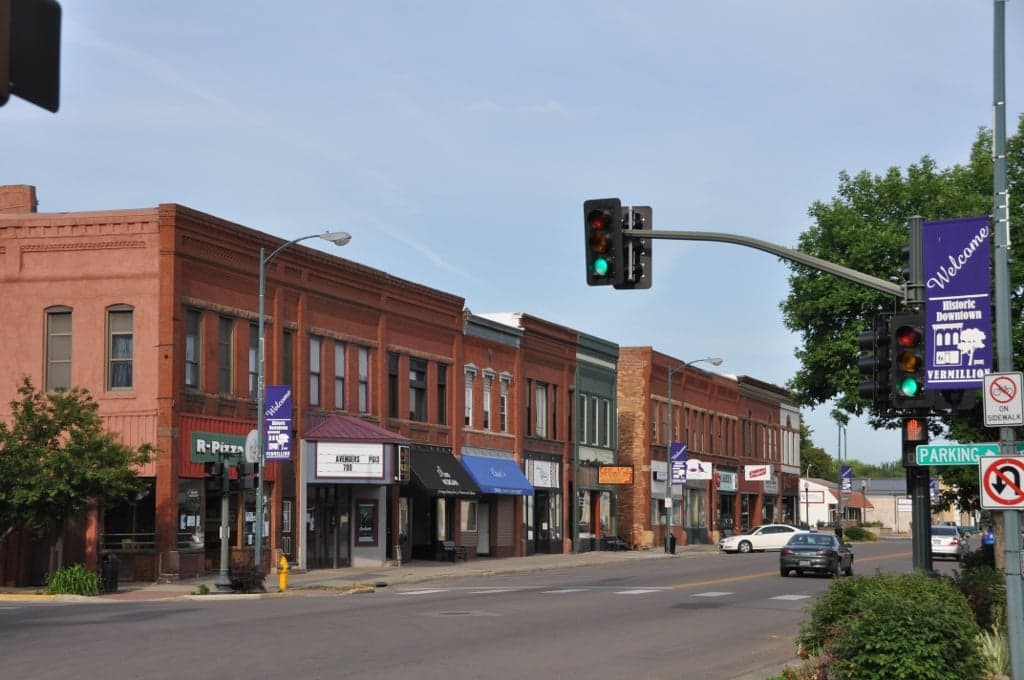
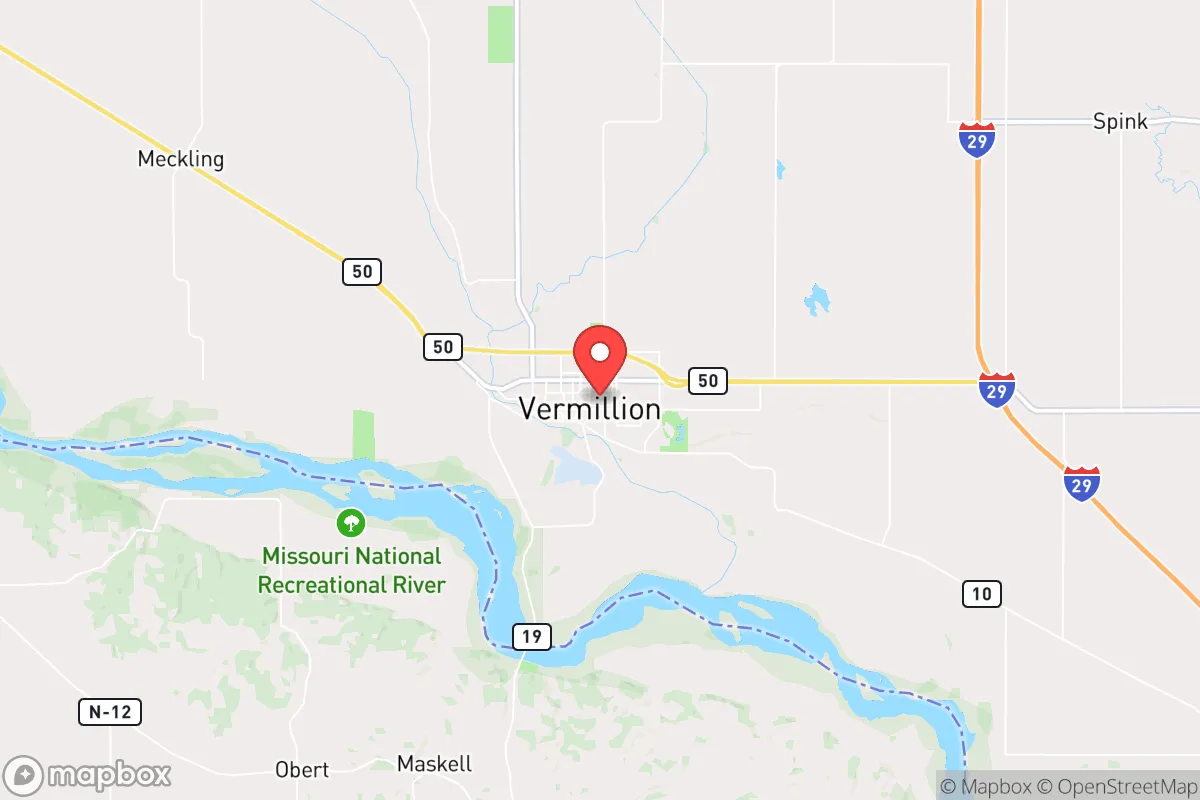
Photo: Wikipedia
Political ClimatePolitical Climate in Vermillion, SD
District shown is the primary district for this city’s centroid. Cities may span multiple districts.
Inherited from parent state — no local data available.
Local Political AnalysisPolitical Analysis of Vermillion, SD
Vermillion has long been a reliably conservative community, anchored by Clay County’s strong Republican lean—the Cook PVI sits at R+15, meaning the area votes about 15 points more Republican than the national average. In the 2024 presidential race, the county went for the GOP candidate by a solid 58% to 39%, a margin that reflects the town’s traditional values and skepticism of big-government solutions. That said, if you’ve lived here as long as I have, you’ve noticed a slow shift: the university crowd (University of South Dakota) brings in a more progressive element, and the city council has seen a few close votes on zoning and spending issues that would have been no-brainers a decade ago. The trajectory is still red, but it’s not as deep as it used to be, and that’s something worth keeping an eye on.
How it compares
Drive 30 minutes north to Sioux Falls, and you’ll find a much more mixed political landscape—Minnehaha County is still Republican-leaning, but the city itself has embraced more progressive policies on housing and public spending, with tax hikes and density mandates that would never fly here. Head south to Yankton, and you’re in a similar conservative pocket, though Yankton County is slightly more moderate (R+12) and has a stronger agricultural base that keeps things grounded. The real contrast is with Vermillion’s own university precincts: on campus, you’ll see signs for candidates who wouldn’t get a second look in the rest of town, and the student vote can swing a local election by a few points if turnout is high. Outside of those few blocks, though, the surrounding rural areas—like Meckling and Burbank—vote overwhelmingly Republican, and the county commission has stayed firmly conservative on property rights and gun laws.
What this means for residents
For folks who value personal freedoms and limited government, Vermillion is still a pretty good place to be. The city council has resisted calls for stricter rental regulations and kept property taxes relatively low compared to neighboring counties—Clay County’s levy rate is about 1.2%, well below the state average of 1.5%. You won’t see mask mandates or business shutdowns here; during the 2020 lockdowns, the county pushed back hard against state overreach, and most businesses stayed open with minimal interference. The school board has also held the line on curriculum battles, keeping parental rights front and center. That said, the progressive influence from the university is growing, and there’s been chatter about “affordable housing” ordinances that sound a lot like rent control in disguise. If that kind of government creep bothers you, it’s worth getting involved in local elections—turnout in off-years is low, and a few dozen votes can make a difference.
Culturally, Vermillion still feels like a small town where neighbors look out for each other, and the Second Amendment is respected without question. The annual Dakota Days parade is a good barometer: you’ll see more American flags than political signs, and the local churches are still the social hubs. The biggest policy distinction is the city’s approach to development—Vermillion has kept zoning light, so you can build a workshop or keep livestock on a residential lot without jumping through hoops, unlike in Sioux Falls where the bureaucracy is thick. Long-term, the concern is that as the university expands and attracts more out-of-state faculty, the cultural balance could tip. But for now, if you value your rights and want a place where the government stays out of your business, Vermillion is still holding strong.

State Political ClimatePolitical Climate in South Dakota
State Political AnalysisPolitical Environment in the State
South Dakota is one of the most reliably Republican states in the nation, with a deep-red partisan lean that has only intensified over the past two decades. The dominant coalition is a blend of rural conservatives, libertarian-leaning ranchers, and evangelical Christians, with the state consistently voting +30 points or more for GOP presidential candidates since 2000. While the state has always leaned right, the shift accelerated after 2010 as the Democratic brand collapsed in the rural Great Plains, leaving the GOP with supermajorities in both legislative chambers and control of every statewide office. Today, no Democrat holds a statewide elected position, and the state’s congressional delegation is entirely Republican.
Urban vs. rural divide
The political map of South Dakota is defined by a stark urban-rural split, but unlike many states, the urban areas are still reliably conservative. Sioux Falls, the largest city and economic engine, votes Republican in most races, though it has shown slight purple tendencies in recent cycles—Minnehaha County went +18 for Trump in 2020, down from +24 in 2016. Rapid City and Pennington County are solidly red, with the Black Hills region anchoring the western conservative base. The true Democratic strongholds are limited to a few small pockets: Minnehaha County’s more liberal precincts around downtown Sioux Falls, Brookings (home to South Dakota State University), and Vermillion (University of South Dakota). These college towns occasionally elect a Democratic state legislator, but they have no real influence on statewide outcomes. The rural counties—Harding, Perkins, and Jones in the west, and Hutchinson, Turner, and Union in the east—routinely deliver 80-85% of the vote to Republicans. The divide isn’t ideological so much as demographic: the few urban liberals are vastly outnumbered by the conservative rural majority, and even the cities themselves lean center-right on most issues.
Policy environment
South Dakota’s policy environment is among the most conservative in the country, with a strong emphasis on low taxes, limited regulation, and traditional values. The state has no personal income tax and no corporate income tax, relying instead on sales tax (4.5% state rate) and property taxes. The regulatory posture is business-friendly, with minimal zoning restrictions outside of Sioux Falls and Rapid City. Education policy is a mixed bag: the state has a robust school choice movement, with a new Education Savings Account (ESA) program passed in 2024 that allows parents to use public funds for private or homeschool expenses. However, the state’s K-12 funding formula remains a point of contention, with rural districts struggling to maintain staffing. Healthcare policy is hands-off—no Medicaid expansion until 2023 (voter-approved), and the state has some of the loosest telemedicine and scope-of-practice laws for nurse practitioners. Election laws are secure but not restrictive: voter ID is required, same-day registration is not allowed, and mail-in voting requires an excuse. The state also passed a 2022 law banning ballot drop boxes, which was framed as an election integrity measure. On social issues, South Dakota has a near-total abortion ban (trigger law effective 2022) and a 2023 law protecting medical conscience rights for healthcare providers.
Trajectory & freedom
South Dakota is trending toward more personal freedom in most domains, though the trajectory is not without concerns. The state has aggressively expanded gun rights: permitless carry was enacted in 2019, and a 2023 law prohibits any state or local enforcement of federal gun regulations that don’t exist in state law (a Second Amendment Sanctuary measure). Parental rights were strengthened with a 2022 law requiring schools to notify parents of any curriculum involving sexuality or gender identity, and a 2024 law banning transgender athletes from female sports. On medical autonomy, the state passed a 2021 law prohibiting COVID-19 vaccine mandates by employers or government entities, and a 2023 law banning mRNA vaccine requirements for children. Property rights are robust, with no state-level property tax on agricultural land for primary residences, and a 2024 law limiting eminent domain for carbon pipeline projects (a direct response to the Summit Carbon Solutions controversy). However, there are red flags: the state’s sales tax is regressive and has crept up over the years, and the 2023 Medicaid expansion, while increasing healthcare access, also brought federal strings that some conservatives view as an erosion of state sovereignty. The biggest freedom concern is the state’s overreliance on federal funds—South Dakota receives more federal dollars per capita than most states, which creates a dependency that could be leveraged for future mandates.
Civil unrest & political movements
South Dakota has seen relatively little civil unrest compared to coastal states, but there have been notable flashpoints. The Keystone XL pipeline protests in 2016-2017 drew national attention, with activists clashing with law enforcement in rural areas near the Nebraska border. The state’s response was firm: then-Governor Dennis Daugaard deployed the National Guard, and the legislature passed a 2017 law criminalizing trespassing on critical infrastructure, which effectively ended the protests. More recently, the Summit Carbon Solutions pipeline has become a major political battleground, with landowners in eastern South Dakota (especially around Hanson and Miner counties) fighting eminent domain for CO2 pipelines. This has spawned a grassroots property rights movement that crosses party lines, with some rural Democrats and Republicans uniting against corporate interests. On the left, the South Dakota Democratic Party is nearly moribund, but activist groups like Rural Organizing Project have tried to build a progressive base in Sioux Falls and on the reservations. Immigration politics are quiet—the state has a small foreign-born population (about 4%), and there are no sanctuary policies. Election integrity controversies have been minimal, though the 2020 election saw some local GOP activists question the use of Dominion voting machines in Minnehaha County, leading to a 2021 audit that found no irregularities. The most visible political movement is the constitutional carry and Second Amendment sanctuary network, which holds regular rallies at the state capitol in Pierre.
Projection
Over the next 5-10 years, South Dakota is likely to become even more conservative, driven by in-migration of right-leaning families from blue states and a continued exodus of young liberals to larger metros. The state’s population is growing modestly (about 1% annually), with most growth concentrated in Sioux Falls and the Black Hills. This influx is disproportionately conservative: many newcomers are fleeing high taxes and COVID mandates in California, Illinois, and Minnesota, and they are actively seeking South Dakota’s low-regulation environment. The political implications are clear: the GOP will remain dominant, and the state will likely pass further restrictions on abortion, expand school choice, and resist federal overreach on environmental and healthcare mandates. The biggest wildcard is the Native American vote, which makes up about 9% of the population and leans heavily Democratic. If tribal turnout increases—especially on the Pine Ridge and Rosebud reservations—it could shift a few legislative districts in western South Dakota, but it won’t change the statewide balance. The property rights movement around pipelines could also fracture the GOP coalition, pitting rural landowners against corporate agriculture interests. But overall, the trajectory is toward more freedom in the traditional sense: lower taxes, fewer mandates, and stronger protections for gun rights and parental control.
For a conservative individual or family moving to South Dakota, the bottom line is this: you will find a state that largely aligns with your values on taxes, guns, education, and personal liberty. The political climate is stable and predictable, with no serious threat of a blue shift in the near term. The main practical considerations are the cold winters, the rural isolation (most of the state is very empty), and the need to be self-reliant—government services are minimal, and you’ll want to budget for private healthcare and education options if you live outside Sioux Falls. If you’re looking for a place where government stays out of your life and your wallet, South Dakota is one of the best bets in the country. Just be prepared for the wind and the snow.
* Values derived from national, state, county, city and local statistics and may differ in a specific area. Last updated: 2026-04-23T09:55:26.000Z
Narrative content on this page is AI-generated and may contain mistakes. Verify any details that matter before acting on them.
ReloMaps may earn a commission from affiliate links at no extra cost to you.

