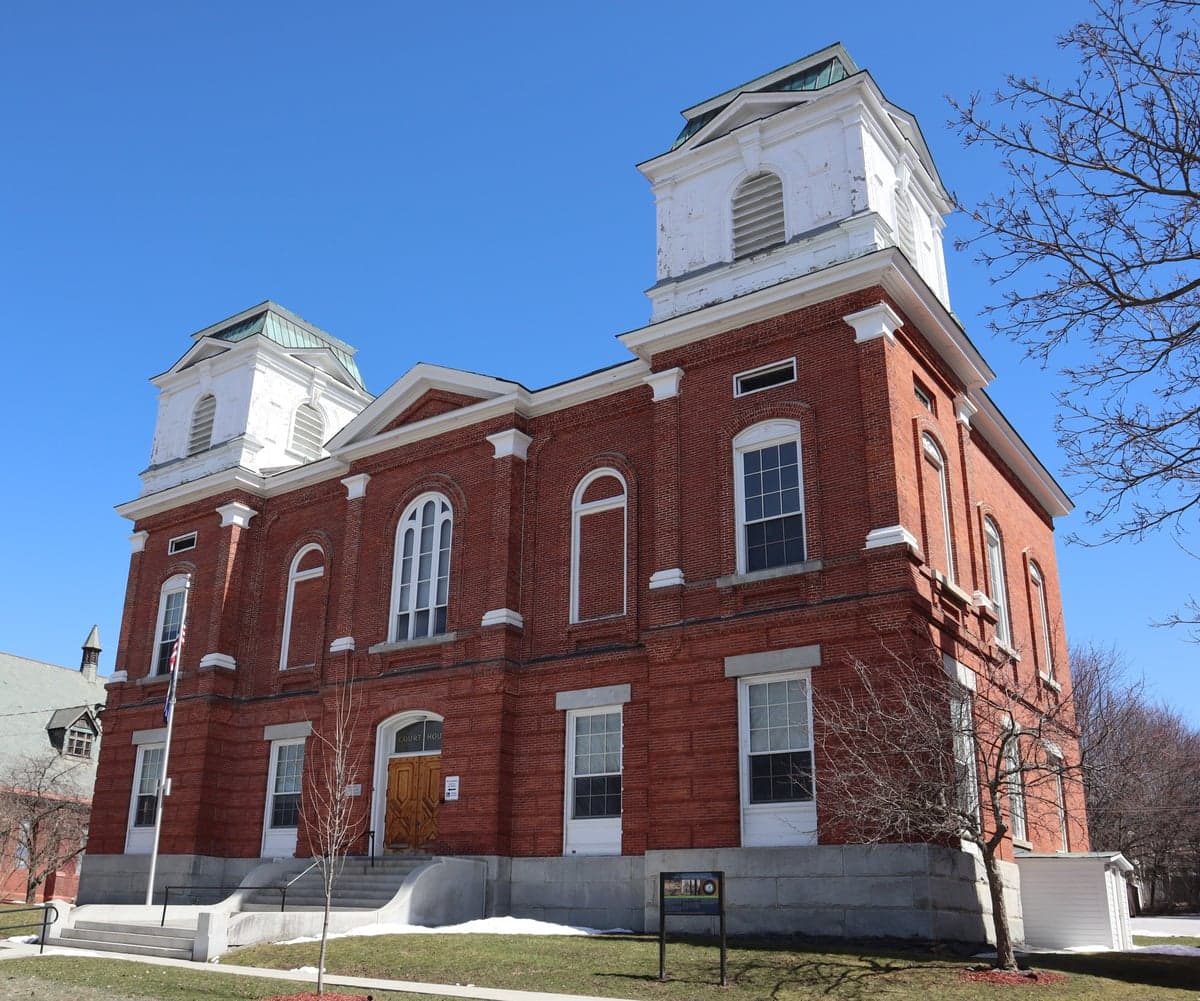
Photo: Wikipedia
Demographics of Franklin County
Affluence Level in Franklin County
A middle-class area roughly in line with national averages across income, home values, education, and employment.
People of Franklin County
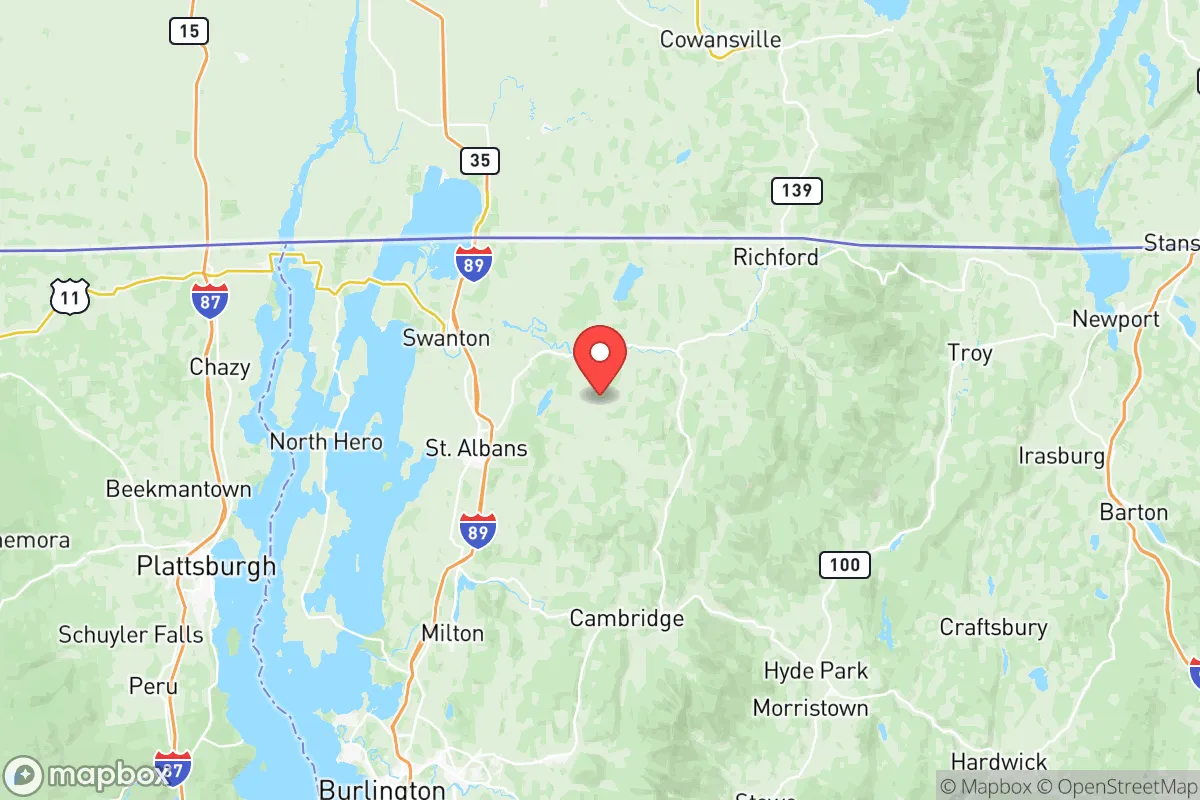
Franklin County, Vermont, is home to roughly 50,379 residents, making it one of the state's more populous rural counties, yet it retains a distinctly homogeneous character: 92.2% of the population identifies as White, with a foreign-born share of just 0.9%—among the lowest in New England. The county's identity is shaped by its deep French-Canadian and Yankee roots, a working-class agricultural and manufacturing heritage, and a strong Catholic and conservative-leaning cultural fabric. Unlike Vermont's more tourist-driven or college-town regions, Franklin County feels like a quieter, family-oriented corner of the state where community ties run deep and demographic change has been slow and incremental.
Settlement & growth (pre-1960)
Before European settlement, the area now known as Franklin County was part of the traditional territory of the Western Abenaki people, particularly the Missisquoi band, who maintained villages and fishing camps along the Missisquoi River and Lake Champlain. French explorers and missionaries passed through in the 17th and early 18th centuries, but permanent European settlement did not begin in earnest until after the American Revolution. The county was chartered in 1792, carved from Chittenden County, and named after Benjamin Franklin.
The first major wave of settlers were Yankees from southern New England—primarily Connecticut, Massachusetts, and New Hampshire—who arrived between the 1790s and 1820s, drawn by land grants and the promise of fertile Champlain Valley soils. These English-descended families established the county's earliest towns, including St. Albans (the county seat), Swanton, and Enosburg Falls. St. Albans quickly became a commercial and political hub, while Swanton grew around its position on the Missisquoi River and the Lake Champlain shoreline.
A second, transformative wave began in the mid-19th century: French-Canadian immigration from Quebec. Starting around the 1840s and accelerating through the 1880s, thousands of French-Canadian families crossed the border into northern Vermont, seeking work in the county's growing textile mills, lumber camps, and railroads. Towns like Richford, Highgate, and St. Albans saw their populations swell with French-speaking Catholics who built their own parishes, schools, and social institutions. By 1900, French-Canadians and their descendants made up a majority of Franklin County's population, a demographic reality that persists today. The 1864 St. Albans Raid—a Confederate raid launched from Canada—briefly disrupted this cross-border flow, but the cultural and economic ties between Quebec and Franklin County remained strong.
Smaller groups of Irish immigrants arrived in the 1850s and 1860s, primarily as laborers on the railroads and in the quarries around Georgia and Fairfield. A modest number of German and Polish families settled in the late 19th century, but they were never numerous enough to form distinct ethnic enclaves. The county's population remained overwhelmingly rural and agricultural through the early 20th century, with dairy farming as the economic backbone. The Great Depression hit hard, but Franklin County's population held relatively steady, unlike more industrial parts of Vermont that saw outmigration.
Modern era (post-1965)
The 1965 Hart-Cellar Act had minimal impact on Franklin County. Unlike Vermont's Chittenden County (home to Burlington), which saw modest growth in refugee and immigrant communities, Franklin County's foreign-born population has remained below 1% for decades. The county's demographic story since 1965 is not one of new immigration but of domestic stability and slow, selective in-migration.
From the 1970s through the 1990s, Franklin County experienced a gradual suburbanization, particularly in the southern towns closest to Burlington's job market. St. Albans and Swanton saw new subdivisions and strip development, attracting families priced out of Chittenden County and workers commuting to the University of Vermont and Fletcher Allen Health Care. This in-migration was overwhelmingly White and native-born, drawn by lower housing costs and a quieter lifestyle. The county's Hispanic population, now at 1.9%, grew slightly during this period, largely from Puerto Rican and Mexican families moving for agricultural work in the dairy industry and apple orchards around Fairfield and Sheldon.
The East/Southeast Asian population (0.5%) and Indian subcontinent population (0.1%) are tiny and concentrated almost entirely in St. Albans, where a handful of professionals work at the Northwestern Medical Center or in remote tech roles. The Black population (0.3%) is similarly small and scattered, with no distinct neighborhood or enclave. The county's racial and ethnic homogeneity is a product of its geography—far from major airports, interstate highways, and urban centers—and its economic base, which offers limited opportunities for the kinds of skilled immigrants who have reshaped other parts of Vermont.
One notable modern trend has been the return of some French-Canadian descendants from Quebec, particularly retirees and second-home owners, who have bought properties along Lake Champlain in Swanton and Highgate. This cross-border movement has reinforced the county's Franco-American identity rather than diluting it.
The future
Franklin County's population is likely to remain one of Vermont's most demographically stable regions over the next 10-20 years. The population is projected to grow slowly, if at all, as the county's birth rate declines and outmigration of young adults to Burlington and beyond continues. The foreign-born share may rise slightly—perhaps to 2-3%—as agricultural employers seek labor from Central America and as a trickle of remote workers discover the county's affordability, but these numbers will remain negligible compared to national averages.
The county is not tribalizing into distinct ethnic enclaves; rather, it is slowly homogenizing as the small Hispanic and Asian populations assimilate into the broader White, French-descended culture. The most significant cultural tension is not racial but linguistic: the historic French-English divide has faded, but a small revival of French-language programs in St. Albans schools suggests a desire to preserve the county's Franco-American heritage. Politically, Franklin County leans conservative by Vermont standards, and the slow pace of demographic change means that newcomers—whether from out of state or abroad—are likely to be absorbed into the existing cultural fabric rather than reshaping it.
For someone moving in now, Franklin County offers a stable, family-oriented community where the population is aging but still rooted, where the schools are small and local, and where the pace of life remains distinctly rural. The county is not becoming more diverse in any meaningful sense; it is becoming more of what it already is: a quiet, rural, predominantly White and French-descended corner of Vermont that values continuity over change.

* Values derived from national, state, county, city and local statistics and may differ in a specific area. Last updated: 2026-05-17T09:02:27.000Z
Narrative content on this page is AI-generated and may contain mistakes. Verify any details that matter before acting on them.
ReloMaps may earn a commission from affiliate links at no extra cost to you.

