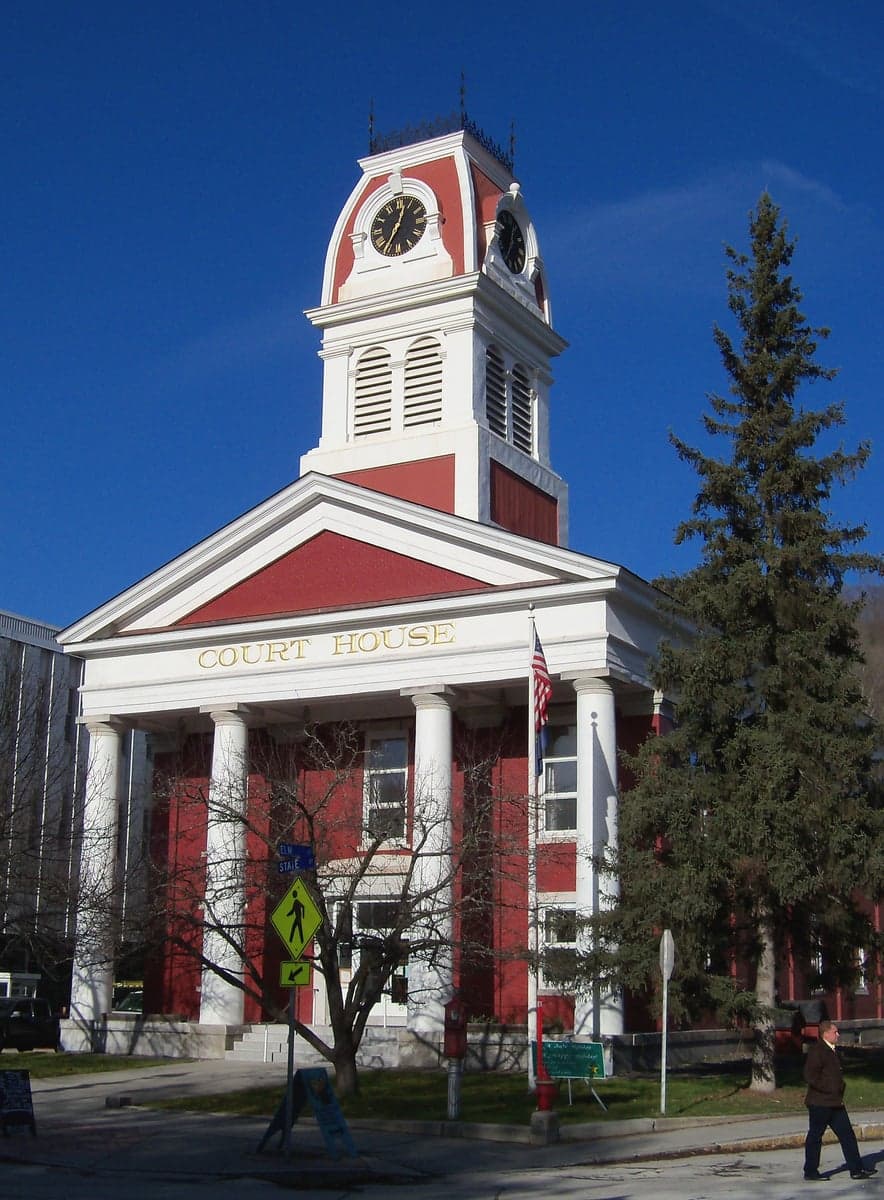
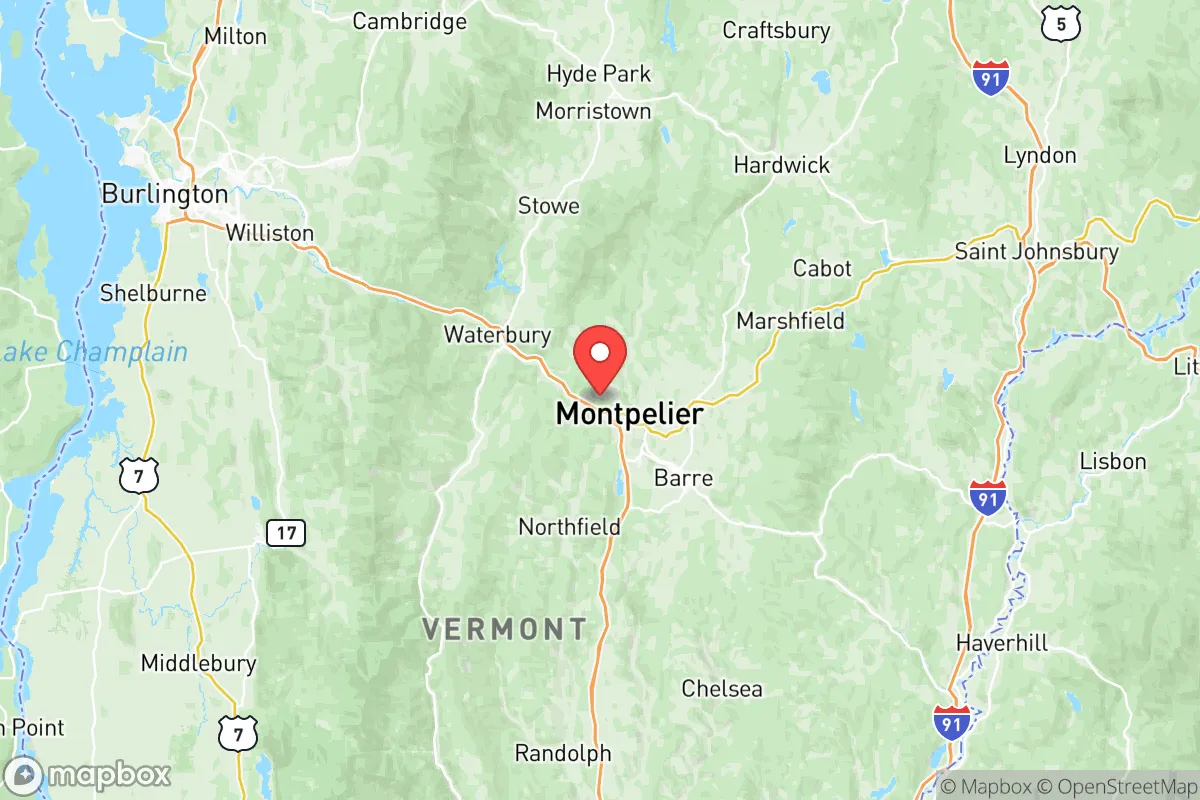
Photo: Wikipedia
Demographics of Washington County
Affluence Level in Washington County
A middle-class area roughly in line with national averages across income, home values, education, and employment.
People of Washington County
Washington County, Vermont, is a predominantly white, highly educated, and deeply rooted population of 59,958 residents, characterized by a strong sense of place and a demographic profile that has changed little in decades. With 91.9% of the population identifying as white and a foreign-born share of just 1.1%, the county is one of the least ethnically diverse in New England, a direct reflection of its history as a destination for specific waves of Yankee and European settlers. The county’s identity is shaped by its role as the seat of state government in Montpelier and the home of Vermont’s largest employer, the University of Vermont Medical Center, which together anchor a stable, civic-minded, and college-educated workforce (47.0% hold a bachelor’s degree or higher). This is a place where family lineages often stretch back to the 18th century, and where the population is aging slowly, holding steady, and showing little sign of the rapid demographic churn seen in other parts of the country.
Settlement & growth (pre-1960)
The human history of Washington County begins with the Western Abenaki people, who inhabited the Winooski River valley and the uplands around what is now Montpelier, Barre, and Waterbury for thousands of years before European contact. The Abenaki lived in semi-permanent villages, moving seasonally between fishing sites on the Winooski and hunting grounds in the Green Mountains. Their population was devastated by European diseases in the 17th century, and by the mid-1700s, most had been pushed north into Quebec or absorbed into remaining bands. Today, the Abenaki presence is largely erased from the county’s demographic data, though the Nulhegan Band of the Coosuk Abenaki Nation maintains cultural ties to the region.
Permanent European settlement began in earnest after the American Revolution, when the New Hampshire Grants (later the Vermont Republic) opened the land to Yankee settlers from southern New England. The first wave, arriving between 1780 and 1820, was overwhelmingly of English and Scots-Irish stock, drawn by the promise of cheap, fertile land in the Winooski and Mad River valleys. These settlers founded the county’s core towns: Montpelier (chartered 1781), Barre (1788), Waterbury (1763), and Northfield (1781). They were subsistence farmers, millers, and small-scale merchants, and their descendants still form the backbone of the county’s population. The second major wave came with the granite boom in Barre from the 1880s through the 1920s. Scottish stonecutters, many from Aberdeen, arrived to work the massive granite quarries, establishing a tight-knit community that still holds an annual Scottish Festival. Italian immigrants followed, also drawn to the quarries, settling in Barre’s “Little Italy” neighborhood around Granite Street. By 1910, Barre’s population was nearly 40% foreign-born, a peak that has never been repeated. A smaller wave of French-Canadian laborers came to work in the mills and farms of Waterbury and Montpelier in the same period, but they largely assimilated into the Yankee mainstream by the mid-20th century.
From 1920 to 1960, Washington County’s population grew slowly, as the granite industry declined and the state’s agricultural base shrank. The county’s role as the state capital insulated it from the worst of the Depression, as state government employment provided a stable economic floor. No major new immigrant groups arrived during this period; the county remained overwhelmingly white and native-born. The post-World War II era saw modest suburbanization around Montpelier and Barre, but the county never experienced the explosive growth of Vermont’s Chittenden County (Burlington). By 1960, Washington County was already a mature, settled place, with a population that was 98% white and deeply rooted in its Yankee and Scottish-Italian heritage.
Modern era (post-1965)
The 1965 Hart-Cellar Act, which reshaped American immigration, had almost no impact on Washington County. Unlike urban centers or Sun Belt suburbs, the county attracted virtually no new immigrant groups from Asia, Latin America, or Africa. The foreign-born population today stands at just 1.1%, a figure that has barely budged since 1970. The small Hispanic population (2.7%) is largely composed of second- and third-generation families who moved from other parts of Vermont or from New York, not recent arrivals. The East/Southeast Asian population (0.5%) and Indian subcontinent population (0.2%) are tiny, concentrated almost entirely among professionals working at the University of Vermont Medical Center or at state government offices in Montpelier. There are no ethnic enclaves in the county; these residents are scattered and highly assimilated.
Domestic migration has been the more significant driver of change, but it has been modest. Since the 1970s, Washington County has attracted a steady trickle of in-migrants from other parts of the Northeast, particularly from New York, Massachusetts, and Connecticut. These are often college-educated professionals seeking a slower pace, outdoor recreation, and a politically progressive environment. They have settled disproportionately in the Mad River Valley towns of Waitsfield, Warren, and Fayston, drawn by the ski industry and second-home market, and in the more rural towns of Middlesex and East Montpelier. This in-migration has raised the county’s educational attainment (47.0% college-educated, well above the national average) and reinforced its left-leaning political character, but it has not significantly altered the racial or ethnic makeup. The county remains 91.9% white, a figure that has declined only slightly from 96% in 1990. Suburbanization has been limited; the largest town, Barre, has just 8,500 residents, and Montpelier, the state capital, is the smallest state capital in the U.S. with about 8,000 people. The county’s population has grown by only about 5% since 2000, a rate far below the national average.
The future
Washington County’s population is projected to remain stable or decline slightly over the next 10-20 years, as the county’s aging Yankee and European-descended population is not being replaced by younger families or immigrants. The birth rate is below replacement level, and the modest in-migration of professionals from out of state is barely offsetting out-migration of young adults to Burlington or out of Vermont entirely. The county is not tribalizing into distinct ethnic enclaves; it is homogenizing into an older, whiter, and more educated population. The small Hispanic and Asian communities are likely to grow slowly, if at all, as the county lacks the job base or housing stock to attract significant new immigrant flows. The cultural identity of the county is being reshaped by the influx of out-of-state professionals, who tend to be more politically progressive and less tied to the county’s Yankee and granite-working traditions, but this change is gradual and generational. The county is becoming more secular, more educated, and more oriented toward state government and healthcare employment, while its historic working-class character in Barre and Northfield is fading.
For someone moving in now, Washington County offers a stable, safe, and deeply rooted community where the population is not growing or changing rapidly. The demographic profile is overwhelmingly white and native-born, with a strong civic culture centered on Montpelier’s state government and the University of Vermont Medical Center. The county is not a destination for immigrants or for those seeking ethnic diversity, but it is a place where family history and local identity matter, and where the population is likely to look much the same in 2040 as it does today.

* Values derived from national, state, county, city and local statistics and may differ in a specific area. Last updated: 2026-05-14T12:19:19.000Z
Narrative content on this page is AI-generated and may contain mistakes. Verify any details that matter before acting on them.
ReloMaps may earn a commission from affiliate links at no extra cost to you.

