
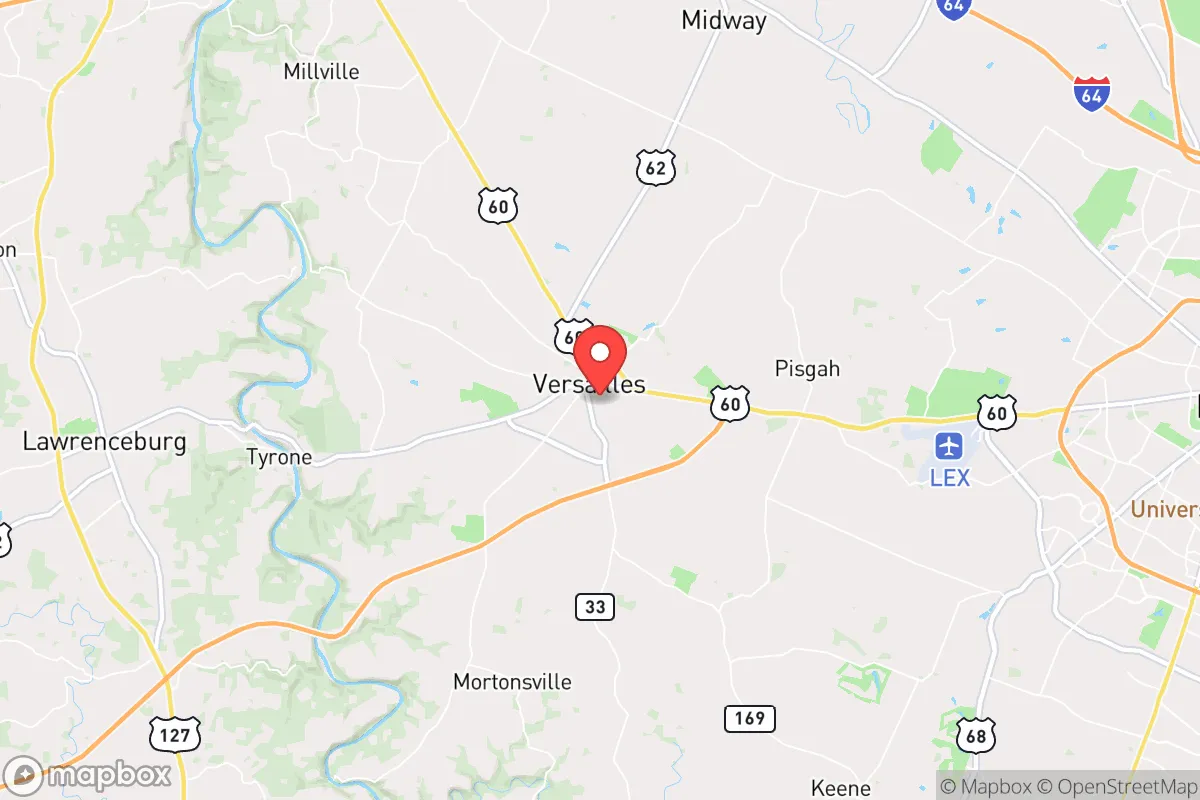
Photo: Wikipedia
Personal Sovereignty in Versailles, KY
Viable for self-reliance. Generally workable, though some barriers may limit total independence.
What does Personal Sovereignty tell us?
Personal Sovereignty measures your capacity for self-reliance and independence with minimal government friction. Higher scores mean fewer barriers between you and the way you want to live... but it assumes you have the space you need and good neighbors.
What does this tell us?
Personal Sovereignty measures your capacity for self-reliance and independence with minimal government friction. Higher scores mean fewer barriers between you and the way you want to live... but it assumes you have the space you need and good neighbors.
State Policy
Energy independence: Importer (60% of energy produced in-state)
Personal Liberty
Homesteading

Personal Liberty Analysis
Versailles, Kentucky, offers a notably high degree of personal sovereignty compared to many areas of the country, functioning as a pocket of relative autonomy within a state that already leans heavily toward individual liberty. The town’s character is shaped by a deep-seated culture of self-reliance, a local government that generally stays out of daily life, and a legal framework that prioritizes personal responsibility over state control. For those concerned with preserving freedom of action—whether in self-defense, medical choices, or property use—Versailles presents a strategic environment where the default assumption is that you can manage your own affairs without excessive bureaucratic interference.
Tax burden and regulatory posture: How Kentucky’s low-tax framework supports autonomy
Kentucky’s tax structure is a major asset for anyone seeking to minimize government encroachment on their income and property. The state levies a flat individual income tax of 4.5% as of 2026, with a scheduled reduction to 4.0% by 2027, and no local income tax is imposed in Versailles or Woodford County. Property taxes are among the lowest in the nation, with the effective rate on residential property hovering around 0.83% of assessed value—roughly half the national average. This means a $300,000 home carries an annual tax bill of about $2,490, leaving more capital in your hands for land, supplies, or investments in self-sufficiency. Sales tax is a flat 6%, but groceries and prescription drugs are exempt, which reduces the regressive burden on daily essentials. On the regulatory side, Woodford County is not a hotbed of zoning overreach. While there are basic building codes and subdivision regulations, the county’s approach is generally permissive for agricultural and rural residential uses. You won’t find the kind of hyper-specific land-use ordinances common in coastal states. The state also lacks a broad “sick leave” or “paid family leave” mandate for small businesses, and there is no state-level rent control or price-gouging law that would interfere with private transactions. For a prepper or survivalist, the key takeaway is that Kentucky’s fiscal conservatism leaves you with more disposable income and fewer compliance headaches than in high-tax states like New York or California.
Self-defense and gun law specifics: Constitutional carry and castle doctrine in practice
Versailles sits in a state that is unequivocally pro-Second Amendment. Kentucky is a constitutional carry state, meaning no permit is required to carry a concealed firearm for anyone legally allowed to possess one. There is no state-level waiting period, no universal background check system beyond the federal NICS check, and no registry of firearms or ammunition. The castle doctrine is codified in Kentucky Revised Statutes § 503.055, which establishes a legal presumption that a person using deadly force against an unlawful intruder in their home, vehicle, or place of business acted in self-defense. This presumption is strong—it shifts the burden of proof to the prosecution, meaning you don’t have to prove you were in fear for your life; the state must prove you weren’t. Stand-your-ground protections also apply, removing any duty to retreat before using force in any place you are lawfully present. Woodford County’s sheriff’s office is generally supportive of gun rights, and local gun ranges and training facilities are available within a short drive. For those concerned about federal overreach, Kentucky passed a Second Amendment Preservation Act in 2021 that prohibits state resources from being used to enforce any future federal ban on firearms or magazines. While the legal durability of such measures is uncertain, they signal a political environment that will resist federal encroachment. In practical terms, you can own suppressors, short-barreled rifles, and machine guns (with proper NFA paperwork), and there are no state-level restrictions on magazine capacity or “assault weapon” features. This is a jurisdiction where your ability to defend yourself and your family is treated as a fundamental right, not a privilege to be licensed.
Self-reliance and homesteading viability: Lot sizes, zoning, and off-grid feasibility
For those looking to reduce dependence on centralized systems, Versailles offers genuine opportunities for homesteading and off-grid living, though with some practical limitations. Agricultural and rural residential zoning in Woodford County typically allows for lots as small as one to three acres for a single-family home with livestock, but larger parcels (five to ten acres or more) are common and provide more buffer from neighbors. The county does not have a blanket ban on rainwater collection, composting toilets, or solar panels, though you will need to comply with basic health department standards for septic systems and well water. The biggest regulatory hurdle is the Kentucky Building Code, which applies to all new construction and major renovations—meaning you cannot legally build a completely unpermitted dwelling without facing fines or a stop-work order. However, the code is not draconian; many rural builders work with owners to meet requirements without excessive cost. Off-grid solar is entirely legal, and net metering is available if you want to stay connected to the grid. Woodford County does not have a county-wide ban on chickens, goats, or even larger livestock on parcels over one acre, though you should check any homeowners’ association covenants if you buy in a subdivision. The local agricultural extension office is supportive of small-scale farming, and the soil quality in the Bluegrass region is excellent for gardens and orchards. For a prepper, the key limitation is that Versailles is not remote—it’s within 20 minutes of Lexington—so you won’t have the isolation of rural Montana. But that proximity also means access to hardware stores, feed suppliers, and medical facilities. The trade-off is manageable: you can achieve a high degree of self-sufficiency on a few acres without being cut off from civilization.
Personal liberties: Parental rights, medical autonomy, speech, and property
Kentucky’s legal environment strongly favors parental rights and medical freedom, though with some caveats. The state has no mandatory vaccination law for children attending public school—parents can claim a religious or philosophical exemption without a notarized statement, and the process is straightforward. During the COVID-19 pandemic, Kentucky did impose some mask and vaccine mandates, but those have been repealed, and the state legislature has since passed laws limiting the governor’s emergency powers and prohibiting vaccine passports for government services. Medical autonomy extends to the right to refuse any treatment, and there is no state-level mandate for health insurance coverage of specific procedures. On the speech front, Kentucky has no hate speech laws that criminalize political or religious expression, and the state’s public universities generally respect First Amendment protections. Property rights are robust: there is no state-level inheritance tax, and the estate tax only applies to estates over $11.7 million (federal level). Eminent domain is limited to public projects, and Woodford County has not engaged in the kind of aggressive land-use condemnation seen in some urban areas. Parental rights are explicitly protected in state law, with a statute affirming that parents have the fundamental right to direct the upbringing, education, and health care of their children. This includes the right to opt out of any school curriculum or activity that conflicts with their religious or moral beliefs. For those concerned about government overreach into family life, Versailles offers a legal framework that treats the family as the primary unit of authority, not the state.
Overall, Versailles provides a sovereignty profile that is strong relative to most of the United States, particularly when compared to the Northeast, West Coast, or urban centers. The combination of low taxes, constitutional carry, permissive zoning for homesteading, and robust parental rights creates an environment where an individual or family can live with minimal state interference. The main trade-offs are proximity to Lexington (which brings some urban influence) and the fact that Kentucky is still subject to federal laws that may become more restrictive in the future. But for a strategic relocation aimed at maximizing personal autonomy while maintaining access to infrastructure, Versailles represents a solid, defensible choice in a state that has historically resisted federal overreach. It is not a libertarian utopia, but it is a place where a determined person can build a life on their own terms.

* Values derived from national, state, county, city and local statistics and may differ in a specific area. Last updated: 2026-04-21T09:13:36.000Z
Narrative content on this page is AI-generated and may contain mistakes. Verify any details that matter before acting on them.
ReloMaps may earn a commission from affiliate links at no extra cost to you.

