Photo: Wikipedia
Demographics of Versailles, KY
Affluence Level in Versailles, KY
A middle-class area roughly in line with national averages across income, home values, education, and employment.
People of Versailles, KY
The people of Versailles, Kentucky, today number 10,382 and form a community that is predominantly white (74.1%) with a significant and growing Hispanic minority (13.6%) and a smaller Black population (7.1%). The city is notably more diverse than surrounding Woodford County, with a foreign-born share of 6.8% that is nearly double the county average, driven largely by a steady influx of Hispanic workers into the local equine and agricultural industries. With 36.2% of adults holding a college degree, Versailles has a moderately educated workforce, though its character remains distinctly tied to its rural Bluegrass roots and the horse-farm economy that defines the region.
How the city was settled and grew
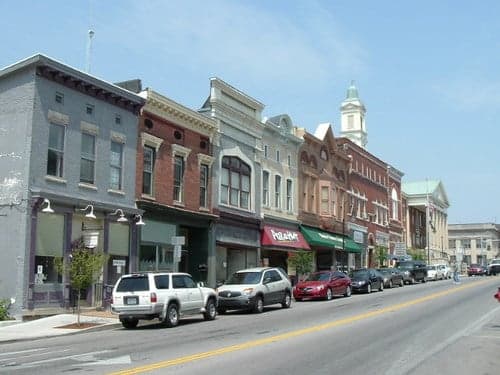
Versailles was founded in 1792 as the seat of newly formed Woodford County, named after the French palace to honor the nation that aided the American Revolution. The original white settlers were primarily of English, Scots-Irish, and German descent, arriving from Virginia, Maryland, and Pennsylvania via the Great Wagon Road. These early families—many of them land speculators and tobacco planters—established large estates along the Kentucky River palisades and the fertile inner Bluegrass plain. The historic Morgan Street district, centered on the courthouse square, became the commercial and social hub for these founding families, while the South Main Street corridor saw the construction of Federal-style brick homes by the planter elite. A second wave arrived in the mid-19th century, including Irish laborers who built the Lexington and Frankfort Railroad and settled in what became known as Irish Hill, a working-class neighborhood near the rail yards. Enslaved African Americans, who made up roughly 40% of Woodford County’s population before the Civil War, lived in quarters on the large farms and in small clusters along Green Street and Water Street (now part of the city’s historic district). After Emancipation, many of these families formed the core of Versailles’ Black community, establishing churches like First Baptist Church on Green Street and building homes in the West Versailles area near the old fairgrounds.
Modern era (post-1965)
The post-1965 period brought the most significant demographic shift to Versailles. The Immigration and Nationality Act of 1965 opened doors for new arrivals, but the city’s modern diversity is less a product of global migration and more a result of domestic and regional in-migration tied to the horse industry. Beginning in the 1970s, thoroughbred farms like Claiborne Farm, Lane’s End, and Three Chimneys began recruiting experienced grooms, hotwalkers, and exercise riders from Mexico and Central America. These workers settled primarily in the Clifton Heights neighborhood, a modest area of mid-century ranch homes and rental duplexes west of US-62, and in mobile home parks along the Lexington Road corridor. By 2020, the Hispanic share of Versailles’ population had reached 13.6%, up from roughly 5% in 2000, making it one of the fastest-growing Hispanic communities in central Kentucky outside of Lexington. The Black population, by contrast, has declined from its post-war peak of around 15% in 1970 to 7.1% today, as younger Black families have moved to larger cities like Lexington and Louisville for broader job opportunities. The East/Southeast Asian community remains very small at 0.3%, and the Indian-subcontinent population is negligible at 0.1%, reflecting the city’s lack of the tech or medical sectors that draw those groups to other Kentucky cities. White residents, while still the majority, have seen their share drop from over 90% in 1980 to 74.1% today, with many newer white arrivals being professionals working in Lexington’s suburbs or in the horse industry’s management tier.
The future
Versailles’ population is trending toward greater Hispanic integration and a slow homogenization of its white and Black populations. The Hispanic community, now large enough to sustain its own businesses, churches, and a Spanish-language mass at St. Leo’s Catholic Church, is likely to continue growing as the horse industry remains labor-intensive and resistant to automation. The city’s foreign-born share of 6.8% could rise to 10-12% by 2040 if current trends hold, with most new arrivals settling in Clifton Heights and the Lexington Road corridor. The white population will likely continue its gradual decline in share, though not in absolute numbers, as new subdivisions like Hunter’s Trace and Woodford Hills attract families priced out of Lexington’s housing market. The Black population appears stable at around 7%, with no major out-migration or in-migration expected. The city is not tribalizing into distinct ethnic enclaves—most neighborhoods remain mixed—but the Hispanic community is geographically concentrated enough to form a recognizable cultural district along Lexington Road. For a conservative-leaning newcomer, this means moving into a community that is quietly diversifying without the political friction seen in larger cities, where the horse-farm economy provides a shared identity that transcends ethnic lines.
Versailles is becoming a more Hispanic-influenced, still predominantly white, and economically stable small city where the horse industry anchors both the economy and the social fabric. For someone moving in now, the city offers a low-crime, family-oriented environment with a growing cultural diversity that is largely absorbed into the existing rural-conservative ethos, rather than challenging it. The key practical takeaway is that the most affordable housing and the most diverse social environment are found in the Clifton Heights and Lexington Road areas, while the historic Morgan Street and South Main districts remain the preserve of longer-established, wealthier families.

* Values derived from national, state, county, city and local statistics and may differ in a specific area. Last updated: 2026-04-21T09:13:36.000Z
Narrative content on this page is AI-generated and may contain mistakes. Verify any details that matter before acting on them.
ReloMaps may earn a commission from affiliate links at no extra cost to you.

