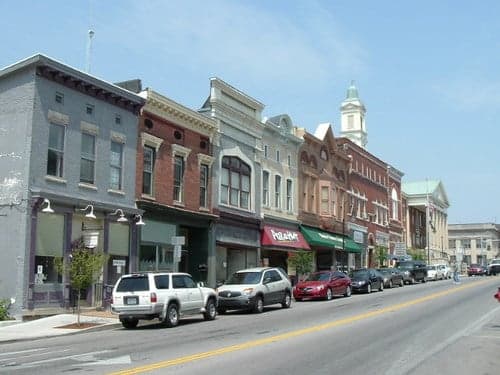

Photo: Wikipedia
Political ClimatePolitical Climate in Versailles, KY
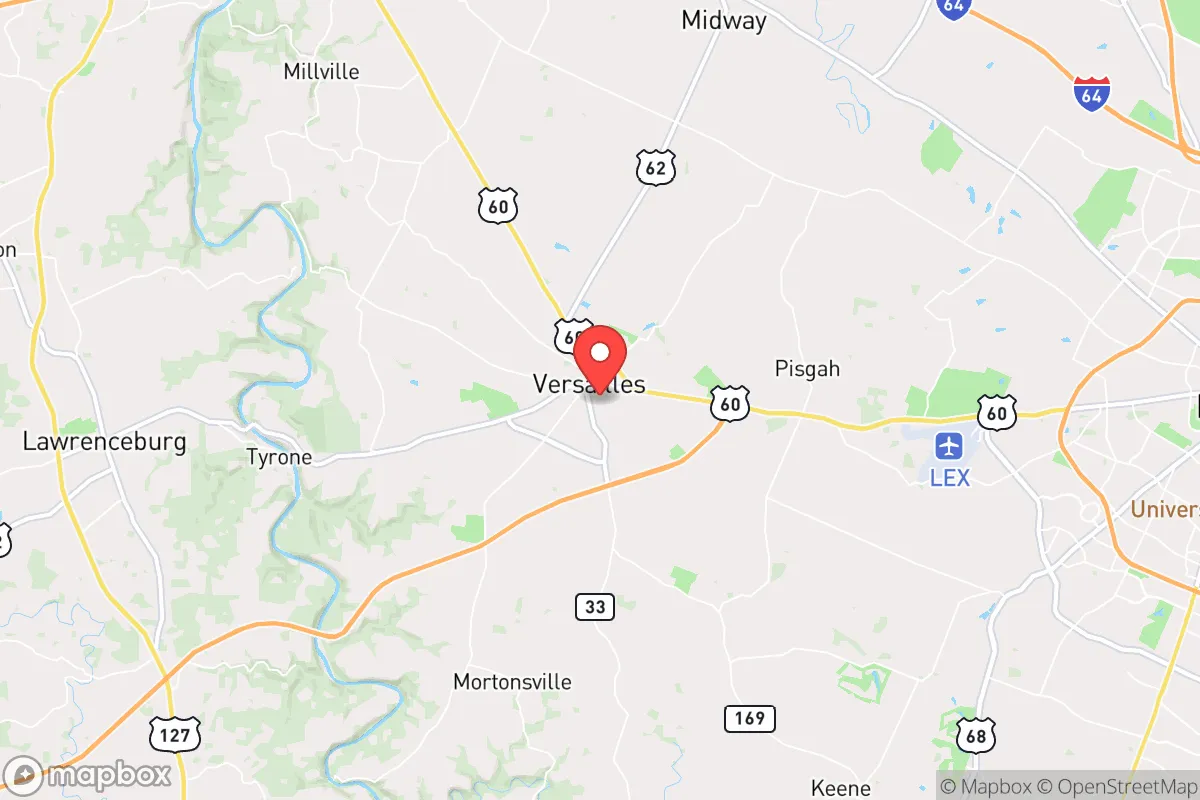
District shown is the primary district for this city’s centroid. Cities may span multiple districts.
Local Political AnalysisPolitical Analysis of Versailles, KY
Versailles, Kentucky, has long been a reliably conservative community, and that hasn't changed much despite some national trends. The Cook Partisan Voting Index (PVI) of R+7 tells you the real story: this area leans Republican by a solid margin, and that's been the case for as long as most folks around here can remember. You see it in local elections, in the way people talk about taxes and property rights, and in the general attitude that government ought to stay out of your business. If you're looking for a place where the political winds haven't shifted dramatically toward the progressive side, Versailles is still holding steady, though you can feel the pressure from the bigger cities creeping in.
How it compares
Drive twenty minutes east to Lexington, and you're in a completely different world politically. That's where you'll find the university crowd, the younger transplants, and a much more liberal voting bloc. Versailles, by contrast, feels like a quiet holdout. The surrounding Woodford County is even more conservative than the city itself, with a strong agricultural base that keeps things grounded. Compare it to Frankfort, the state capital just north, which has its own mix of state workers and a more moderate-to-liberal tilt, and you see the contrast clearly. Versailles is the kind of place where people still wave at each other on the street and don't appreciate outsiders telling them how to run their lives. The R+7 rating isn't just a number—it reflects a deep-seated skepticism of government overreach, whether that's in zoning, school curriculum, or gun rights.
What this means for residents
For the people living here, the political climate means a few practical things. First, you're not going to see a lot of heavy-handed local ordinances that try to micromanage your property or your business. The county commission and city council tend to lean toward letting people make their own choices, which is a relief if you've ever dealt with the kind of red tape you find in more progressive areas. Second, the schools here still reflect traditional values—there's no push to overhaul curriculum with the latest social trends, and parents generally have a say in what their kids are learning. That said, you do see some subtle shifts. A few younger families moving in from Lexington bring different ideas, and there's been chatter about more bike lanes and "green" initiatives that feel like a foot in the door for bigger government involvement. It's not alarming yet, but it's worth keeping an eye on.
Culturally, Versailles holds onto its horse-farming heritage and small-town pace, which naturally aligns with a conservative worldview. The annual Woodford County Fair and the local bourbon distilleries are more than just attractions—they're symbols of a community that values tradition and self-reliance. You won't find many protests or political rallies here; instead, the politics are lived out in quiet conversations at the feed store or over coffee at the local diner. The trajectory, as I see it, is that Versailles will stay conservative for the foreseeable future, but it's not immune to the pressures of growth. If you're looking for a place where your rights and freedoms are still respected without a lot of bureaucratic nonsense, this is still a good bet. Just don't expect it to stay exactly the same forever—nothing does.

State Political ClimatePolitical Climate in Kentucky
State Political AnalysisPolitical Environment in the State
Kentucky has long been a reliably red state in federal elections, but its political climate is far more nuanced than a simple partisan label suggests. The state has voted for the Republican presidential candidate in every election since 2000, often by double-digit margins, yet it maintains a strong populist and libertarian streak that resists top-down control from either party. Over the last 10-20 years, the dominant coalition has shifted from a more moderate, Blue Dog Democratic presence in state government to a solidly Republican supermajority in the legislature, driven by a realignment of rural and working-class voters who feel abandoned by national progressive trends. This trajectory has accelerated since 2015, with the GOP now holding veto-proof majorities in both chambers and the governor’s mansion flipping between parties every four years, most recently to Democrat Andy Beshear in 2019 and 2023, who governs as a relative moderate on cultural issues while clashing with the legislature on fiscal and social policy.
Urban vs. rural divide
The political map of Kentucky is a textbook study in the urban-rural split. The state’s two major metros—Louisville (Jefferson County) and Lexington (Fayette County)—are the primary engines of Democratic votes, with Louisville leaning about 20 points blue and Lexington around 15 points blue in recent presidential cycles. These cities are surrounded by deep-red suburban and exurban rings, such as Oldham County (northeast of Louisville) and Jessamine County (south of Lexington), which vote Republican by 30-40 point margins. The rest of the state is overwhelmingly rural and conservative, with Eastern Kentucky’s coal country (Pike, Floyd, Letcher counties) having flipped from reliably Democratic to reliably Republican over the past two decades—a shift driven by cultural backlash to national Democratic environmental and energy policies. Northern Kentucky, including the Cincinnati suburbs of Boone, Kenton, and Campbell counties, is a competitive but increasingly red region, with Boone County voting +25 R in 2024. The only other significant blue pocket is the western city of Bowling Green (Warren County), home to a growing immigrant population and Western Kentucky University, which votes about 10 points blue but is surrounded by deep-red rural areas. This geographic divide means that while the state legislature is heavily Republican, the governor’s race remains competitive because Louisville and Lexington can turn out enough votes to offset rural margins, especially when a moderate Democrat like Beshear runs.
Policy environment
Kentucky’s policy environment is a mixed bag for conservatives, with strong wins on some fronts and frustrating stagnation on others. The state has a flat income tax that was reduced from 5% to 4% in 2024, with a scheduled path to 3.5% by 2026—a clear victory for fiscal conservatives. There is no state property tax, and sales tax is capped at 6%, though groceries are exempt. The regulatory posture is generally business-friendly, with right-to-work laws and a tort reform system that caps non-economic damages in medical malpractice cases. On education, the legislature passed a school choice bill in 2022 that created education opportunity accounts, though it was struck down by the state Supreme Court in 2023 on procedural grounds; a new version is pending. The state also has a near-total abortion ban, with exceptions only to save the mother’s life, passed in 2022 after the Dobbs decision. Election laws are moderately conservative: voter ID is required, early voting is limited to three days (though expanded to two weeks during the pandemic, then rolled back), and no-excuse absentee voting was eliminated in 2023. However, the state has not passed a comprehensive election integrity bill like Georgia or Texas, leaving some activists frustrated. The biggest policy tension is between the Republican legislature and Democratic Governor Beshear, who has vetoed numerous bills on transgender sports bans, school choice, and tax cuts, only to be overridden by the supermajority.
Trajectory & freedom
On the freedom front, Kentucky has moved decisively in a conservative direction over the past decade, but with notable exceptions. The state passed constitutional carry (permitless concealed carry) in 2019, and in 2023 expanded stand-your-ground protections. It also passed a parental rights bill in 2022 requiring schools to notify parents of any changes to a child’s mental or physical health services—a direct response to transgender policies in other states. Medical autonomy saw a win with the 2022 passage of a law allowing terminally ill patients to access experimental treatments (Right to Try). However, property rights remain a sore spot: the state has no statewide zoning preemption, meaning cities like Louisville and Lexington can impose rent control and restrictive land-use regulations. The biggest freedom concern for many conservatives is the state’s high incarceration rate and strict drug laws, which have led to overcrowded prisons and a sense that the state is too quick to criminalize rather than rehabilitate. On the positive side, Kentucky became a Second Amendment Sanctuary state in 2021, with a law prohibiting state enforcement of any future federal gun bans. The trajectory is toward more personal liberty on guns and parental rights, but the legislature has been slow to tackle occupational licensing reform and property tax relief, which are key issues for freedom-minded residents.
Civil unrest & political movements
Kentucky has seen its share of political flashpoints, though they are less frequent than in coastal states. The most visible was the 2020 Breonna Taylor protests in Louisville, which led to months of demonstrations, property damage, and the eventual passage of a police reform bill (the Breonna Taylor Law) that banned no-knock warrants—a move that divided conservatives, with some supporting the reform and others viewing it as a concession to mob rule. The state also saw a significant right-wing movement in 2020-2021 with the formation of local “Three Percent” and “Oath Keeper” chapters, particularly in rural areas like Pulaski and Laurel counties. Immigration politics are relatively quiet, as Kentucky has a small foreign-born population (about 4%), but there have been localized tensions in Bowling Green, where a growing refugee community has led to some cultural clashes. Election integrity controversies flared after 2020, with Republican Secretary of State Michael Adams (a moderate) defending the state’s election system against claims of fraud, while some grassroots activists pushed for a full audit. The most notable recent political movement is the “School Choice Now” coalition, which has organized rallies in Frankfort and successfully pressured the legislature to keep pushing for education savings accounts despite court setbacks. Overall, the state is not a hotbed of civil unrest, but the Louisville protests and the ongoing school choice fight show that political passions run deep, especially when local control is perceived as being threatened by state or federal overreach.
Projection
Looking five to ten years out, Kentucky is likely to become more conservative on cultural and fiscal issues, but the pace of change will depend on in-migration patterns and the state’s ability to attract new residents. The state is seeing a slow but steady influx of retirees and remote workers from higher-tax states like Illinois, Ohio, and California, particularly to the Lexington suburbs (Georgetown, Nicholasville) and the Lake Cumberland region (Somerset, Monticello). These newcomers tend to be fiscally conservative but socially moderate, which could create a tension with the existing rural base that is more culturally traditional. The biggest wildcard is the governor’s race: if Beshear runs for Senate or leaves office, the GOP is favored to retake the governorship in 2027, which would accelerate tax cuts, school choice, and election integrity reforms. However, if a Democrat holds the governor’s mansion, the legislature will continue to override vetoes, leading to a stalemate that frustrates both sides. Demographically, the state is aging and losing young people to Nashville and Charlotte, which could dampen economic growth and make it harder to fund infrastructure. The most likely scenario is a continued rightward drift on cultural issues (abortion, guns, parental rights) combined with incremental tax relief, but with persistent battles over education funding and local control. A new resident moving in now should expect a state that is broadly conservative but with a strong libertarian undercurrent, where the biggest fights are between the legislature and the governor, not between left and right.
For a conservative individual or family considering relocation, Kentucky offers a solid foundation: low taxes, strong gun rights, and a legislature that is actively pushing back against progressive overreach. The trade-offs are a relatively weak economy outside of Louisville and Lexington, a healthcare system that ranks poorly in access and outcomes, and a political environment where the governor can block some conservative priorities. If you value local control and personal liberty, the rural and suburban areas offer a high degree of freedom, but you’ll need to be prepared for the constant tug-of-war between Frankfort and the governor’s office. The bottom line: Kentucky is a good bet for conservatives who want a red state without the extreme culture wars of the Deep South, but it’s not a libertarian paradise—you’ll still have to deal with a powerful state government that sometimes overreaches, especially on criminal justice and property rights. If you’re looking for a place where your vote counts and your values are respected, the Bluegrass State is a solid choice, just keep an eye on the governor’s race every four years.
* Values derived from national, state, county, city and local statistics and may differ in a specific area. Last updated: 2026-04-21T09:13:36.000Z
Narrative content on this page is AI-generated and may contain mistakes. Verify any details that matter before acting on them.
ReloMaps may earn a commission from affiliate links at no extra cost to you.

