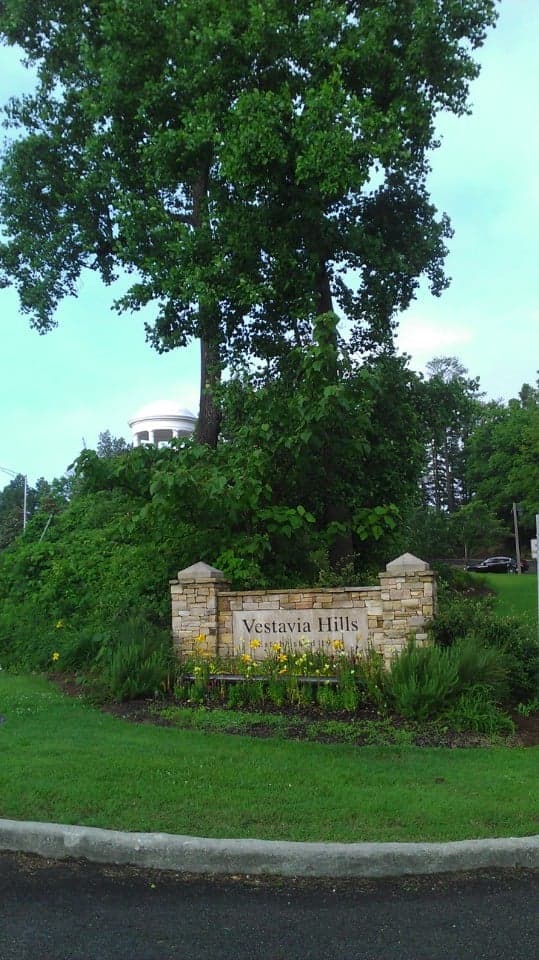
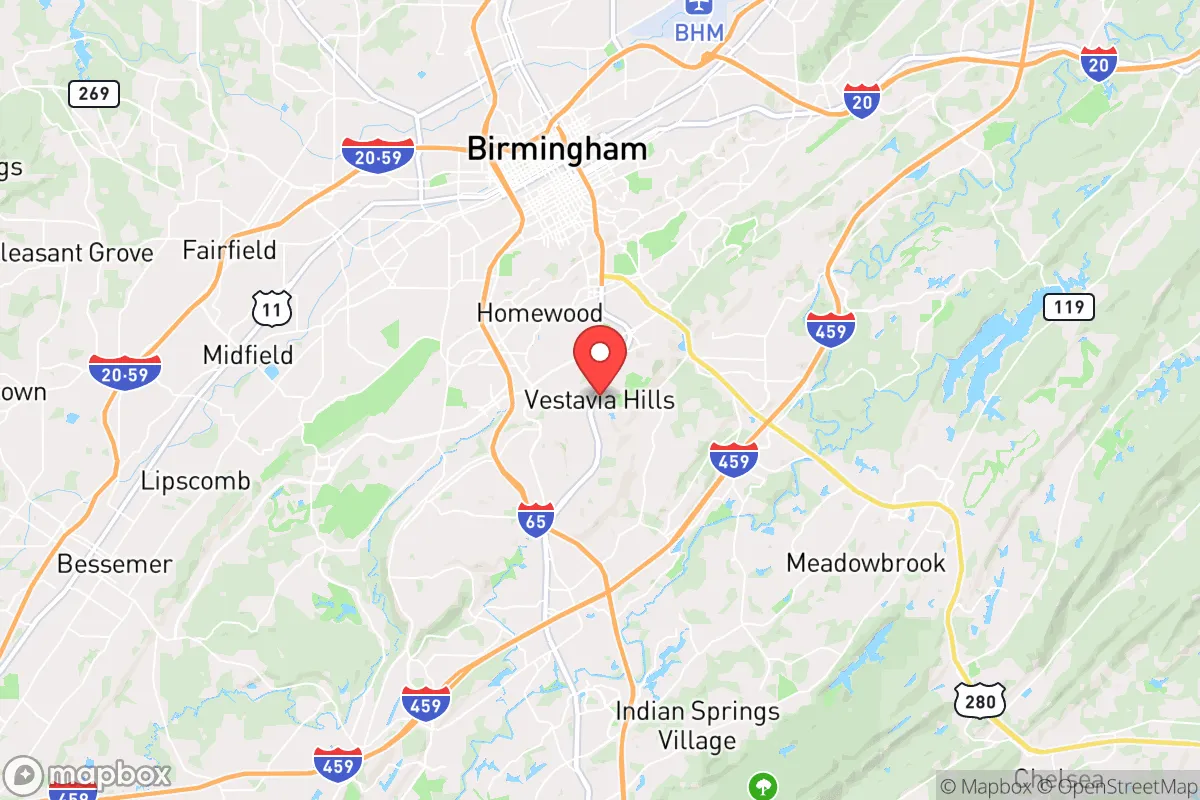
Photo: Wikipedia
Demographics of Vestavia Hills, AL
Affluence Level in Vestavia Hills, AL
An upper-middle-class area. Household wealth, education levels, and homeownership run ahead of national benchmarks.
People of Vestavia Hills, AL
Vestavia Hills, Alabama, is a city of 38,704 residents that is predominantly white (83.2%) and highly educated (62.2% hold a college degree), with a notably small foreign-born population of just 2.2%. The city’s identity is shaped by its history as a planned, affluent suburb of Birmingham, characterized by a strong sense of community, low crime, and a conservative-leaning political culture. Its population is relatively homogeneous compared to the broader Jefferson County area, with small but distinct communities of East/Southeast Asian (2.6%) and Indian subcontinent (2.5%) residents, while Hispanic (3.5%) and Black (5.8%) populations remain modest.
How the city was settled and grew
Vestavia Hills is a post-1900 Sun Belt suburb with no colonial or antebellum history. The land was originally part of rural Jefferson County, used for small farms and timber. The city’s founding is tied to the vision of developer George B. Ward, who in the 1920s purchased a large tract of land atop Shades Mountain to create an exclusive residential enclave for Birmingham’s white professional class. Ward named the development “Vestavia” after his own estate, and the first homes were built in the Vestavia Hills Estates neighborhood, which remains a historic core of large, custom-built homes on wooded lots. The city was officially incorporated in 1950, and its early population was almost entirely white, upper-middle-class families drawn by the promise of scenic views, large lots, and proximity to downtown Birmingham (about 7 miles away). The Liberty Park area, developed later in the 1960s and 1970s, became a second major node, attracting families with its golf course and newer, more affordable housing stock. No significant immigrant or minority populations settled in Vestavia Hills during this period; the city was explicitly marketed as a white, Protestant, family-oriented community.
Modern era (post-1965)
The post-1965 era saw Vestavia Hills continue its trajectory as a white, affluent suburb, but with subtle demographic shifts. The city’s population grew steadily through the 1970s and 1980s as Birmingham’s white middle class moved further south and east, seeking newer schools and lower taxes. The Cahaba Heights neighborhood, annexed in the 1990s, brought a slightly more diverse mix of residents, including some working-class white families and a small number of Black households. The Rocky Ridge area, developed in the 1980s and 1990s, attracted a wave of professionals from the growing medical and engineering sectors, including a notable number of Indian subcontinent families drawn to the city’s top-ranked schools (Vestavia Hills City Schools are consistently rated among the best in Alabama). The East/Southeast Asian community, primarily Chinese and Korean, concentrated in the Altadena Woods and Shades Mountain neighborhoods, drawn by the same educational pull. The Hispanic population, though small, grew modestly in the 2000s, settling mostly in the more affordable apartment complexes along U.S. Highway 31. The Black population, at 5.8%, remains concentrated in the older, less expensive sections of Cahaba Heights and along the city’s southern fringe. Overall, Vestavia Hills has not experienced the rapid diversification seen in some other Birmingham suburbs; its foreign-born share (2.2%) is far below the national average (13.7%), and the city remains overwhelmingly white and native-born.
The future
The population of Vestavia Hills is likely to continue its slow, steady growth, driven by domestic in-migration from other parts of Alabama and the Southeast, rather than by international immigration. The city’s high housing costs (median home value over $400,000) and limited rental stock will likely maintain its character as an affluent, predominantly white enclave. The East/Southeast Asian and Indian subcontinent communities, while small, are expected to grow slowly as professionals in healthcare and engineering continue to be attracted by the school system. The Hispanic and Black populations are projected to plateau or grow only marginally, as the city’s housing market and zoning policies do not favor the development of affordable housing that might attract a more diverse population. The city is not tribalizing into distinct ethnic enclaves; rather, it is homogenizing around a high-income, highly educated, conservative-leaning demographic. The next 10-20 years will likely see Vestavia Hills remain one of the whitest and most affluent suburbs in the Birmingham metro area, with a population that is stable, family-oriented, and resistant to rapid demographic change.
For a conservative-leaning individual or family considering relocation, Vestavia Hills offers a stable, safe, and academically excellent environment with a population that is overwhelmingly white, native-born, and politically conservative. The city is not becoming more diverse in any significant way, and its future demographic trajectory points toward continued homogeneity. This is a place for those seeking a predictable, high-quality suburban lifestyle with minimal cultural or demographic flux.

* Values derived from national, state, county, city and local statistics and may differ in a specific area. Last updated: 2026-04-19T19:12:36.000Z
Narrative content on this page is AI-generated and may contain mistakes. Verify any details that matter before acting on them.
ReloMaps may earn a commission from affiliate links at no extra cost to you.

