Photo: Wikipedia
Demographics of Victoria, TX
Affluence Level in Victoria, TX
A middle-class area roughly in line with national averages across income, home values, education, and employment.
People of Victoria, TX
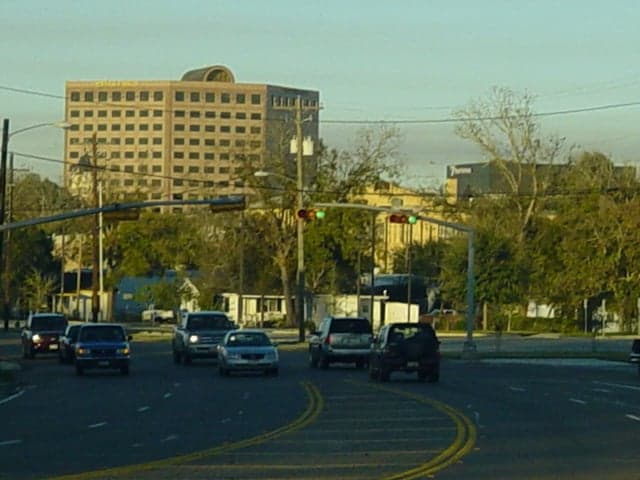
The people of Victoria, Texas, today form a majority-Hispanic community of 65,514 residents, shaped by deep ranching roots and steady industrial growth. The city’s identity is distinctly Texan—practical, family-oriented, and politically conservative—with a population density of roughly 1,200 people per square mile. Unlike many Texas cities that have seen explosive suburban sprawl, Victoria retains a compact, small-city character where longtime families and newer arrivals mix across well-defined neighborhoods.
How the city was settled and grew
Victoria was founded in 1824 as part of a Mexican land grant to Martín De León, a rancher who brought Irish and Mexican families to settle the Guadalupe River valley. The original colonists—known as the De León colonists—established the city as a ranching and trading hub, with the De León Plaza at the center of what is now downtown. By the 1840s, German immigrants arrived via the Adelsverein colonization society, settling in the German Hill Country areas north of town and establishing farms and small businesses. The railroad reached Victoria in the 1880s, bringing Anglo-American merchants and cotton farmers who built homes in the Historic Old Victoria district, a neighborhood of Victorian-era houses near the downtown core. African American families, many formerly enslaved, formed a community in the Southside area around the same period, centered on churches and schools along Sam Houston Drive. The early 20th century saw oil discoveries in the 1930s, drawing workers from across Texas and Oklahoma, who settled in modest bungalow neighborhoods like Northcrest and Memorial Square.
Modern era (post-1965)
After the 1965 Hart-Cellar Act, Victoria’s Hispanic population grew substantially through both immigration and natural increase. Mexican-origin families, many with roots in the original De León settlement, expanded into the Mission Valley area west of the city, a suburban-style development of ranch-style homes built in the 1970s and 1980s. The city’s foreign-born population today stands at just 5.0%, lower than the Texas average, indicating that most Hispanic growth comes from U.S.-born families rather than new arrivals. White non-Hispanic residents, who made up a majority through the 1970s, have declined to 35.2% as many younger families moved to larger metros like Houston or San Antonio for jobs. The Black population, at 6.0%, remains concentrated in the Southside and Riverside Park neighborhoods, with stable but slow growth. East and Southeast Asian communities (1.3%) and Indian-subcontinent residents (0.3%) are small but visible in professional roles tied to the petrochemical and healthcare sectors, with clusters near the Victoria Regional Medical Center and the Formosa Plastics plant east of town. Suburbanization since the 1990s has pushed newer subdivisions—such as Bloomington Road and Northside—into the city limits, attracting families seeking larger lots and newer schools.
The future
Victoria’s population is projected to grow modestly, reaching roughly 70,000 by 2035, driven by Hispanic natural increase and limited domestic in-migration from nearby rural counties. The city is not homogenizing into a single cultural bloc; rather, neighborhoods remain distinct by income and historical settlement patterns. Hispanic residents are increasingly moving into previously Anglo-dominated subdivisions like Northcrest, while the Mission Valley area continues to attract upwardly mobile Hispanic families. The foreign-born share is likely to remain low, as Victoria lacks the large immigrant employer base of Houston or Dallas. The Black and Asian communities are expected to grow slowly, primarily through job transfers to the petrochemical and healthcare sectors. The city’s college-educated share, at 20.1%, is below the national average, but local efforts to expand the University of Houston-Victoria campus may gradually raise that figure.
For someone moving to Victoria now, the city offers a stable, family-oriented environment where traditional values and community ties remain strong. The population is becoming more Hispanic and slightly more educated, but the overall character—rooted in ranching, industry, and conservative politics—is unlikely to shift dramatically. New arrivals will find a place where neighborhoods still carry the imprint of the families who built them, from the De León Plaza to the subdivisions of the 21st century.

* Values derived from national, state, county, city and local statistics and may differ in a specific area. Last updated: 2026-05-12T00:14:43.000Z
Narrative content on this page is AI-generated and may contain mistakes. Verify any details that matter before acting on them.
ReloMaps may earn a commission from affiliate links at no extra cost to you.

