
Photo by Brian LeFevre on Unsplash
Demographics of Manassas City County
Affluence Level in Manassas City County
An upper-middle-class area. Household wealth, education levels, and homeownership run ahead of national benchmarks.
People of Manassas City County
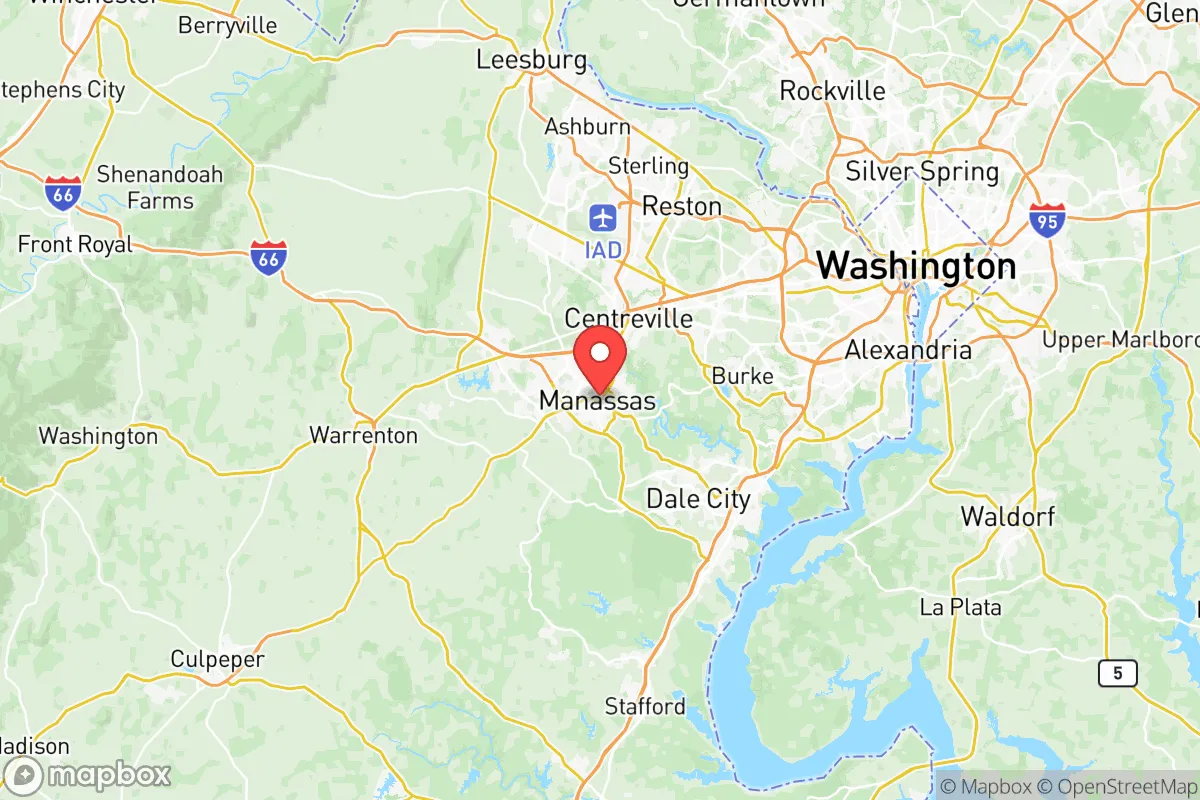
Manassas City County, Virginia, is a dense, majority-minority urban enclave of 42,674 residents, defined by its rapid diversification and a population that is now 43.0% Hispanic, 34.5% White, and 12.4% Black. The city’s identity is shaped by its role as a historic railroad junction and Civil War battleground, which has transformed into a modern gateway for immigrant communities and domestic migrants seeking affordable access to the Washington, D.C., metropolitan area. With a foreign-born population of 17.8% and a growing East/Southeast Asian and Indian subcontinent presence, Manassas today is a place where a historic Southern past coexists with a dynamic, multicultural present.
Settlement & growth (pre-1960)
Before European settlement, the area now known as Manassas City County was part of the ancestral homeland of the Doeg and Manahoac Native nations, who used the region for hunting and seasonal camps along the Occoquan River. By the early 18th century, English colonists from the Tidewater region pushed westward, establishing small tobacco plantations on land grants from the Northern Neck Proprietary. The settlement that would become Manassas was originally called Tudor Hall, a tiny crossroads community that grew slowly until the arrival of the railroad in the 1850s.
The decisive moment for Manassas came with the construction of the Orange and Alexandria Railroad and the Manassas Gap Railroad, which converged at the junction that gave the city its name. This railroad hub attracted a wave of Irish immigrant laborers in the 1850s, who dug the cuts and laid the tracks, settling in rough camps near the depot. The Civil War brought devastation—two major battles were fought on the surrounding fields—but the post-war period saw a slow recovery as the railroad rebuilt and the town became a shipping point for Piedmont farmers. By the 1880s, a small community of freed slaves had established themselves in the area, working as laborers, domestics, and sharecroppers, with their descendants forming the core of the city’s historic Black population.
Through the early 20th century, Manassas remained a small, rural county seat of about 1,000 residents, dominated by native-born White Virginians of English and Scots-Irish descent. The Great Depression and World War II brought little change, but the post-war boom and the expansion of the federal government in Washington, D.C., began to trickle south. By 1960, the population had reached just 3,500, and the city was still overwhelmingly White and native-born, with a small Black minority concentrated in the neighborhood around Liberia Avenue and the historic Manassas Industrial School for Colored Youth.
Modern era (post-1965)
The 1965 Hart-Cellar Act fundamentally reshaped Manassas, as it did the entire Washington region. The first major wave of new residents came not from abroad but from domestic migration: from the 1970s through the 1990s, Manassas attracted White and Black families leaving the inner suburbs of Northern Virginia for cheaper housing and newer schools. This suburbanization turned Manassas from a sleepy town into a fast-growing bedroom community, with the population surging past 20,000 by 1990 and 35,000 by 2000. The new subdivisions of Wellington and Sudley Manor filled with middle-class families employed in defense contracting, federal agencies, and the technology sector.
Beginning in the 1980s, a significant wave of Hispanic immigrants—predominantly from El Salvador, Guatemala, and Mexico—arrived to work in construction, landscaping, and the service industries that supported the region’s growth. They settled initially in the older neighborhoods near the historic downtown, particularly along Grant Avenue and Church Street, where small tiendas, panaderías, and Latin American restaurants began to appear. By 2000, the Hispanic share of the population had reached 20%, and it has since doubled to 43.0%, making Manassas one of the most heavily Hispanic cities in Virginia. The Salvadoran community is especially prominent, with many families tracing their roots to the civil war-era migrations of the 1980s.
The post-1965 era also brought a smaller but notable wave of East/Southeast Asian immigrants, now 4.2% of the population, including Vietnamese and Korean families who arrived in the 1980s and 1990s, many drawn by the area’s affordable housing and proximity to Asian-American communities in Annandale and Centreville. More recently, a growing Indian subcontinent population (1.4%) has begun to settle in the newer developments near the Prince William County line, attracted by tech and professional jobs. The Black population, now 12.4%, includes both long-standing families descended from the historic community and newer arrivals from the Washington, D.C., area and other parts of the country. The White population, once the overwhelming majority, has declined to 34.5% as the city has diversified.
The future
Manassas City County is projected to become even more diverse in the coming decades, with the Hispanic share likely to continue rising as younger families and new immigrants arrive, while the White share is expected to decline further. The city’s foreign-born population of 17.8% is already well above the national average, and this trend is reinforced by the region’s strong job market in construction, logistics, and services. New residential development is concentrated in the western and southern edges of the city, near the boundaries with Prince William County, where townhomes and apartments are drawing younger, more diverse households.
Culturally, Manassas is evolving from a historically Southern town into a bilingual, bicultural city where Spanish is heard as often as English in public spaces. The annual Manassas Latino Festival and the growing number of Hispanic-owned businesses along Center Street signal a community that is putting down deep roots. The city’s schools reflect this shift: over 60% of students in Manassas City Public Schools are Hispanic, and the system has adapted with dual-language programs and community outreach. At the same time, the city’s historic identity—its Civil War battlefields, the old railroad depot, the historic district—remains a draw for tourists and long-time residents, creating a sometimes tense but generally stable coexistence between old and new.
For someone moving in now, Manassas offers a dense, walkable urban core with a strong sense of community, but it is a community in rapid transition. The city is becoming younger, more Hispanic, and more working-class, even as it retains a core of older White and Black families who remember the pre-boom era. The next 10-20 years will likely see continued diversification, with the Hispanic majority solidifying and the East/Southeast Asian and Indian populations growing modestly. Manassas is not becoming a homogenized suburb; it is becoming a distinctively Central American-influenced city within the Washington orbit, a place where the past is preserved in brick and battlefield but the future is spoken in Spanish.

* Values derived from national, state, county, city and local statistics and may differ in a specific area. Last updated: 2026-08-24T19:33:11.000Z
Narrative content on this page is AI-generated and may contain mistakes. Verify any details that matter before acting on them.
ReloMaps may earn a commission from affiliate links at no extra cost to you.

