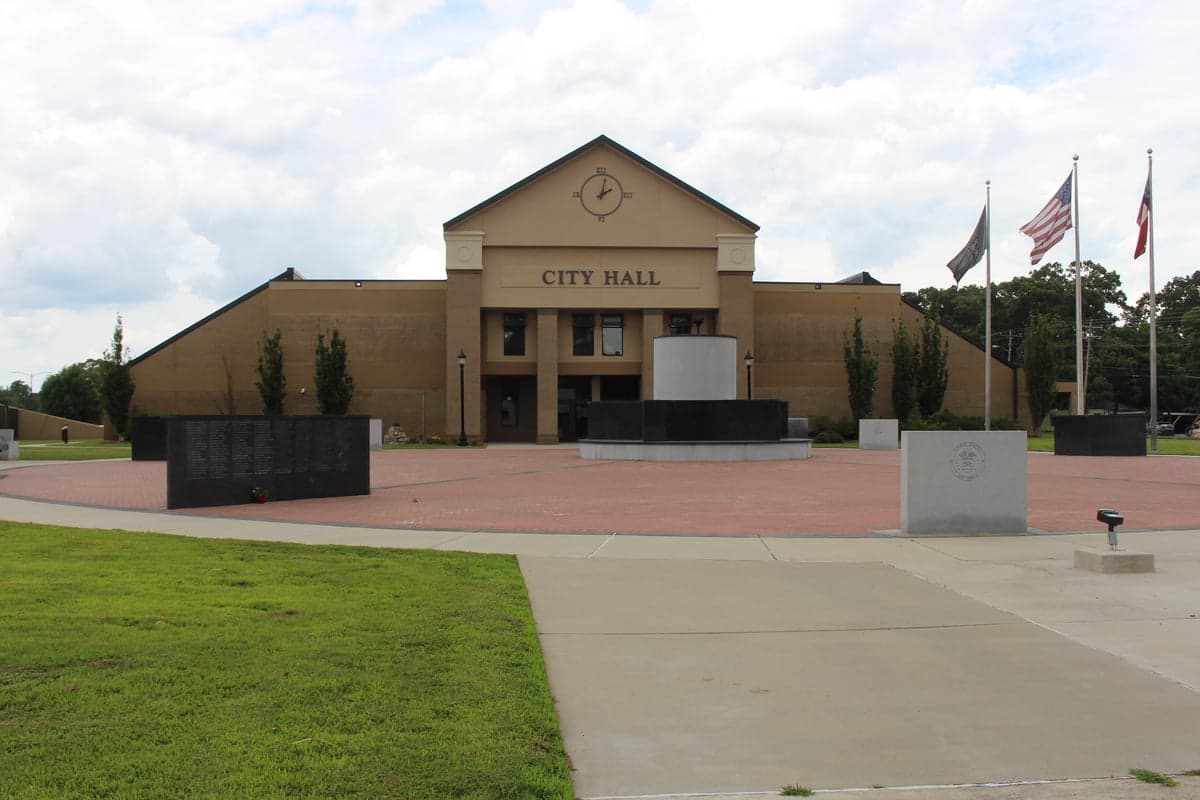
Photo: Wikipedia
Demographics of Warner Robins, GA
Affluence Level in Warner Robins, GA
A below-average socioeconomic profile. Incomes, home values, and educational attainment trail the U.S., with higher poverty and unemployment.
People of Warner Robins, GA
The people of Warner Robins, Georgia, today form a majority-minority community of 81,438, where White residents make up 41.6% and Black residents 39.6%, with a growing Hispanic population at 8.8% and a small but notable East/Southeast Asian community at 2.9%. The city is a dense, middle-class hub defined by its deep ties to Robins Air Force Base, a strong military and civil-service culture, and a relatively low foreign-born share of 4.4%. Distinctive identity markers include a pronounced Southern Baptist and evangelical Christian presence, a high rate of veteran households, and a civic life organized around base-related employment and family-oriented subdivisions. The population is younger than the state median, with a median age of 33.5, and is increasingly diversifying through domestic migration rather than international immigration.
How the city was settled and grew
Warner Robins is a post-1900 planned city, founded explicitly to support Robins Air Force Base, which opened in 1942 as a maintenance and logistics depot for the U.S. Army Air Forces. The original population was drawn almost entirely from the surrounding rural Middle Georgia counties—mostly White tenant farmers and small-town laborers seeking steady wartime wages. The first residential neighborhoods, such as Wellston (the original name for the area before it was renamed Warner Robins in 1943) and Shirley Hills, were built by the federal government and private developers to house base workers. These early subdivisions were racially segregated by law and custom, with Black workers initially living in unincorporated pockets or commuting from nearby Macon. The post-World War II boom brought a second wave: returning veterans and their families, many from outside Georgia, who settled in expanding subdivisions like Green Acres and Lake Joy Estates. By 1960, the population had surged past 18,000, overwhelmingly White and native-born, with a small Black minority concentrated in the Northview area near the base's edge.
Modern era (post-1965)
After the 1965 Hart-Cellar Act, Warner Robins saw only modest international immigration, as the base economy did not attract the same refugee or labor flows as coastal cities. The major demographic shift came from domestic in-migration: the 1970s and 1980s brought a steady stream of Black families from rural Georgia and the Deep South, drawn by stable civil-service jobs at the base and lower housing costs than Atlanta. These families settled primarily in the Northview and Russell Parkway corridor, which gradually became majority-Black neighborhoods. Meanwhile, White families moved outward into newer subdivisions like Bonaire and Kathleen in unincorporated Houston County, creating a pattern of racial sorting by neighborhood rather than integration. The Hispanic population began growing in the 1990s, driven by construction and service jobs, and concentrated in the Watson Boulevard area and parts of South Warner Robins. The East/Southeast Asian community, at 2.9%, is largely composed of Filipino and Vietnamese families connected to the base through military service, and they are dispersed across the city rather than clustered in a single enclave. The Indian-subcontinent population, at 0.8%, is a smaller, more recent cohort of professionals in engineering and healthcare, also base-linked.
The future
The population of Warner Robins is heading toward greater racial balance between White and Black residents, with the Hispanic share likely to continue rising slowly as second-generation families grow. The city is not tribalizing into rigid enclaves—most neighborhoods are transitioning from majority-White to mixed, especially in the Russell Parkway and Lake Joy areas—but the Northview area remains predominantly Black, and newer subdivisions on the city's northern edge remain predominantly White. International immigration is unlikely to surge, as the base economy does not attract large refugee or H-1B flows; the foreign-born share is expected to plateau near 5-6%. The next 10-20 years will likely see continued domestic in-migration from other parts of Georgia and the Southeast, with the population becoming slightly older as the base workforce ages. The city is homogenizing in terms of income and lifestyle—most residents share a base-centric, middle-class, family-oriented culture—even as racial lines soften.
Warner Robins is becoming a stable, majority-minority Southern city where racial change is happening gradually through domestic migration, not immigration, and where the unifying force of the air base keeps the population economically and culturally cohesive. For a conservative-leaning mover, this means a community that is diversifying in demographics but not in values, with a strong military ethos, low crime relative to similarly sized Georgia cities, and a housing market that remains affordable for families seeking a base-adjacent lifestyle.

* Values derived from national, state, county, city and local statistics and may differ in a specific area. Last updated: 2026-04-24T06:30:35.000Z
Narrative content on this page is AI-generated and may contain mistakes. Verify any details that matter before acting on them.
ReloMaps may earn a commission from affiliate links at no extra cost to you.

