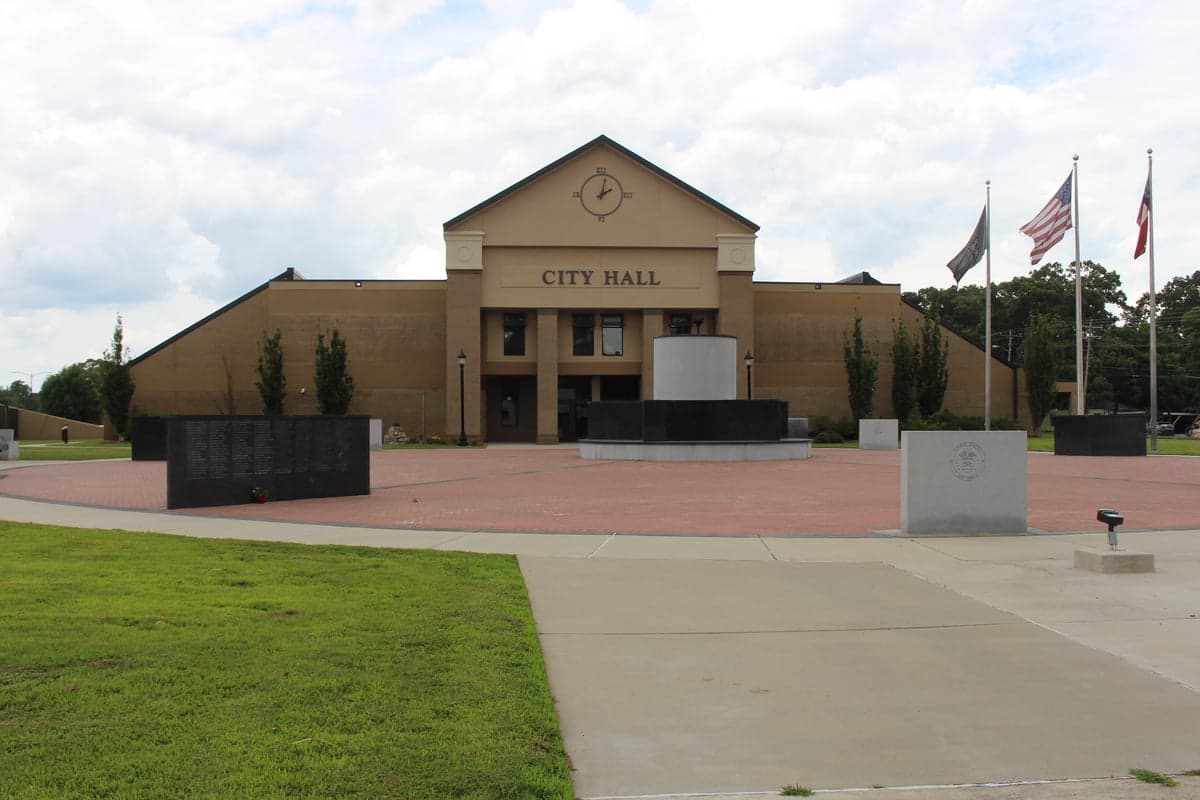
Photo: Wikipedia
Strategic Assessment of Warner Robins, GA
Meaningful friction. Expect exposure to either population pressure, blast zones, or natural disaster risk. Consider buying a retreat property.
What does the Strategic Assessment tell us?
Our Strategic Assessment grades tactical survivability of an area. Major population centers, military targets, fallout zones, natural disasters, and border exposure all drive risk — lower exposure means a more defensible position in a crisis.
This is heavily inspired by Joel Skousen's Strategic Relocation book. Highly recommended you checkout the book ($)What does this tell us?
Our Strategic Assessment grades tactical survivability of an area. Major population centers, military targets, fallout zones, natural disasters, and border exposure all drive risk — lower exposure means a more defensible position in a crisis.
This is heavily inspired by Joel Skousen's Strategic Relocation book. Highly recommended you checkout the book ($)Strategic Pillars

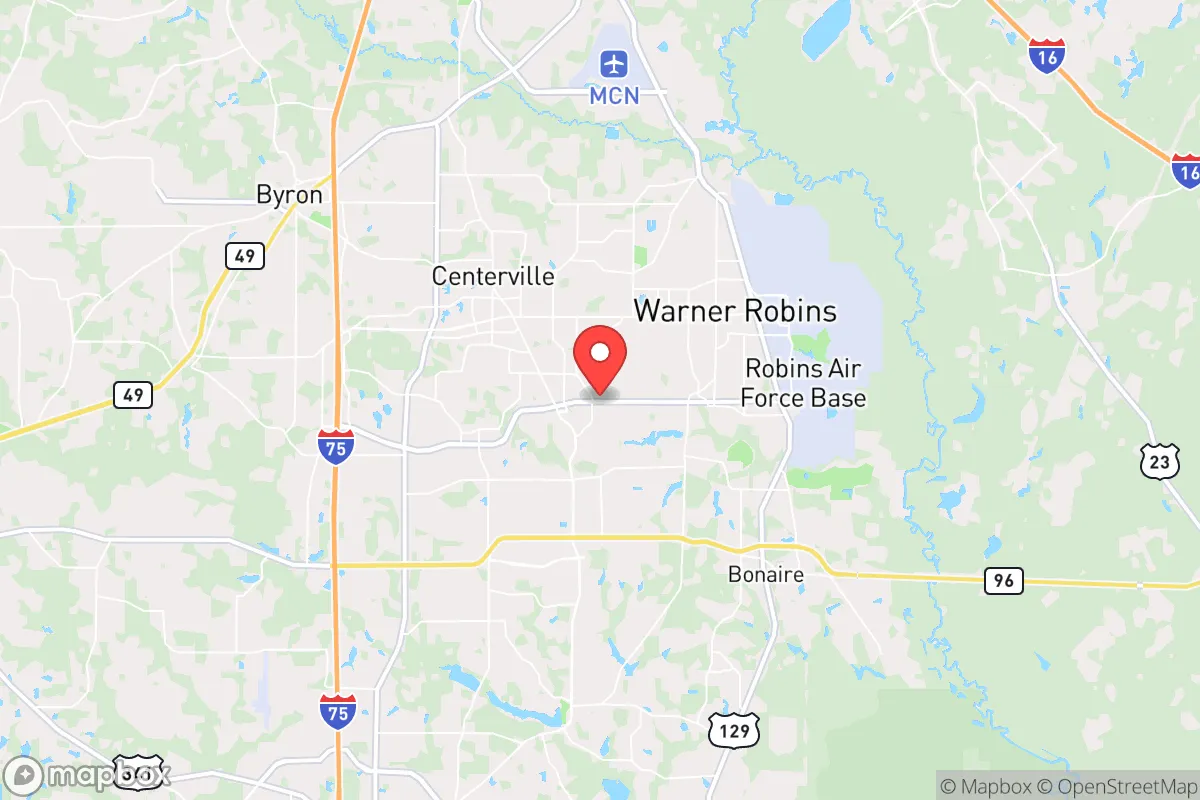
Key Distances
Regional Safe Places
Below is our recommended "safe zones" in Georgia and the surrounding area based on our strategic heuristics. For most people, it's unrealistic to live in a “safe zone” full-time due to work, family or other personal reasons. They tend to be more rural. However, many of these areas are perfect for second homes and retreat properties that double as a vacation home or even a short-term rental.
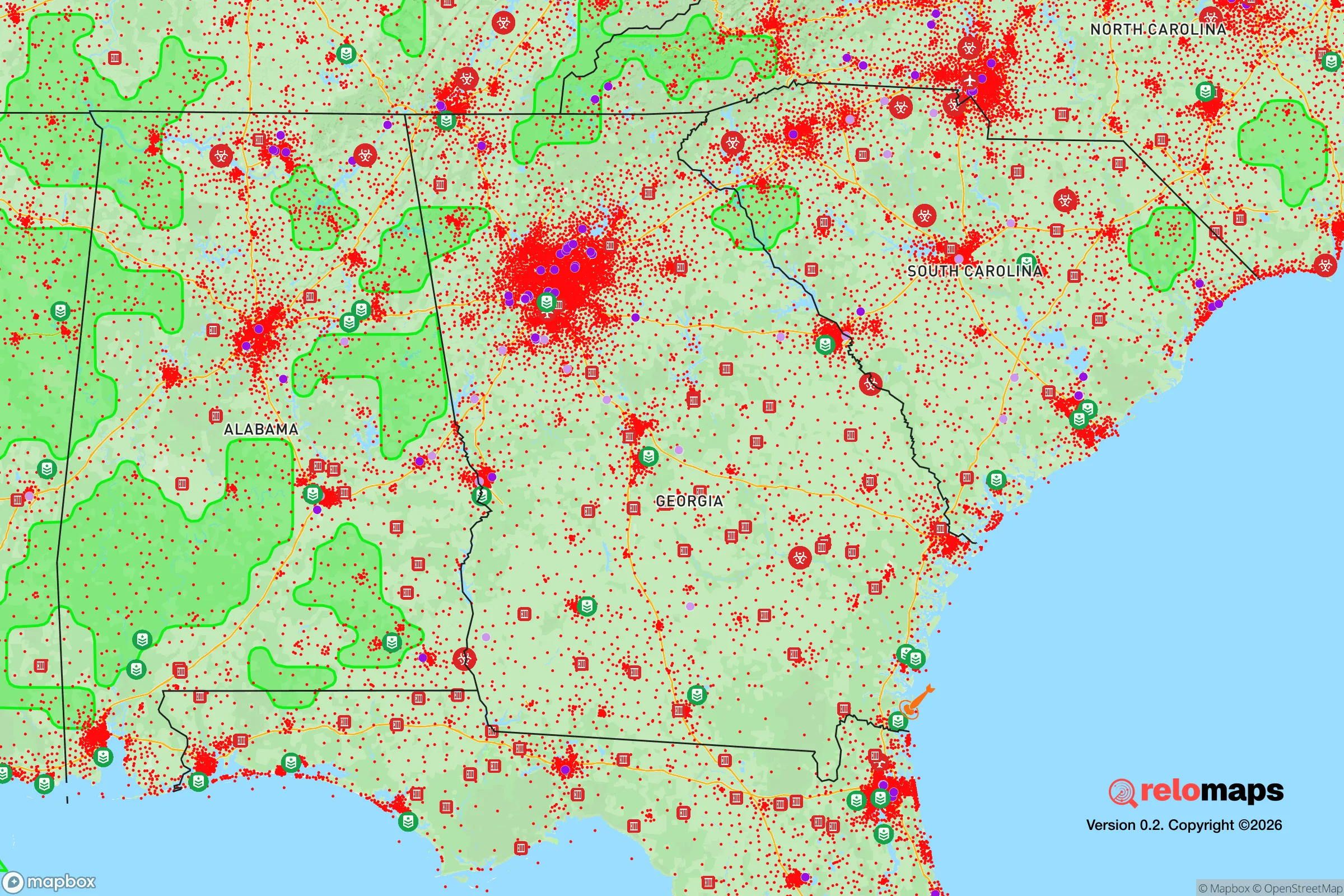
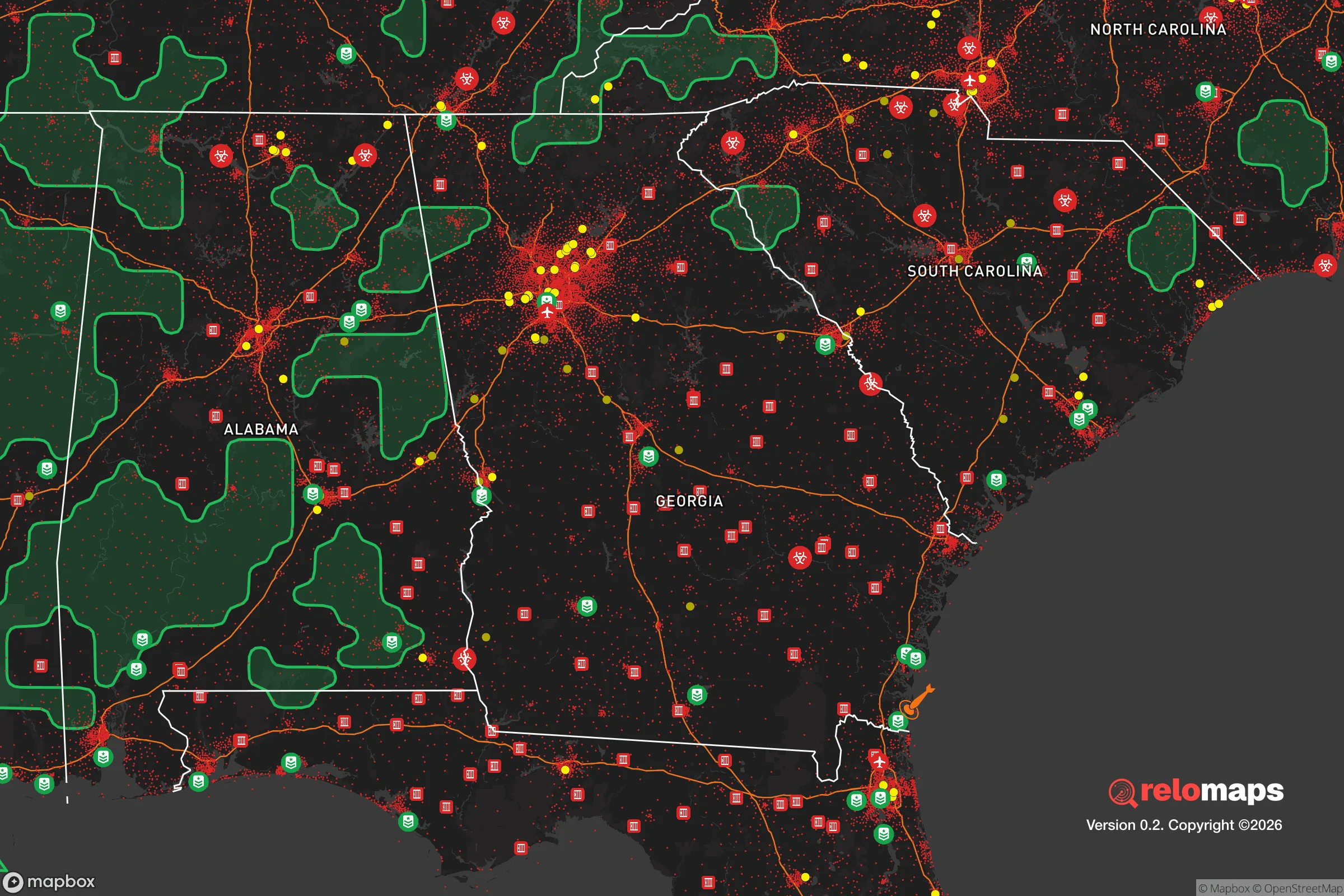


Important Note: For informational purposes only. This does not mean nothing bad ever happens in the green zones. Please use common sense. This is based on public data and modeled with AI. We tried to take a conservative approach but mistakes happen. We update this regularly as new information becomes available.
Solar Generator Recommendations
Backup power matters more here than in safer locations. We've picked three solar generators across budgets and capacity tiers — start with the budget unit if you only need a few essentials, or step up if you want to run a fridge and HVAC for days at a time.

Jackery Portable Power Station Explorer 300
Budget OptionPower on the Go: Weighing only 11 lbs, it's convenient to set up and store with book-sized foldable solar panels

BLUETTI Portable Power Station AC180
Designed for both indoor and outdoor scenarios, AC180 is highly capable as it has a robost capacity and continuous output power.

EF ECOFLOW DELTA Pro Ultra Power Station
Upgraded PickEcoFlow DELTA Pro Ultra is a whole-home energy system designed to grow with your family. Integrated with the Smart Home Panel 2, it scales to meet your evolving energy needs — keeping your home powered, intelligent, and secure through every stage of life.
We earn a commission, at no additional cost to you.
Strategic Assessment Analysis
Warner Robins, Georgia, sits in a strategic pocket of the state that offers a blend of industrial resilience and geographic insulation, making it a serious contender for those prioritizing long-term preparedness. Located roughly 100 miles south of Atlanta and 30 miles south of Macon, the city is anchored by Robins Air Force Base, a massive employer and a dual-edged asset: it provides economic stability and infrastructure that would likely be prioritized in a crisis, but it also introduces a target profile that a prepper must weigh carefully. The area’s position along the Fall Line—the geological boundary between the Piedmont and the Coastal Plain—gives it access to reliable groundwater and slightly higher elevation than much of Georgia, reducing flood risk while keeping it within a day’s drive of both the mountains and the coast. For a conservative-leaning relocator concerned with civic stability and self-sufficiency, Warner Robins offers a middle-ground option: not so remote that supply chains vanish, but not so urban that you’re trapped in a gridlock scenario.
Geographic position and natural advantages for long-term stability
Warner Robins sits in Houston County, which is part of the broader Macon-Warner Robins combined statistical area. The terrain is gently rolling, with sandy loam soils that drain well—good for gardening and septic systems—and the area is far enough inland to avoid direct hurricane storm surge, though tropical remnants can bring heavy rain. The Ocmulgee River runs about 15 miles east, providing a potential water source, but the region’s real hydrological asset is the Upper Floridan Aquifer, which lies beneath much of central Georgia and offers deep, reliable groundwater. Wells in the area typically hit good water at 100–200 feet, and many rural properties already have them. The climate is humid subtropical, with hot summers and mild winters, meaning a freeze is rare enough that you can grow food year-round with minimal hoop-house protection. The lack of major natural barriers—no mountains to cross, no wide rivers to ford—means evacuation routes are straightforward, primarily via I-75 and I-16, but it also means the area is not naturally defensible against a determined threat. The surrounding countryside is a mix of pine forests and farmland, offering plenty of rural buffer zones within a 20-minute drive of the city center.
Risks, exposures, and proximity to fallout-relevant landmarks
The most significant risk for a prepper in Warner Robins is the presence of Robins Air Force Base itself. As a major logistics and maintenance hub for the U.S. Air Force, it is a high-value target in any conflict scenario involving state-level adversaries. The base employs over 23,000 people and houses the Warner Robins Air Logistics Complex, which handles C-5, C-17, and C-130 aircraft. In a conventional war or a major terrorist event, this facility would be a primary target for long-range missiles or sabotage. Additionally, the base stores and handles jet fuel, munitions, and hazardous materials, meaning a secondary risk of chemical or fire incidents even in a non-attack scenario. The city is also within 30 miles of the Georgia Nuclear Aircraft Laboratory site near Dawsonville—though that facility is decommissioned, the legacy contamination is minimal. More practically, the area is about 90 miles from the Vogtle Electric Generating Plant near Augusta, the nation’s newest nuclear power station. A worst-case release from Vogtle could put Warner Robins in a downwind plume path depending on weather patterns, though prevailing winds typically push east toward the coast. For civic unrest, the proximity to Macon (pop. 150,000) and Atlanta (pop. 500,000 metro) means that any large-scale urban collapse could send refugees south along I-75. Warner Robins itself has a population of about 80,000, with a relatively low crime rate compared to Macon, but the city’s growth has outpaced its infrastructure in some areas, leading to occasional water main breaks and power outages during summer storms.
Practical resilience for a relocator: food, water, energy, and defensibility
For a relocator focused on self-sufficiency, Warner Robins offers a mixed bag. The local climate supports three-season gardening, and the sandy loam is easy to work, though it requires amendment with organic matter to hold moisture. The Houston County Extension office offers soil testing and master gardener programs, which is a plus for serious growers. Water is the biggest win: the Upper Floridan Aquifer means that a properly drilled well can provide 10–20 gallons per minute, enough for a household and small-scale irrigation. Rainwater catchment is also viable, with annual rainfall around 47 inches, though you’ll need to account for the occasional drought. Energy resilience is more challenging. The local grid is served by Georgia Power, which has a mixed reliability record—outages during ice storms and summer thunderstorms are common, but usually short. Solar is feasible, with about 215 sunny days per year, but net metering policies are not as favorable as in some states, so battery storage is recommended. Natural gas is available in most suburban areas, which can power generators and heating, but rural properties may rely on propane. Defensibility is the weak point. The terrain is flat and open, with few natural chokepoints. A determined group could approach from any direction, and the lack of dense forest cover means you’d need to rely on perimeter security—fencing, cameras, and good neighbors—rather than natural barriers. The local gun culture is strong, with several ranges and gun shops in the area, and Georgia’s constitutional carry law means you can legally defend your property without a permit. The sheriff’s office is generally conservative and responsive, but in a widespread collapse scenario, you’d be on your own for the first 72 hours at least.
The overall strategic picture for Warner Robins is one of calculated trade-offs. It is not a remote survivalist retreat—you’re within an hour of a major interstate and a military base that could become a liability. But for a relocator who wants to maintain a job in aerospace or logistics while building a resilient homestead, it offers a rare combination of economic stability, good water access, and a climate that supports year-round food production. The conservative community is active, with churches, gun clubs, and a strong veteran presence that would likely organize quickly in a crisis. The biggest unknown is the base: if you’re planning for a long-term scenario where the federal government remains intact, the base is an asset; if you’re planning for a complete breakdown, it’s a liability. For the prepper who wants to be within striking distance of infrastructure but not dependent on it, Warner Robins is a solid B+ option—worth a serious look, but only if you’re willing to invest in well water, solar backup, and a good perimeter plan.

* Values derived from national, state, county, city and local statistics and may differ in a specific area. Last updated: 2026-04-24T06:30:35.000Z
Narrative content on this page is AI-generated and may contain mistakes. Verify any details that matter before acting on them.
ReloMaps may earn a commission from affiliate links at no extra cost to you.

