 Popular
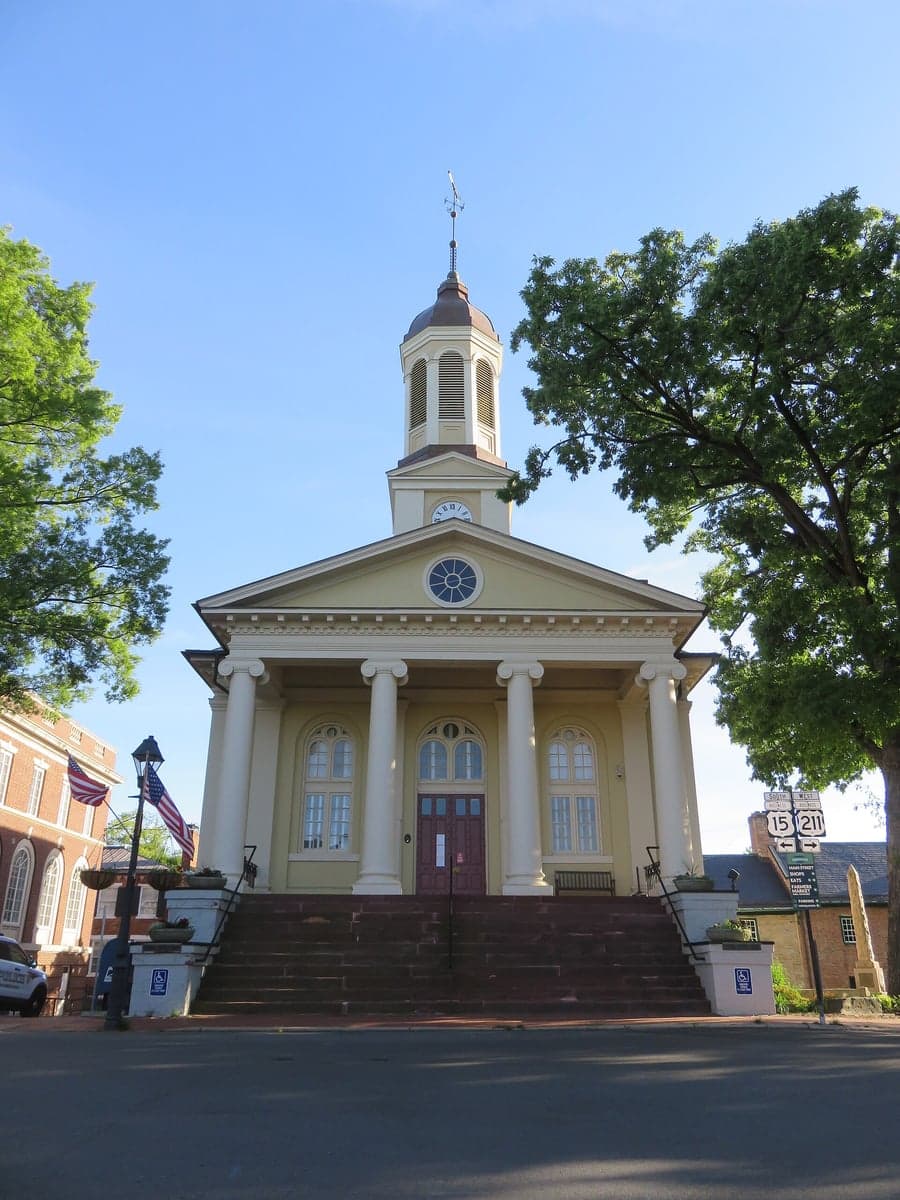
Photo: Wikipedia
Demographics of Warrenton, VA
Affluence Level in Warrenton, VA
A middle-class area roughly in line with national averages across income, home values, education, and employment.
People of Warrenton, VA
The people of Warrenton, Virginia today number 10,151, forming a predominantly white (72.3%) and college-educated (43.9%) community with a notably low foreign-born share of just 2.4%. The city’s identity is shaped by its role as the Fauquier County seat, blending historic small-town character with a growing professional class drawn by proximity to Washington, D.C. and a reputation for conservative values and rural landscapes. Despite its small size, Warrenton is demographically more diverse than the surrounding county, with Black (9.0%) and Hispanic (8.3%) residents making up significant minorities, while East/Southeast Asian (1.6%) and Indian subcontinent (0.8%) communities remain small but present.
How the city was settled and grew
Warrenton was founded in 1790 as the county seat of Fauquier County, named after Revolutionary War hero Dr. Joseph Warren. The original population consisted largely of English and Scots-Irish settlers who arrived via land grants in the Virginia Piedmont, establishing tobacco plantations and later mixed agriculture. The historic Old Town Warrenton district, centered around the courthouse on Main Street, was built by these early families, with Federal and Greek Revival homes still standing today. A second wave arrived after the Civil War, when freed Black families established the Blackwelltown neighborhood (also known as the “Black Bottom” area) along Lee Street and Winchester Street, creating a self-sufficient community with churches, schools, and businesses. The early 20th century brought a small influx of German and Irish immigrants who worked on the railroad and in the growing service economy, settling in the North Third Street area near the depot. By 1950, Warrenton remained a deeply rural, segregated town of roughly 3,500 residents, with the white population concentrated in Old Town and the Black population in Blackwelltown and the Meetze area along Route 29.
Modern era (post-1965)
The post-1965 period transformed Warrenton’s population through two major forces: the end of legal segregation and the suburbanization of the Washington, D.C. exurbs. The Civil Rights era saw the gradual integration of schools and neighborhoods, though Blackwelltown and Meetze remained predominantly Black through the 1980s. The real demographic shift began in the 1990s and accelerated after 2000, as D.C.-area professionals—many white, college-educated, and politically conservative—moved south along the I-66 corridor seeking larger lots and lower taxes. These newcomers concentrated in newer subdivisions like Vint Hill Farms (a former Army base redeveloped into a 700-home planned community) and Lake of the Woods (a gated golf-course community just outside city limits). Hispanic residents, primarily of Mexican and Central American origin, began arriving in the 1990s to work in construction, landscaping, and the horse industry, settling in the Southern Fauquier area and along Route 29 south of town. The Black population, which had been roughly 25% in 1970, declined to 9.0% by 2020 as older families moved to larger cities or were displaced by rising property values. The East/Southeast Asian and Indian subcontinent populations remain tiny (1.6% and 0.8% respectively), mostly professionals in tech and healthcare who live in Vint Hill Farms and newer subdivisions near the Warrenton Village shopping center.
The future
Warrenton’s population is trending older and more homogenously white and affluent, with the Hispanic share plateauing around 8-9% and the Black share continuing a slow decline. The foreign-born population (2.4%) is among the lowest in Northern Virginia, and no new immigrant gateway is emerging. New housing construction is concentrated in high-end subdivisions like Warrenton Manor and Foxcroft, attracting D.C. commuters and retirees, while affordable housing remains scarce. The next 10-20 years will likely see continued growth of the white professional class, further assimilation of the Hispanic community into the broader population, and a stable but small presence of East/Southeast Asian and Indian residents. The city is not tribalizing into distinct ethnic enclaves; rather, it is homogenizing around a conservative, family-oriented, and increasingly wealthy identity.
For someone moving in now, Warrenton offers a stable, low-crime, and politically conservative community with strong schools and a historic downtown, but little racial or economic diversity. The population is becoming more uniformly white and college-educated, with the small Hispanic and Black communities concentrated in older neighborhoods and facing rising housing costs. It is a place where the past—plantation-era roots, Civil War history, and a segregated mid-century—is still visible in the built environment, but the future belongs to the exurban professional class.

* Values derived from national, state, county, city and local statistics and may differ in a specific area. Last updated: 2026-05-01T16:56:39.000Z
Narrative content on this page is AI-generated and may contain mistakes. Verify any details that matter before acting on them.
ReloMaps may earn a commission from affiliate links at no extra cost to you.

