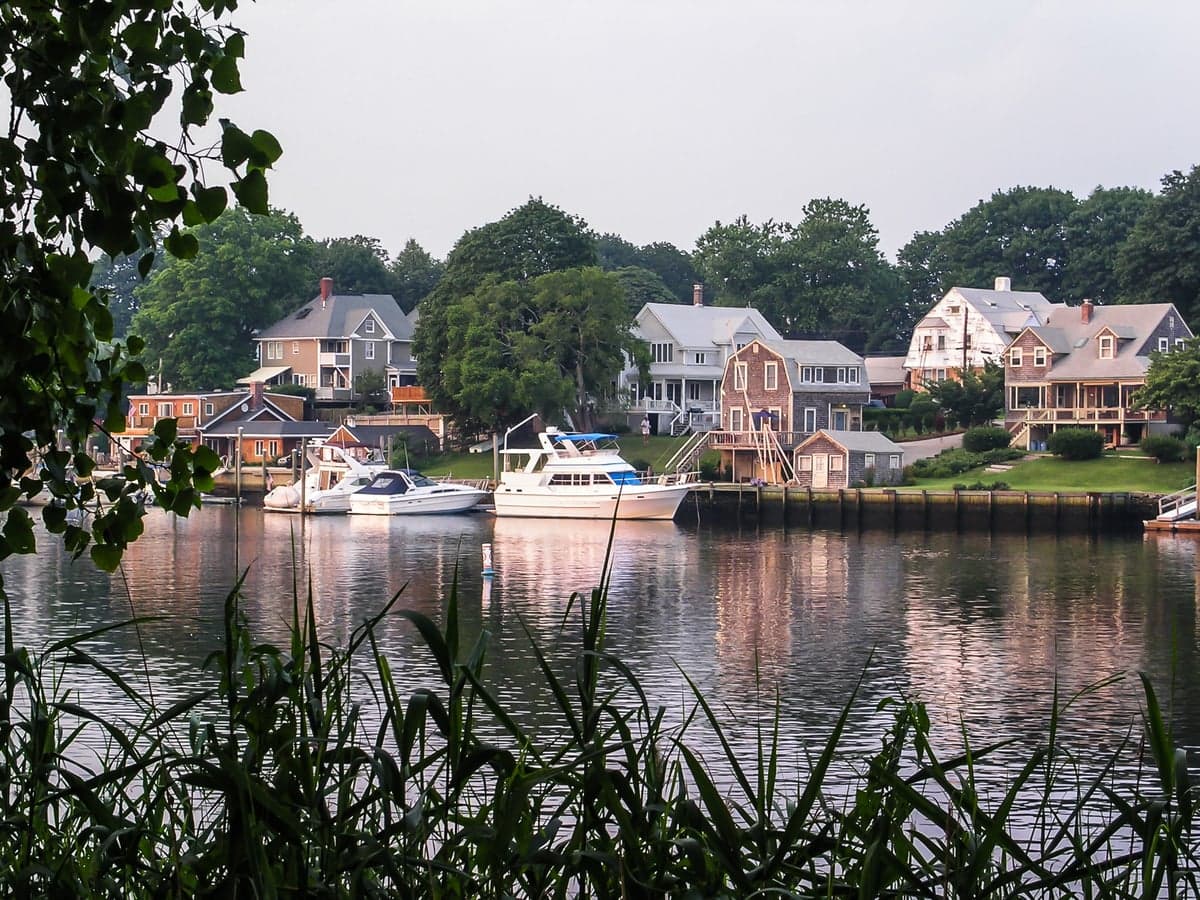
Photo: Wikipedia
Personal Sovereignty in Warwick, RI
Viable for self-reliance. Generally workable, though some barriers may limit total independence.
What does Personal Sovereignty tell us?
Personal Sovereignty measures your capacity for self-reliance and independence with minimal government friction. Higher scores mean fewer barriers between you and the way you want to live... but it assumes you have the space you need and good neighbors.
What does this tell us?
Personal Sovereignty measures your capacity for self-reliance and independence with minimal government friction. Higher scores mean fewer barriers between you and the way you want to live... but it assumes you have the space you need and good neighbors.
State Policy
Energy independence: Importer (1% of energy produced in-state)
Personal Liberty
Homesteading

Personal Liberty Analysis
Warwick, Rhode Island, presents a mixed picture for those prioritizing personal sovereignty, with the state’s heavy regulatory and tax climate significantly constraining individual autonomy compared to less interventionist regions. While the city itself offers some practical advantages for self-reliance—like reasonable lot sizes and proximity to coastal resources—the overarching legal and fiscal environment in Rhode Island imposes notable limits on gun rights, medical freedom, and property use. For a conservative-leaning individual or family weighing relocation, Warwick demands a clear-eyed assessment of where state power ends and personal liberty begins, especially given the broader national trends toward centralized control.
Tax burden and regulatory posture: how Rhode Island’s fiscal policies affect your autonomy
Rhode Island’s tax structure is among the most aggressive in New England, directly impacting how much of your income and property you control. The state levies a progressive income tax with rates up to 5.99%, and Warwick’s property tax rate hovers around $17.50 per $1,000 of assessed value, one of the higher rates in the state. This means a median home valued at $350,000 carries an annual tax bill near $6,125—a significant recurring cost that reduces funds available for personal savings, preparedness supplies, or off-grid investments. Sales tax stands at 7%, applied to most goods, and the state imposes an estate tax on assets over $1.6 million, which can erode generational wealth transfer. Regulatory posture is similarly dense: Rhode Island mandates strict building codes, environmental reviews for land use changes, and a complex permitting process for any structural modifications. For a prepper or homesteader, this translates to limited flexibility—installing a rainwater catchment system, erecting a workshop, or adding a secondary dwelling often requires municipal approval that can take months. The state’s energy policies also mandate participation in regional grid regulations, making independent solar or generator setups subject to interconnection rules that favor utility control. In short, Warwick’s tax and regulatory environment consistently prioritizes state revenue over individual financial sovereignty.
Self-defense and gun law specifics: what Warwick residents can and cannot do
Rhode Island is not a gun-friendly state, and Warwick residents face some of the tightest restrictions in the Northeast outside of New York or Massachusetts. The state requires a purchase permit or a valid concealed carry permit to buy any handgun, and all firearm sales—including private transactions—must go through a licensed dealer with a background check. Magazine capacity is capped at 10 rounds for long guns and 10 rounds for handguns, effectively limiting defensive firearm utility. Concealed carry permits are issued by the Warwick Police Department on a “may-issue” basis, meaning the chief has discretion to deny applications without a specific reason; in practice, approval is not guaranteed and often requires demonstrating a “proper need” beyond general self-defense. Open carry is technically legal but practically discouraged, as local ordinances and police attitudes can lead to harassment or charges of disorderly conduct. Stand-your-ground laws do not exist in Rhode Island; instead, a duty to retreat applies before using deadly force, even in your own home if a safe retreat is possible. For a survivalist mindset, these laws create a legal minefield: storing firearms for emergency scenarios, carrying while traveling, or defending property during civil unrest could all invite prosecution. The state also maintains a firearm registry for handguns, and recent legislative pushes have targeted “ghost guns” and private manufacturing, further eroding the ability to self-equip without government oversight.
Self-reliance and homesteading viability: lot sizes, zoning, and off-grid feasibility in Warwick
Warwick offers a mixed bag for those seeking self-sufficiency. The city’s residential zoning allows for lots as small as 10,000 square feet in denser neighborhoods, but many single-family homes sit on quarter-acre to half-acre parcels, providing modest space for gardens, small livestock, or workshop sheds. Agricultural zoning exists in parts of western Warwick, where lots can exceed one acre, but these areas are limited and often subject to conservation restrictions. Raising chickens is permitted in most residential zones with a permit, but goats, pigs, or larger livestock are generally prohibited unless you’re on a minimum of two acres with special approval. Off-grid living faces significant hurdles: Rhode Island law requires connection to municipal water and sewer in most developed areas, and solar panel installations must comply with net metering rules that discourage true energy independence. Rainwater collection is legal but limited to non-potable uses, and any system exceeding 500 gallons requires a permit from the Department of Environmental Management. Composting toilets are not recognized as primary sanitation, so a septic system or sewer hookup is mandatory. For a prepper, this means true off-grid autonomy is effectively illegal within city limits; you’d need to look at rural areas in neighboring towns like Coventry or West Greenwich for more freedom. However, Warwick’s coastal location does offer a strategic advantage—access to Narragansett Bay for fishing, crabbing, and potential waterborne evacuation routes, which can supplement food security in a crisis.
Personal liberties: parental rights, medical autonomy, speech, and property protections
Rhode Island’s stance on personal liberties is generally restrictive from a conservative perspective. Parental rights are under pressure: the state mandates comprehensive sex education in public schools without a parental opt-out for specific content, and recent laws have limited parental notification requirements for certain medical decisions involving minors. Medical autonomy is similarly constrained—Rhode Island has broad vaccine mandates for school attendance, and during public health emergencies, the governor holds expansive powers to enforce quarantines, treatment orders, and business closures without legislative approval. This was demonstrated during the COVID-19 pandemic, when the state imposed some of the longest-lasting mask and vaccine mandates in the region. Free speech protections are standard under the First Amendment, but local noise ordinances and public assembly permits can be used to limit protests or gatherings, particularly those deemed disruptive. Property rights are perhaps the strongest area: eminent domain is rarely used aggressively in Warwick, and zoning variances are obtainable with proper application, though the process is bureaucratic. However, the state’s coastal zone management laws restrict development near shorelines, and environmental regulations can limit tree removal or land clearing on your own property. For a survivalist, the key takeaway is that Rhode Island’s legal framework consistently favors collective public health and safety over individual choice, meaning you have less room to opt out of government-mandated medical interventions or educational curricula than in states like New Hampshire or Texas.
Overall, Warwick offers a moderate baseline for personal sovereignty compared to deep-blue urban centers like Boston or New York, but it falls well short of the autonomy found in lower-tax, gun-friendly states in the South or Mountain West. The city’s practical advantages—coastal access, reasonable lot sizes, and a relatively stable local economy—are offset by a state government that actively limits self-defense options, medical freedom, and off-grid living. For a conservative-leaning individual or family prioritizing maximum personal control, Warwick is a compromise location where you can carve out a degree of self-reliance within a heavily regulated system, but you’ll need to accept ongoing friction with state authority. If your relocation calculus weighs tax burden and gun rights heavily, this area may feel like a holding pattern rather than a sanctuary.

* Values derived from national, state, county, city and local statistics and may differ in a specific area. Last updated: 2026-04-22T22:51:39.000Z
Narrative content on this page is AI-generated and may contain mistakes. Verify any details that matter before acting on them.
ReloMaps may earn a commission from affiliate links at no extra cost to you.

