Political ClimatePolitical Climate in Washington, DC
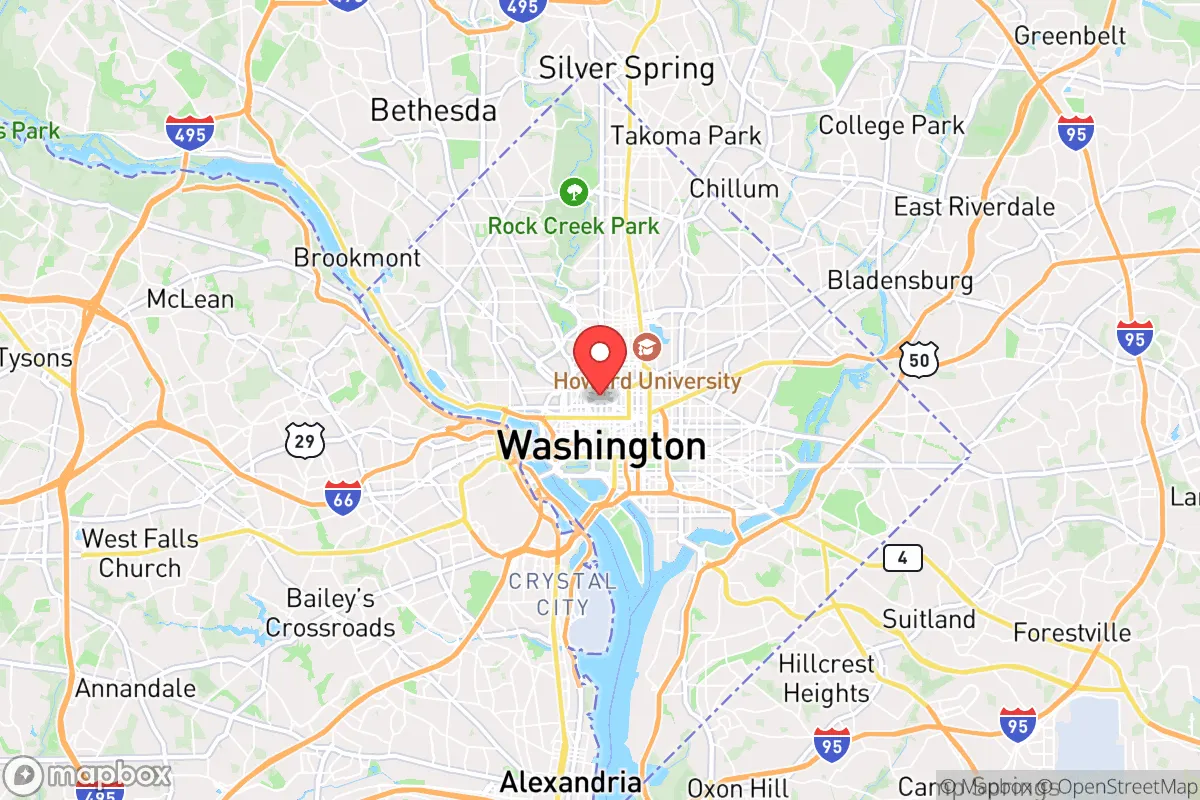
District shown is the primary district for this city’s centroid. Cities may span multiple districts.
Inherited from parent state — no local data available.
Local Political AnalysisPolitical Analysis of Washington, DC
Look, I’ve lived in and around Washington, DC for over twenty years, and I’ve watched this place shift from a complicated, politically mixed Southern city into a one-party progressive stronghold. DC has always been Democratic, but the margin has gotten extreme. In the 2024 presidential election, DC voted over 92% for the Democratic candidate. That’s not just a lean—it’s a lock. The real story is the cultural and policy drift: what was once a moderate, workaday town has become a laboratory for progressive governance, with city council votes often falling 11-2 along party lines. The trajectory is toward more government intervention in daily life, not less.
How it compares
If you drive just a few miles outside the District, the political landscape flips hard. Neighboring Fairfax County, Virginia, is reliably blue but more suburban and pragmatic—think higher taxes for better schools, but less of the ideological edge you see in DC proper. Head west to Loudoun County, and you’ll find a real battleground: it went for Biden in 2020 but has since swung back toward the center on school board and local races, with parents pushing back on curriculum overreach. Then there’s Prince William County, which is more purple and working-class, where concerns about crime and cost of living often outweigh progressive priorities. The contrast is stark: DC residents live under a city government that has decriminalized virtually everything short of murder, while just across the Potomac in Arlington, you still see a more traditional approach to public safety and zoning. The surrounding suburbs are not conservative by any stretch, but they’re a whole lot more grounded than the District itself.
What this means for residents
For the average person living in DC, the political climate translates directly into your wallet and your freedoms. The city council has steadily expanded its reach: from strict rent control measures that actually discourage new housing, to a paid family leave program funded by a new payroll tax, to a 2022 law that eliminated cash bail for most offenses. Property crime is up over 30% since 2020, yet the council has resisted tougher sentencing. If you run a small business, you’re dealing with a maze of new mandates—mandated scheduling, paid sick leave expansions, and a minimum wage that hit $17.50 in 2025. The city also passed a “Clean Energy DC” act that effectively bans natural gas in new construction, driving up building costs. For families, the school system (DCPS) remains a mixed bag: high-performing charter schools exist, but the traditional public schools struggle with bureaucracy and declining enrollment. Your personal freedoms—like choosing your own energy source or running a business without endless paperwork—are shrinking year by year. The city’s approach is “we know best,” and that trust is wearing thin for a lot of longtime residents.
On the cultural side, DC has become a place where progressive orthodoxy is the default in most social and professional circles. Federal workers and contractors dominate the economy, and that creates a culture where questioning the prevailing political winds can cost you professionally. The city’s once-famous “go along to get along” ethos has hardened into something more ideological. Neighborhoods like Capitol Hill and Dupont Circle are filled with people who work in policy or advocacy, and the conversation rarely strays from the party line. Meanwhile, the city’s tax base is heavily reliant on the federal government, which means local leaders can afford to experiment with policies that would bankrupt a less-subsidized city. If you value personal autonomy, fiscal restraint, and a government that stays out of your life, DC is becoming a harder place to call home. The suburbs offer a bit more breathing room, but even there, the blue tide is rising. My honest advice: if you’re thinking of moving here, look closely at the local laws and the cost of compliance—because the political climate isn’t just about who you vote for; it’s about how much of your life the government gets to run.

State Political ClimatePolitical Climate in District of Columbia
State Political AnalysisPolitical Environment in the State
The District of Columbia is not a state, but it functions as one for most governance purposes, and its political climate is overwhelmingly progressive, with Democrats holding virtually every elected office and winning over 90% of the vote in recent presidential elections. Over the past two decades, the city has shifted even further left, driven by rapid gentrification, an influx of young professionals from blue states, and a local political culture that prizes expansive government programs and strict social regulation. For a conservative considering relocation, the District represents perhaps the most hostile environment in the nation for traditional values, fiscal restraint, and personal liberty.
Urban vs. rural divide
There is no meaningful urban-rural divide in the District because the entire 68-square-mile city is urban. However, there are sharp neighborhood-level political distinctions. Wards 7 and 8, east of the Anacostia River, are predominantly African American and reliably Democratic, but they often have lower voter turnout and are less engaged in the activist left-wing politics that dominate the city's core. Wards 1, 2, 3, and 6 — encompassing neighborhoods like Dupont Circle, Logan Circle, Capitol Hill, and Georgetown — are the engine of the city's progressive politics, filled with federal employees, nonprofit staffers, and young professionals who vote overwhelmingly for candidates like Mayor Muriel Bowser and Councilmember Charles Allen. The only faintly conservative pockets are in Chevy Chase DC and Friendship Heights, where older, wealthier residents occasionally vote for moderate Democrats, but even there, Republican registration is below 5%. The city's political geography is essentially a single-party state with no meaningful opposition.
Policy environment
The District's policy environment is a laboratory for progressive governance. Income taxes are among the highest in the nation, with a top marginal rate of 10.75% on income over $1 million, and the city imposes a progressive rate structure that hits middle-income earners hard. Property taxes are moderate but rising, and the sales tax is 6% with additional taxes on prepared food and alcohol. The regulatory posture is aggressively pro-tenant and pro-labor, with rent control laws that discourage new construction and a $17.50 minimum wage that is among the highest in the country. Education policy is dominated by a powerful teachers' union and a school board that has resisted charter school expansion, despite mediocre outcomes in traditional public schools. Healthcare is heavily subsidized through the DC Healthcare Alliance, which provides free coverage to low-income residents regardless of immigration status. Election laws are extremely permissive: same-day voter registration, no-excuse absentee voting, and automatic voter registration have made the city a model for progressive turnout, but also raise concerns about election integrity. The city also has a sanctuary law that prohibits local law enforcement from cooperating with federal immigration authorities, making it a magnet for undocumented immigrants.
Trajectory & freedom
The District is becoming less free by almost any measure of personal liberty. The most glaring example is gun rights: despite the Supreme Court's Heller decision (which originated in DC), the city maintains some of the strictest gun laws in the nation, including a ban on assault weapons, high-capacity magazines, and a requirement that handguns be registered and stored safely. In 2023, the city passed the Comprehensive Policing and Justice Reform Amendment Act, which severely restricts police use of force, limits no-knock warrants, and makes it harder to prosecute certain crimes — a move that critics say has contributed to rising crime. On parental rights, the city has moved in the opposite direction of many red states: in 2022, the DC Council passed a law allowing minors as young as 12 to consent to vaccines without parental knowledge, and the city's public schools have implemented LGBTQ+ inclusive curricula that some parents find objectionable. Medical autonomy is expansive for progressive causes — abortion is legal up to viability and publicly funded — but limited for conservative ones, with no conscience protections for medical providers who object to certain procedures. Property rights are weak: the city has used eminent domain aggressively for development projects, and rent control effectively transfers wealth from landlords to tenants. Taxation continues to climb, with the council regularly considering new taxes on sugar-sweetened beverages, plastic bags, and even mileage driven.
Civil unrest & political movements
The District has a long history of civil unrest, from the 1968 riots following Martin Luther King Jr.'s assassination to the 2020 Black Lives Matter protests that saw the city become a focal point for national demonstrations. In June 2020, the city renamed a street near the White House "Black Lives Matter Plaza" and painted a massive mural on the pavement, a move that remains a flashpoint for conservatives. The city's activist left is organized and vocal, with groups like the DC Justice Lab and Empower DC pushing for defunding the police, decriminalizing sex work, and abolishing cash bail. On the right, conservative activism is minimal, with the DC GOP being a largely symbolic organization that struggles to field candidates. Immigration politics are a constant source of tension: the city's sanctuary policies have led to clashes with the Trump and Biden administrations, and the city has been a destination for busloads of migrants sent by Texas Governor Greg Abbott, which has strained social services. Election integrity is a major concern for conservatives: the city's mail-in ballot system and same-day registration have been criticized for lacking safeguards, though no major fraud has been proven. Visible flashpoints include the annual March for Life (which draws hundreds of thousands of pro-life activists to the National Mall) and the Trump rallies that occasionally erupt near the Capitol, but these are transient events, not reflections of local sentiment.
Projection
Over the next 5-10 years, the District's political trajectory is likely to continue leftward, driven by demographic trends. The city is losing its Black middle-class population to suburbs in Maryland and Virginia, while gaining wealthier, more progressive white and Asian transplants. The city's population is projected to grow modestly, but the political character will become even more uniformly Democratic. The only potential check on this trend is the federal government: if a future Republican administration withholds funding or imposes conditions on DC's budget autonomy, it could force the city to moderate some policies. However, given the city's deep-blue electorate and the absence of any organized conservative opposition, the most realistic projection is that DC will continue to expand government programs, raise taxes, and restrict individual freedoms in the name of equity and public safety. A new resident moving in now should expect to live in a place where their vote is essentially meaningless in local elections, where their tax dollars fund programs they may oppose, and where their personal choices — from gun ownership to school curriculum to medical decisions — are heavily regulated by a government that sees itself as a moral arbiter.
For a conservative considering relocation, the bottom line is clear: the District of Columbia offers world-class amenities, career opportunities, and cultural institutions, but it demands a willingness to live under a political system that is fundamentally at odds with conservative principles. If you value low taxes, gun rights, school choice, and limited government, you will find yourself constantly swimming against the current. If you can tolerate the policy environment for the sake of a job or family, you will need to be strategic about where you live — perhaps in the quieter neighborhoods of Ward 3 or Ward 4 — and prepared to engage in the political process as a permanent minority. But for most conservatives, the suburbs of Virginia or Maryland, or even a move to a red state, will offer a far more compatible quality of life.
* Values derived from national, state, county, city and local statistics and may differ in a specific area. Last updated: 2026-04-16T00:24:42.000Z
Narrative content on this page is AI-generated and may contain mistakes. Verify any details that matter before acting on them.
ReloMaps may earn a commission from affiliate links at no extra cost to you.

