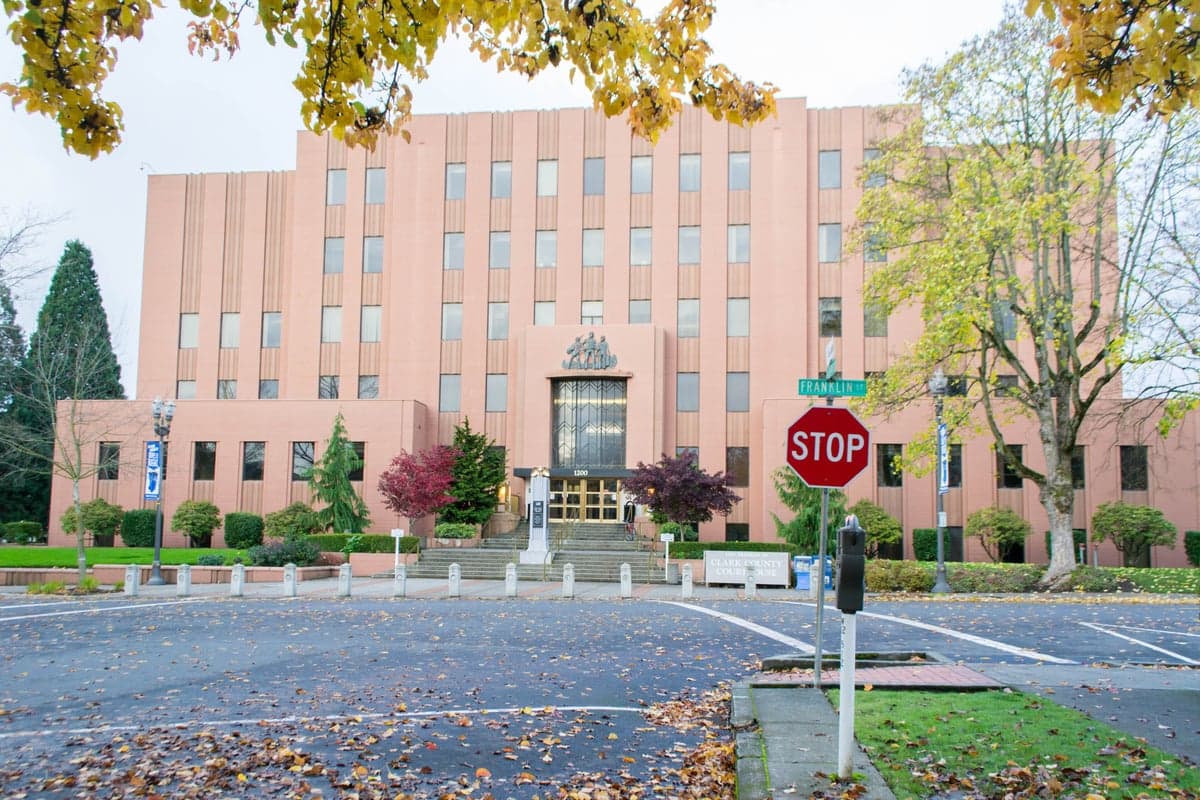
Photo: Wikipedia
Demographics of Clark County
Affluence Level in Clark County
A middle-class area roughly in line with national averages across income, home values, education, and employment.
People of Clark County
Clark County, Washington, is a rapidly growing suburban and exurban region of over 510,000 residents, characterized by a predominantly white population (73.5%) with a significant and growing Hispanic minority (12.0%) and smaller but established Asian (4.1%) and Black (2.0%) communities. The county’s identity is shaped by its position as a more affordable, family-oriented alternative to Portland, Oregon, just across the Columbia River, and by a strong sense of local history rooted in the fur trade, timber, and agriculture. With a foreign-born population of just 4.7%—well below the national average—Clark County remains a destination for domestic migrants, particularly from California and the Pacific Northwest, seeking lower taxes and more space. The population is projected to continue growing steadily, driven by suburban expansion into areas like Camas, Washougal, and Battle Ground, while retaining a distinctly Pacific Northwestern character.
Settlement & growth (pre-1960)
The original inhabitants of Clark County were the Chinookan peoples, including the Clackamas and Cowlitz tribes, who lived along the Columbia River for thousands of years, relying on salmon fishing and trade. The first European contact came with the Lewis and Clark Expedition in 1805–1806, which wintered at Fort Clatsop near the river’s mouth. The region was later claimed by both the British Hudson’s Bay Company and the United States, with the Hudson’s Bay Company establishing Fort Vancouver in 1825 as a major fur-trading post and agricultural hub. This fort, located in present-day Vancouver, Washington, became the center of early non-Native settlement, attracting French-Canadian trappers, Scottish and English traders, and a small number of Hawaiian laborers (known as Kanakas).
American settlement accelerated after the Oregon Treaty of 1846, which set the U.S.-Canada border at the 49th parallel. The Donation Land Claim Act of 1850 granted 320 acres to married couples, drawing a wave of white American settlers from the Midwest and Upper South. These early pioneers were primarily of English, Scots-Irish, and German descent, and they established farms and small communities along the fertile floodplains of the Columbia and Lewis Rivers. The city of Vancouver, incorporated in 1857, grew as a military and supply center, while smaller settlements like Ridgefield (founded 1850s) and La Center (founded 1880s) emerged as farming and logging towns. The arrival of the Northern Pacific Railroad in the 1880s connected Clark County to national markets, spurring growth in Camas, which became a company town for the Crown Zellerbach paper mill, and Washougal, a center for woolen mills and timber.
The early 20th century saw a modest influx of Scandinavian immigrants—Swedes, Norwegians, and Finns—who worked in the logging camps and sawmills around Yacolt and Amboy. The Great Depression and Dust Bowl of the 1930s brought a smaller number of displaced farmers from the Great Plains, though Clark County’s economy remained tied to timber and agriculture. World War II transformed the region: the Vancouver Shipyard (operated by Kaiser Shipbuilding) employed tens of thousands of workers, including a significant number of African Americans from the South and Midwest, who settled in Vancouver’s central neighborhoods. This wartime migration was the first substantial Black presence in the county, though the population remained small (2.0% today). After the war, the shipyard closed, and many workers left, but the construction of the Interstate 5 bridge in 1958 and the expansion of Portland’s suburbs began to shift Clark County toward its modern role as a bedroom community.
Modern era (post-1965)
The 1965 Hart-Cellar Act had a limited direct impact on Clark County compared to major urban centers, as the region’s foreign-born population remains low at 4.7%. However, the act’s broader effects reshaped the county indirectly through domestic migration. The most significant demographic shift since the 1970s has been the influx of white, middle-class families from California and Oregon, drawn by lower housing costs, lower taxes (Washington has no state income tax), and a perceived slower pace of life. This wave concentrated in newer suburban developments in Vancouver’s Cascade Park and Fisher’s Landing neighborhoods, as well as in the rapidly growing city of Battle Ground, which saw its population surge from under 3,000 in 1990 to over 20,000 by 2020.
The Hispanic population has grown steadily since the 1980s, driven by agricultural labor in the berry and hazelnut farms around Brush Prairie and Hockinson, as well as construction and service jobs in Vancouver. Today, Hispanics make up 12.0% of the county, with a visible presence in Vancouver’s Fourth Plain corridor and in the rural areas east of Interstate 205. The Asian population (4.1%) is largely composed of East and Southeast Asian communities—Vietnamese, Chinese, and Filipino—who arrived in two waves: first as refugees after the Vietnam War in the 1970s and 1980s, and later as skilled professionals in the tech and healthcare sectors. These communities are concentrated in Vancouver’s central neighborhoods and in Camas, where the semiconductor industry (notably WaferTech and SEH America) has attracted engineers and technicians. The Indian subcontinent population (0.6%) is a smaller, more recent group, primarily professionals in technology and medicine, with no distinct enclave but a growing presence in Vancouver’s west side.
Suburbanization has been the dominant force since 1990. The county’s population more than doubled from 238,000 in 1990 to 510,516 in 2024, with most growth occurring in unincorporated areas and in cities like Ridgefield, which has transformed from a quiet farm town to a fast-growing suburb with new master-planned communities. The Black population (2.0%) remains small and dispersed, with no historic enclave, though Vancouver’s central neighborhoods near Fort Vancouver have a modest concentration. The county’s overall racial and ethnic diversity has increased, but it remains less diverse than neighboring Multnomah County, Oregon, due to the predominantly white domestic migration stream.
The future
Clark County’s population is projected to continue growing, reaching an estimated 600,000 by 2040, driven by ongoing domestic migration from California, Oregon, and other high-cost states. The county is becoming slightly more diverse, with the Hispanic share expected to rise to 15–18% by 2040, while the white share will decline gradually. The Asian and Indian populations are likely to grow modestly, particularly in tech-adjacent areas like Camas and Vancouver’s west side, as the Portland-Vancouver metro area’s technology sector expands. New immigrant groups remain a small factor, with most growth coming from U.S.-born families and domestic relocations.
The cultural identity of Clark County is evolving from a rural, timber-and-agriculture past to a suburban, commuter-oriented present. New developments are pushing eastward into the rural areas around Yacolt and Amboy, where large-lot subdivisions are attracting families seeking acreage. The county’s political character, once reliably conservative, has become more competitive as Portland-area transplants bring moderate-to-liberal views, particularly in Vancouver’s urban core. However, the eastern and northern parts of the county—Battle Ground, Ridgefield, and La Center—remain more conservative, reflecting the values of the earlier white settlers and the newer domestic migrants.
For someone moving in now, Clark County offers a mix of suburban convenience and access to outdoor recreation, with a population that is predominantly white and English-speaking, but with growing Hispanic and Asian communities that are adding cultural and culinary diversity. The county is becoming more politically and culturally varied, but it remains a place where family-oriented, car-dependent living is the norm, and where the legacy of its pioneer and timber roots is still visible in its small towns and rural landscapes.

* Values derived from national, state, county, city and local statistics and may differ in a specific area. Last updated: 2026-08-14T10:35:09.000Z
Narrative content on this page is AI-generated and may contain mistakes. Verify any details that matter before acting on them.
ReloMaps may earn a commission from affiliate links at no extra cost to you.

