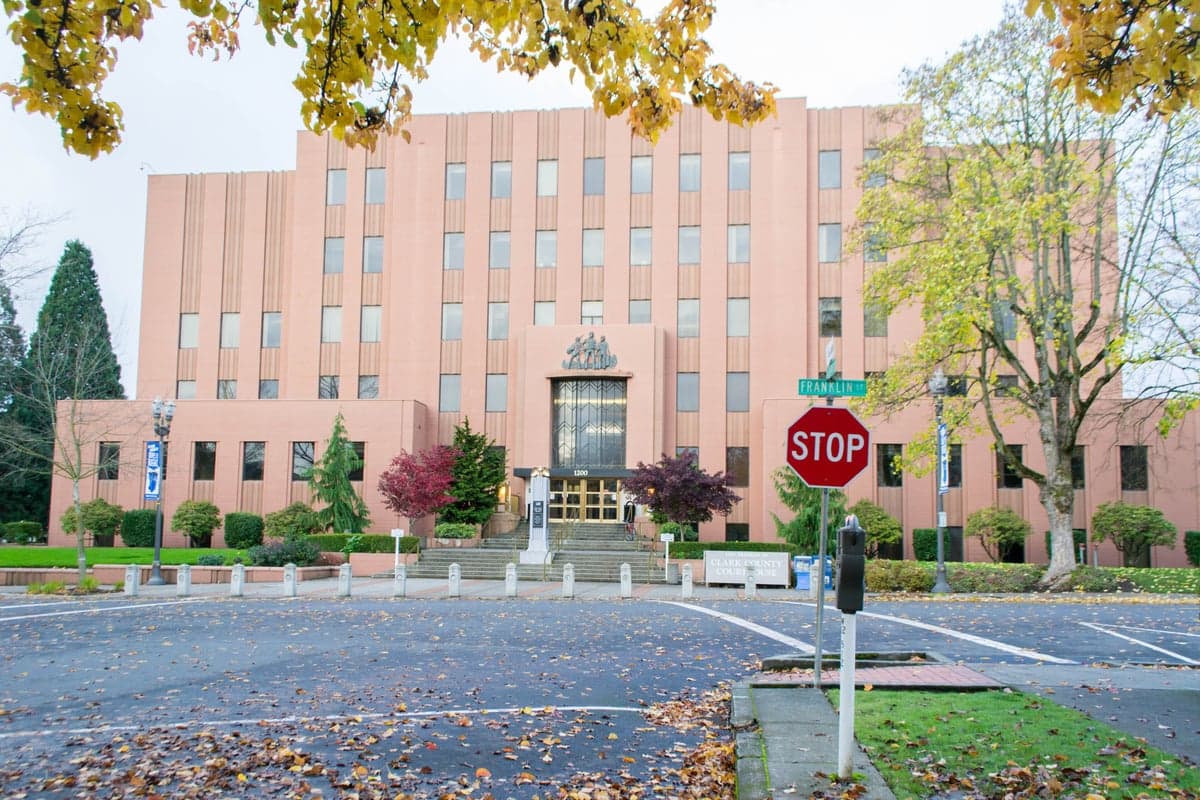
Photo: Wikipedia
Political ClimatePolitical Climate in Clark County
Showing district-level results — no local-only data available.
Local Political AnalysisPolitical Analysis of Clark County
Clark County has long been the conservative counterweight to Seattle’s King County, but that’s changing fast. The county’s Cook PVI of R+2 tells you it’s a true battleground — not ruby red, not deep blue, but a place where elections are won by a few thousand votes. In 2024, the county flipped to Kamala Harris by about 1.5 points, a shift that would have been unthinkable a decade ago when Mitt Romney carried it by 7 points. The old story of Clark County as a Portland exurb of Reagan Democrats is giving way to a new one: a fast-growing, diversifying suburb that’s pulling left, especially in the urban core.
How it compares
Compared to Washington state as a whole, Clark County is still noticeably more conservative, but the gap is shrinking. Statewide, Washington has a Cook PVI of D+8, meaning Clark County is about 10 points more Republican than the average Washington district. That’s a big spread, but it’s narrower than it was in 2016, when the gap was closer to 14 points. The real action is inside the county: Vancouver’s urban precincts — especially around downtown, Uptown Village, and the Waterfront — now vote like mini-Portlands, often going 65-70% Democratic. Meanwhile, the rural eastern half of the county — towns like Battle Ground, Hockinson, and Yacolt — remain solidly red, often voting 70% Republican. The swing precincts are in the middle: Camas and Washougal, where tech workers and commuters to Portland mix with longtime logging families. Those precincts have been trending blue since 2020, but they’re still close enough that a good Republican candidate can win them.
What this means for residents
For conservatives, the practical reality is that Clark County is no longer a safe bet for down-ballot races. County council seats and legislative districts that were once reliably Republican now require serious campaigning. The 17th and 18th legislative districts, which cover the rural east, are still safe GOP seats, but the 49th district (Vancouver) is now a Democratic stronghold, and the 20th district (Camas/Washougal) is a true toss-up. For liberals, the trend is encouraging but not a done deal — turnout in midterms still favors the older, whiter, more conservative parts of the county. What both sides share is a sense that the county’s identity is in flux. You’ll still see Trump flags on pickup trucks in Battle Ground, but you’ll also see Harris yard signs in Vancouver’s new apartment complexes. The old divide — Portland commuters vs. local families — is blurring as more remote workers move in from California and Seattle, bringing their politics with them.
Culturally, the split shows up in policy fights that feel more like Oregon than Washington. Clark County has resisted the state’s push for a carbon tax and has been slower to adopt rent control measures, reflecting its more libertarian, property-rights bent. But the county also passed a local minimum wage increase in 2023, a sign that the progressive wing is gaining traction. The biggest flashpoint is growth: conservatives worry about losing the rural character of places like Ridgefield and La Center, while liberals push for denser housing and transit. If you move here, expect to hear a lot about the Interstate 5 Bridge replacement — it’s the kind of infrastructure fight that reveals where people stand on taxes, growth, and regional cooperation. The bottom line: Clark County is a place where your vote really matters, and where the political temperature is rising along with the population.

State Political ClimatePolitical Climate in Washington
State Political AnalysisPolitical Environment in the State
Washington state has a solidly Democratic lean at the statewide level, with Democrats controlling the governorship, both U.S. Senate seats, and both chambers of the legislature for over a decade. However, this blue veneer masks a deeply divided political geography: the Puget Sound megaregion—Seattle, Bellevue, and Tacoma—drives the state’s leftward tilt, while vast swaths of eastern and southwestern Washington vote reliably Republican. Over the past 20 years, the state has shifted from a competitive purple state to a safe blue one, driven by explosive growth in King County and the suburbanization of formerly moderate areas like Snohomish and Pierce counties.
Urban vs. rural divide
The political map of Washington is essentially a story of two states. King County, home to Seattle and its suburbs, casts roughly 30% of the state’s vote and delivers margins of 70-75% for Democrats. Neighboring Snohomish and Pierce counties have moved left as well—Snohomish went from a swing county in 2000 to a solidly blue one by 2020, while Pierce (Tacoma) now leans Democratic by about 10 points. The eastern half of the state, anchored by Spokane, the Tri-Cities (Kennewick, Pasco, Richland), and Yakima, votes Republican by margins of 15-25 points. The most conservative counties are in the far northeast (Ferry, Stevens, Pend Oreille) and the central basin (Grant, Adams). A notable exception is Whitman County, home to Washington State University in Pullman, which leans left due to the student population. The I-5 corridor from Olympia to the Canadian border is the Democratic engine; everything east of the Cascades is Republican territory, with a few blue islands like Ellensburg (Central Washington University) and Walla Walla.
Policy environment
Washington’s policy environment is defined by its lack of a state income tax—a major draw for conservatives—and its reliance on a high sales tax (state rate 6.5%, with local add-ons pushing it to 10%+ in Seattle) and high property taxes. The state has a strong regulatory posture on environmental issues, including a cap-and-trade program (the Climate Commitment Act) and strict land-use laws. Education policy is progressive: the state funds full-day kindergarten and has a robust public university system, but school choice is limited, with no voucher program and few charter schools. Healthcare is heavily regulated, with a state-based exchange and Medicaid expansion under the Affordable Care Act. Election laws are among the most accessible in the nation: vote-by-mail is universal, same-day registration is available, and ballots are postage-paid. This system is popular across party lines, though some conservatives criticize it for lacking voter ID requirements at the ballot drop box.
Recent policy direction
Over the past five years, Washington has moved decisively left on several fronts. In 2023, the legislature passed a ban on the sale of assault weapons (HB 1240) and a 10-day waiting period for all firearm purchases (HB 1143), along with a requirement to show proof of training. Magazine capacity is capped at 10 rounds. These laws are currently being challenged in federal court. On education, the state expanded parental rights in 2024 with a law requiring school districts to notify parents of curriculum changes and health services offered, though it stopped short of a “parental bill of rights” seen in red states. On privacy, Washington passed one of the nation’s strongest biometric privacy laws (SB 5062) and a comprehensive data privacy act (the Washington Privacy Act). Medical and bodily autonomy is fully protected: abortion remains legal without gestational limits, and the state has a shield law protecting providers who serve out-of-state patients. Property rights are constrained by the Growth Management Act, which limits rural development and has driven up housing costs. Tax policy remains unchanged—no income tax, but voters in 2024 rejected a proposed capital gains tax expansion (I-2109), signaling resistance to new progressive taxes.
Civil unrest & political movements
Washington has a history of visible political activism. The 2020 protests in Seattle, including the Capitol Hill Autonomous Zone (CHAZ), drew national attention and remain a flashpoint in local politics. Since then, organized left-wing activism has focused on climate (the Youth Climate Strike, Extinction Rebellion) and housing (the “Yes in My Backyard” movement pushing for density). On the right, the Washington State Republican Party has become more populist and Trump-aligned, with grassroots groups like the “Moms for Liberty” chapter in Spokane and the “Washington State Patriot Network” organizing around school board races and election integrity. Immigration politics are a major fault line: Washington is a sanctuary state, with state law prohibiting local law enforcement from cooperating with federal immigration authorities except in limited circumstances. This has led to tensions in more conservative areas like Yakima County, where the sheriff has publicly clashed with the state. Election integrity controversies have been muted compared to other states, thanks to the well-established vote-by-mail system, but some rural counties have seen calls for hand-counting ballots. Secession talk is mostly rhetorical—the “Liberty State” movement in eastern Washington has no serious political traction.
Projection
Over the next 5-10 years, Washington’s political trajectory is likely to remain blue, but the margin may narrow slightly. In-migration from California and other states has slowed, and the cost of living—especially housing in the Seattle metro—is pushing some moderate and conservative families to the exurbs or out of state entirely. The Democratic coalition is aging, and younger voters in the suburbs are less reliably Democratic than their parents. However, the state’s growing tech and clean-energy sectors (particularly in the Tri-Cities, with the Hanford site and new battery manufacturing) are attracting a diverse, educated workforce that leans left. The most likely scenario is a continued Democratic hold on statewide offices, with Republicans picking up a few legislative seats in the exurbs and eastern Washington. A new resident moving in now should expect a state where their vote matters less in the presidential race but can be decisive in local races—especially in swing districts like the 3rd Congressional District (southwest Washington) and the 8th (central Washington).
For a conservative relocator, the bottom line is this: Washington offers a low-tax environment and stunning natural beauty, but you’ll be living under a Democratic supermajority that is actively restricting gun rights and expanding government regulation. Your vote will be most impactful at the local level—school board, city council, and county commission races in places like Spokane Valley, Wenatchee, or Vancouver. For a liberal relocator, the state delivers on progressive policy priorities, but the high cost of living and traffic congestion in the Seattle area are real trade-offs. Either way, Washington is a state where your political identity will be shaped by where you choose to live—the blue I-5 corridor or the red rest of the state.
* Values derived from national, state, county, city and local statistics and may differ in a specific area. Last updated: 2026-08-14T10:35:09.000Z
Narrative content on this page is AI-generated and may contain mistakes. Verify any details that matter before acting on them.
ReloMaps may earn a commission from affiliate links at no extra cost to you.

