Photo: Wikipedia
Demographics of Watertown, NY
Affluence Level in Watertown, NY
A low-income area with significant economic hardship. Household wealth and educational attainment are well below national averages.
People of Watertown, NY
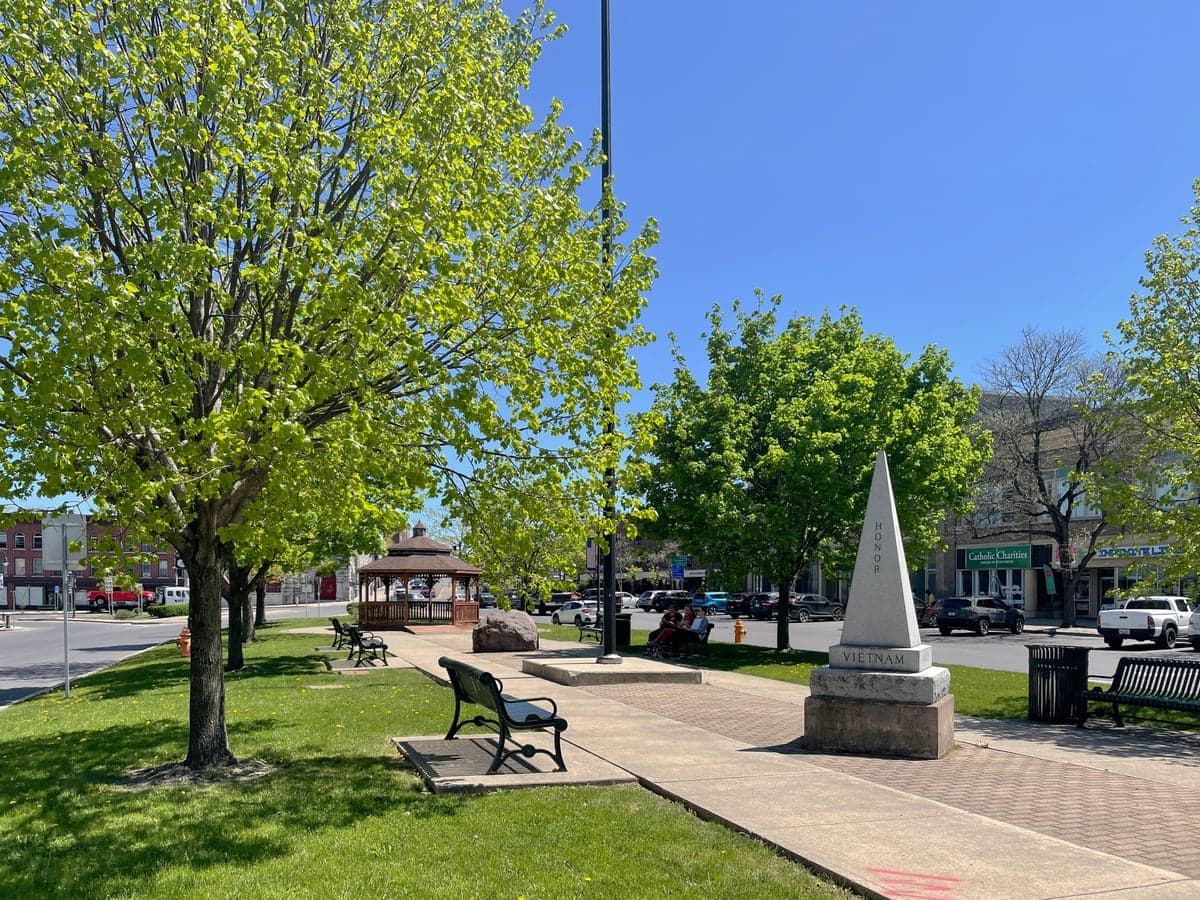
Watertown, New York, is a small city of 24,574 residents with a distinctly Northern, working-class character shaped by its military and industrial roots. It is overwhelmingly white (80.2%) and native-born (only 1.8% foreign-born), with a modest Hispanic minority (6.8%) and small Black (4.5%) and East/Southeast Asian (1.4%) populations. The city’s identity is defined by its proximity to Fort Drum, a strong blue-collar ethic, and a population density that feels tight but not crowded—a place where family ties and local institutions like Jefferson Community College anchor daily life.
How the city was settled and grew
Watertown’s original population was drawn by the Black River’s water power and the promise of manufacturing in the early 19th century. Settlers from New England—primarily Yankees from Vermont and Massachusetts—arrived after the War of 1812, establishing the city as a mill town. The Paddock Arcade neighborhood, built in the 1850s, became the commercial heart for these early Anglo-Protestant families. By the late 1800s, Irish immigrants fleeing the famine and later French-Canadians seeking textile mill work settled in the North Side and Factory Square districts, building St. Patrick’s Church and tight-knit ethnic blocks. A smaller wave of Italian immigrants arrived around 1900, clustering near the Italian Hill area (roughly bounded by State and Mill streets), where they worked in the paper mills and foundries. These groups—Yankee, Irish, French-Canadian, Italian—formed the city’s white ethnic base through the mid-20th century, with little non-European immigration until after 1965.
Modern era (post-1965)
The 1965 Immigration Act had a muted effect on Watertown compared to larger cities. The foreign-born share remains tiny (1.8%), and the city’s demographic shifts since the 1970s have been driven more by domestic migration than international arrivals. The most significant change was the expansion of Fort Drum in the 1980s, which brought a wave of military families—many from the South and Midwest—into the Black River Valley and West Carthage neighborhoods. This influx temporarily diversified the city: the Black population rose from under 2% in 1980 to 4.5% today, and the Hispanic share grew from negligible to 6.8%, largely through military-affiliated families and some Puerto Rican migration. The East/Southeast Asian population (1.4%) is concentrated near the Thompson Park area, often tied to medical professionals at Samaritan Medical Center. The Indian-subcontinent population (0.4%) is very small and scattered, not forming a distinct enclave. Meanwhile, the white population has aged and shrunk as younger native-born residents left for larger job markets, a pattern visible in the Arsenal Street corridor’s declining school enrollments.
The future
Watertown’s population is likely to continue its slow decline or stagnation, with the white share gradually eroding as older generations pass away. The Hispanic and Black populations are growing modestly, but from a low base, and are not forming segregated enclaves—they are dispersed across the city, especially in the North Side and near Fort Drum. The foreign-born share is unlikely to rise sharply given the city’s limited economic draw for immigrants; the 1.8% figure is among the lowest in New York State. The East/Southeast Asian community is stable but small, tied to the hospital and university. The Indian-subcontinent population is too tiny to project trends. The biggest wildcard is Fort Drum: any future base realignment could trigger a rapid outflow of military families, reversing the modest diversity gains of the last 40 years. Without a major new industry, Watertown will likely remain a predominantly white, native-born, aging city with a stable but small minority presence.
For someone moving in now, Watertown offers a straightforward, low-diversity environment where the population is shaped more by the military cycle than by immigration. It is becoming slightly more Hispanic and Black, but remains a place where the dominant culture is white, working-class, and rooted in the region’s Yankee and Irish heritage. The city is not tribalizing into ethnic enclaves—it is slowly homogenizing as older white ethnic neighborhoods fade and newer arrivals integrate across the city. This is a stable, predictable demographic landscape, not a rapidly changing one.

* Values derived from national, state, county, city and local statistics and may differ in a specific area. Last updated: 2026-05-02T00:02:36.000Z
Narrative content on this page is AI-generated and may contain mistakes. Verify any details that matter before acting on them.
ReloMaps may earn a commission from affiliate links at no extra cost to you.

