Photo: Wikipedia
Political ClimatePolitical Climate in Watertown, NY
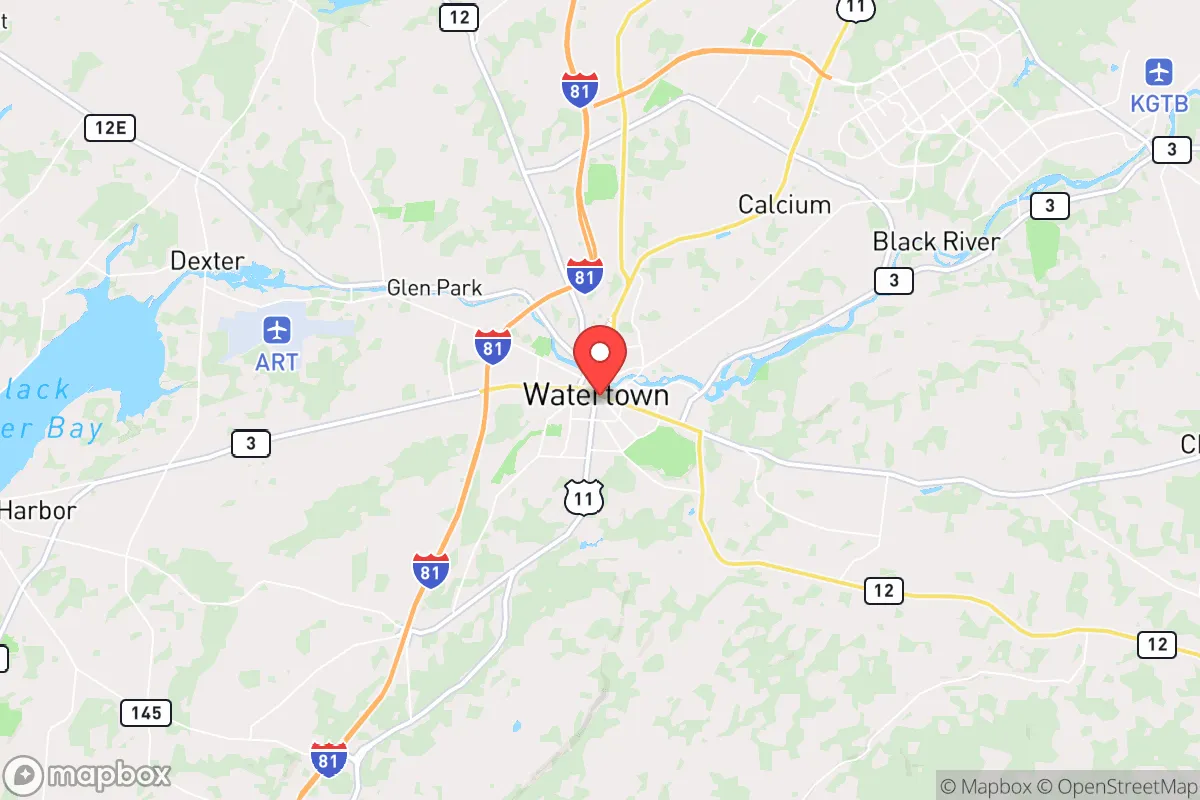
District shown is the primary district for this city’s centroid. Cities may span multiple districts.
Local Political AnalysisPolitical Analysis of Watertown, NY
Watertown, New York, has long been a solidly conservative stronghold in the North Country, and that hasn't changed much despite the national trends. With a Cook Partisan Voting Index of R+11, the area leans heavily Republican, and you can feel it in the local elections and the general attitude around town. The political climate here is rooted in a deep-seated belief in personal responsibility, limited government, and a healthy skepticism of any policy that feels like it's coming from Albany or Washington. While the city itself has a mix of folks, the surrounding Jefferson County is reliably red, and that's the dominant voice you hear in local governance and community life.
How it compares
If you drive just a few hours east to Albany or south to Syracuse, you'll hit a completely different political world—places where progressive policies on taxes, zoning, and public health have taken hold. Watertown feels like a refuge from that. Compared to Plattsburgh to the north, which has a more mixed political vibe thanks to the college and state employees, Watertown is more consistently conservative. The contrast is even sharper with the Adirondack towns like Saranac Lake, where environmental regulations and a more liberal social scene dominate. Here, the talk at the diner is still about property taxes being too high, the Second Amendment being non-negotiable, and the feeling that the state government is constantly overstepping its bounds into local decisions. The R+11 rating isn't just a number; it reflects a community that actively pushes back against what it sees as government overreach into personal freedoms and rights.
What this means for residents
For someone living here, the political climate means a lot of things are left up to you, not the government. There's a strong local culture of self-reliance—people take care of their own property, their own families, and their own businesses without expecting much from the county or state. You won't see the same kind of aggressive zoning or land-use restrictions that you'd find in more progressive areas, and there's a general respect for private property rights. That said, the downside is that local services can feel underfunded, and there's a constant tension between wanting lower taxes and needing decent roads and schools. The recent shifts toward progressive ideology in New York State—like the SAFE Act or COVID-era mandates—have left a bitter taste here, and many residents feel like they're fighting a two-front war: against the state's agenda and against the slow creep of national progressive trends. The long-term worry is that if the state keeps pushing, more people will just leave, and that's already happening to some extent.
Culturally, Watertown is a place where the military presence from Fort Drum reinforces a conservative, patriotic, and family-oriented mindset. You'll find a lot of support for veterans, a strong church community, and a general distrust of big government solutions. The local paper and talk radio reflect that, and most folks are pretty open about their political views. There's a sense that the area is a bit of a last stand for traditional values in a state that's moving in the opposite direction. If you're looking for a place where the government stays out of your business and the community looks out for its own, Watertown fits the bill. But if you're hoping for a more progressive or diverse political scene, you'll find it a tough sell. The trajectory here is toward holding the line, not changing with the times, and that's exactly how most residents want it.

State Political ClimatePolitical Climate in New York
State Political AnalysisPolitical Environment in the State
New York State has long been a Democratic stronghold, but the reality on the ground is far more complicated than the state’s overall partisan lean suggests. Since the early 2000s, the state has shifted from a purple-ish blue to a deep blue, driven almost entirely by the explosive growth and political consolidation of New York City and its immediate suburbs. In the 2020 presidential election, Joe Biden carried the state by 23 points, but that margin is almost entirely a product of the five boroughs and a handful of suburban counties. Outside of that corridor, vast swaths of Upstate New York vote reliably Republican, and the state’s political trajectory over the last two decades has been one of increasing polarization, with the urban core pulling the rest of the state into progressive policy territory that many residents in places like Erie County or the Southern Tier find deeply alienating.
Urban vs. rural divide
The political map of New York is essentially a tale of two states. New York City—Manhattan, Brooklyn, Queens, the Bronx, and Staten Island—is the engine of Democratic dominance, with Manhattan alone delivering margins of 80% or higher in statewide races. The immediate suburbs of Long Island (Nassau and Suffolk counties) and the lower Hudson Valley (Westchester, Rockland, and Putnam) have trended blue over the past decade, though places like Suffolk County still have pockets of Republican resistance, particularly in the eastern towns. Drive north of the Tappan Zee Bridge, and the map flips dramatically. Erie County (Buffalo) and Monroe County (Rochester) are blue islands in a sea of red, while counties like Oneida, Steuben, and Chautauqua vote Republican by 20-30 points. The rural North Country, including St. Lawrence County and the Adirondack region, is deeply conservative, but its population is too small to counterbalance the city. The result is a state where a resident of Buffalo or Rochester lives under the same state government as someone in Manhattan, but with vastly different cultural and economic priorities.
Policy environment
New York’s policy environment is a textbook example of progressive governance that many conservatives view as government overreach. The state has the highest combined state and local tax burden in the nation, with income tax rates topping out at 10.9% for high earners and property taxes among the highest in the country—particularly in Upstate counties like Onondaga and Monroe, where homeowners often pay 3-4% of assessed value annually. The regulatory posture is aggressive: the state’s rent control laws, strict environmental mandates (including a ban on natural gas hookups in new construction starting in 2026), and a sweeping paid family leave program all add layers of compliance cost. Education policy is dominated by the state’s powerful teachers’ unions, and the Board of Regents has pushed progressive curriculum changes, including the controversial “culturally responsive-sustaining education” framework. Healthcare is heavily regulated, with the state expanding Medicaid eligibility and implementing a public option. Election laws have been loosened significantly: no-excuse absentee voting, early voting, and automatic voter registration are now law, which critics argue undermines election integrity. The state also passed the “Green Light Law” in 2019, allowing undocumented immigrants to obtain driver’s licenses, and it remains a “sanctuary state” with strict limits on cooperation with federal immigration enforcement.
Trajectory & freedom
On the freedom front, New York has been moving decisively in one direction: less free. The most glaring example is the 2019 SAFE Act, which banned so-called “assault weapons” and restricted magazine capacity to 10 rounds, followed by the 2022 Concealed Carry Improvement Act (CCIA), which made New York one of the most restrictive states in the nation for gun owners by requiring “good cause” for a permit and banning firearms in a vast list of “sensitive locations.” The state has also expanded its “red flag” law, allowing courts to confiscate firearms based on anonymous tips. On parental rights, the state passed legislation in 2022 that prohibits schools from notifying parents if a child changes their gender identity or pronouns without the child’s consent—a move that has sparked fierce backlash in conservative-leaning districts like Orleans County and Niagara County. Medical autonomy took a hit with the state’s strict COVID-19 vaccine mandates for healthcare workers and school staff, which remained in place long after other states dropped them. Property rights are under pressure from the state’s rent stabilization laws and the 2019 Housing Stability and Tenant Protection Act, which severely limited landlords’ ability to evict or raise rents. The state’s tax burden continues to climb, with no signs of a rollback.
Civil unrest & political movements
New York has been a flashpoint for political activism on both sides. The 2020 Black Lives Matter protests in New York City were among the largest and most destructive in the country, with widespread looting and property damage that led to calls for defunding the police—a movement that gained traction in the city council but ultimately stalled. The state’s sanctuary policies have created ongoing friction with federal immigration authorities, and in 2023, the influx of asylum seekers to New York City led to a humanitarian crisis, with the mayor declaring a state of emergency and the state spending billions on shelter and services. On the right, the “Second Amendment” movement remains strong in Upstate counties, with groups like the New York State Rifle & Pistol Association fighting the CCIA in court. There have been scattered secessionist murmurs in the North Country and the Southern Tier, with some residents floating the idea of joining Pennsylvania or forming a new state, but these remain fringe. Election integrity remains a hot-button issue: the state’s 2020 election was conducted under emergency mail-in voting rules, and subsequent audits revealed irregularities, though no widespread fraud was proven. A new resident in Albany or Syracuse will notice the stark cultural divide between the city-centric media and the lived reality of Upstate communities.
Projection
Looking ahead 5-10 years, the trajectory is clear: New York will continue to become more progressive, more expensive, and more centralized. Demographic trends are working against conservatives: New York City’s population has rebounded after a pandemic dip, while Upstate counties continue to lose residents to lower-tax states like Florida and Texas. The state’s political leadership—Governor Kathy Hochul, the state legislature, and the attorney general—are all firmly progressive, and there is no serious electoral challenge on the horizon. Expect further gun control measures, including a potential ban on semi-automatic rifles entirely, and continued expansion of the state’s welfare state. The tax burden will likely increase to fund the state’s massive pension liabilities and infrastructure needs. For a conservative-leaning individual or family moving in now, the realistic expectation is that you will be living under a government that is increasingly hostile to your values on guns, education, and parental rights. The best-case scenario is that you find a like-minded community in a red county like Steuben or Chautauqua, but you will still be subject to state-level policies that constrain your freedom.
For a new resident, the bottom line is this: New York offers world-class career opportunities in finance, tech, and healthcare, but it comes at the cost of living under one of the most progressive state governments in the country. If you value low taxes, gun rights, parental control over education, and a government that stays out of your life, this is not the state for you. If you are willing to trade those freedoms for the economic and cultural benefits of the New York City metro area, you can carve out a life—but be prepared to fight for your values at the local level, because the state government is not on your side.
* Values derived from national, state, county, city and local statistics and may differ in a specific area. Last updated: 2026-05-02T00:02:36.000Z
Narrative content on this page is AI-generated and may contain mistakes. Verify any details that matter before acting on them.
ReloMaps may earn a commission from affiliate links at no extra cost to you.

