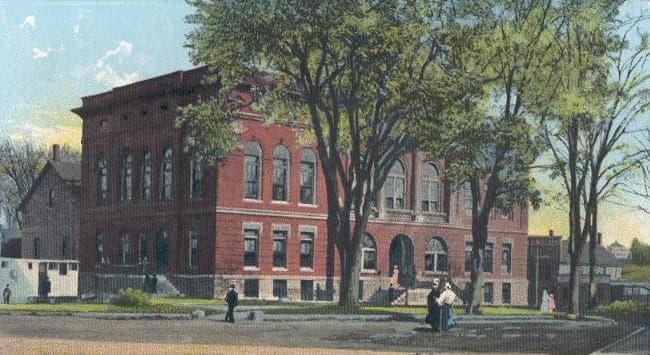
Photo: Wikipedia
Demographics of Waterville, ME
Affluence Level in Waterville, ME
A below-average socioeconomic profile. Incomes, home values, and educational attainment trail the U.S., with higher poverty and unemployment.
People of Waterville, ME
Waterville, Maine, is a city of roughly 16,700 residents that retains a distinctly Franco-American and working-class character, shaped by generations of mill workers and their descendants. The population is overwhelmingly white (89.0%), with a small but notable East/Southeast Asian community (1.9%) and a Hispanic population of 2.6%. The city’s identity is rooted in its industrial past, and today it balances a quiet, family-oriented atmosphere with the stabilizing presence of Colby College.
How the city was settled and grew
Waterville’s early growth was driven by water power and the textile industry. The first European settlers arrived in the late 18th century, but the city’s real population boom came in the mid-19th century with the construction of textile mills along the Kennebec River. French-Canadian immigrants from Quebec were the primary labor force, arriving in large waves between 1850 and 1920 to work in the mills. These families settled in the South End and Head of Falls neighborhoods, building tight-knit Catholic parishes and French-language institutions that defined the city’s culture for generations. A smaller wave of Irish and Scottish immigrants also arrived during this period, settling near the mills in the North End. By 1900, Waterville was a bustling mill town with a population over 10,000, and the Franco-American community remained the dominant ethnic group through the mid-20th century.
Modern era (post-1965)
After the 1965 Immigration and Nationality Act, Waterville saw only modest demographic change. The city’s foreign-born population today is just 2.6%, reflecting limited new immigration. The most notable shift has been the arrival of East/Southeast Asian families—primarily Vietnamese and Chinese—who began settling in the Kennedy Memorial Drive corridor and the West Waterville area in the 1980s and 1990s, often drawn by affordable housing and jobs in the service sector. The Hispanic population (2.6%) is small but growing, with families concentrated in the South End and near the downtown area. The Black population remains very small at 1.1%, and the Indian subcontinent community is negligible at 0.1%. Domestically, the city has seen some in-migration from southern Maine and out-of-state retirees, particularly into the Fairfield Street and College Avenue neighborhoods near Colby College, which has expanded its faculty and staff presence. Suburbanization has been limited; Waterville’s compact, walkable core has retained its historic density, while newer single-family homes have been built on the city’s northern and eastern edges.
The future
Waterville’s population is projected to remain stable or decline slightly over the next decade, mirroring statewide trends. The city is not homogenizing into a single identity; rather, it is slowly diversifying along predictable lines. The East/Southeast Asian community is likely to grow modestly as family reunification and service-sector jobs continue to attract new residents, but the overall foreign-born share will likely remain below 5%. The Hispanic population is also expected to increase gradually, though it will remain a small minority. The Franco-American majority is aging, and younger families—both white and non-white—are moving into the South End and Head of Falls neighborhoods, which are seeing reinvestment through the city’s downtown revitalization efforts. The Indian subcontinent community is not expected to grow significantly, as Waterville lacks the tech or medical sectors that draw that population to larger cities. The city is becoming slightly more diverse, but it will remain predominantly white and Franco-American in character for the foreseeable future.
For someone moving to Waterville now, the city offers a stable, family-friendly environment with a strong sense of local history. The population is aging but not stagnant, and the small but growing East/Southeast Asian and Hispanic communities are adding new cultural threads to a city that has long been defined by its Franco-American roots. The key takeaway is that Waterville is a place where change comes slowly, and new residents—whether from within Maine or abroad—will find a community that values its past while cautiously embracing a more diverse future.

* Values derived from national, state, county, city and local statistics and may differ in a specific area. Last updated: 2026-05-04T10:28:53.000Z
Narrative content on this page is AI-generated and may contain mistakes. Verify any details that matter before acting on them.
ReloMaps may earn a commission from affiliate links at no extra cost to you.

